

Business planning sounds simple until you actually sit down to do it.
You may have a clear business idea, a few goals, some market research, customer notes, product plans, financial thoughts, and a long list of things your team “should do next.”
But once everything is spread across documents, meetings, PDFs, spreadsheets, voice notes, and chat messages, the plan can quickly become confusing.
That is why mind maps are so useful for business planning. They help you take scattered ideas and turn them into a clear visual structure.
Instead of looking at a long document and trying to figure out what matters, you can see the main goal, supporting ideas, action areas, and next steps in one place.
If your business planning starts with reports, proposals, or strategy documents, using a PDF to mind map workflow can make the first stage much easier.
I looked at how businesses usually plan strategies, campaigns, launches, and internal projects. In my experience, the biggest problem is not a lack of ideas. It is a lack of clarity. Mind maps help solve that problem by making business thinking more visible, organized, and easier to act on.
Why business planning often becomes messy
Most business plans do not start messy. They usually start with a clear goal: increase sales, launch a product, enter a new market, improve operations, build a brand, or attract more customers.
But after a few discussions, the plan grows. You start adding customer research, competitor insights, pricing ideas, content plans, team responsibilities, budget notes, and possible risks. Soon, the plan becomes too big to keep in your head.
This is where many teams slow down.
A founder may be thinking about long-term vision. The marketing team may be focused on campaigns. The sales team may care about lead quality.
The operations team may be thinking about delivery. Everyone is working on the same business, but they may not be looking at the same structure.
A mind map gives everyone a shared view. It connects the big idea with the smaller details, so the team can understand how each part of the plan fits together.
That shared understanding is what makes planning easier.
What makes mind maps useful for business planning
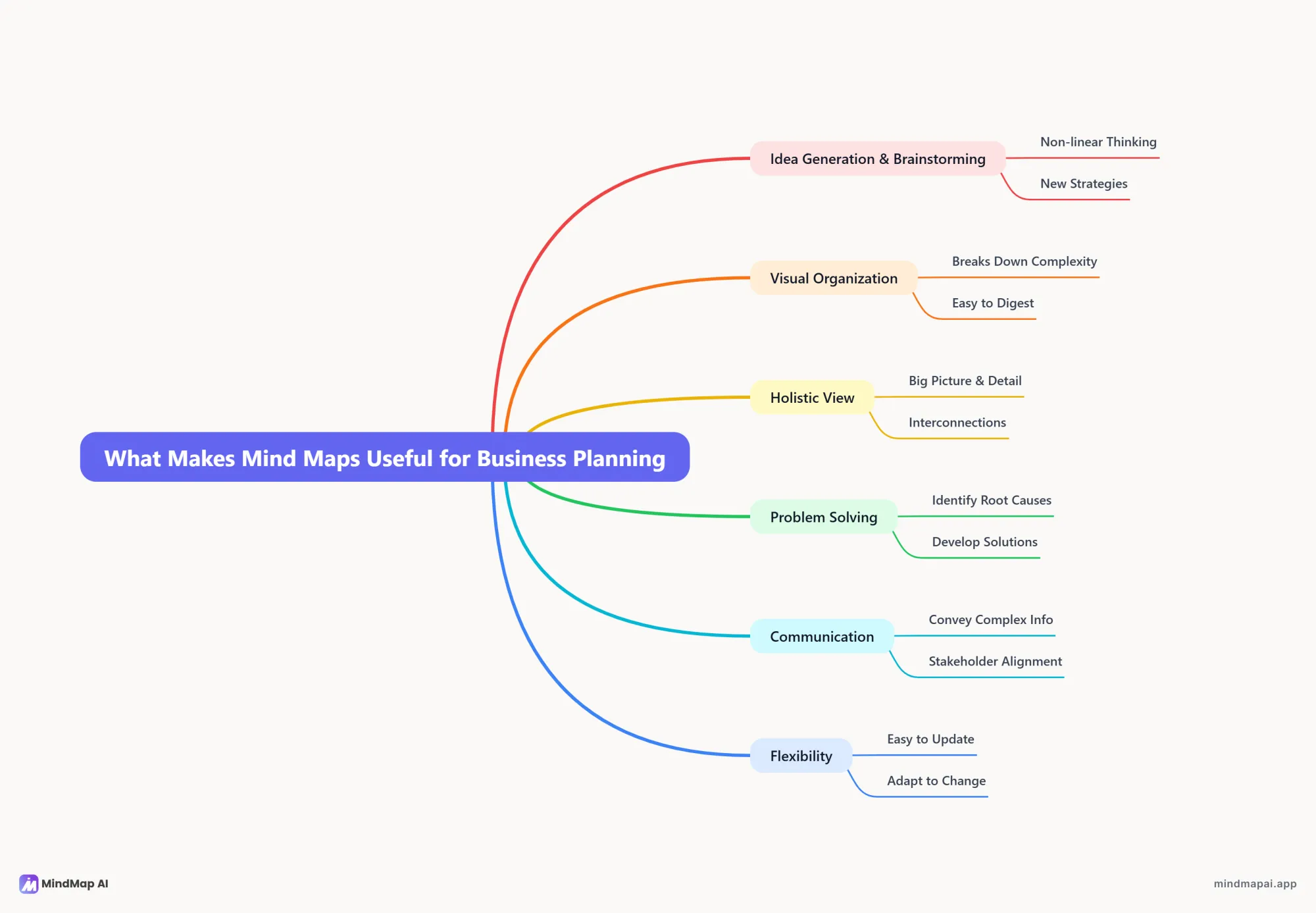
A mind map starts with one central idea. From there, related ideas branch out into categories and subcategories.
For business planning, this structure works well because most business decisions are connected. Your target audience affects your marketing.
Your pricing affects your positioning. Your product features affect your sales message. Your team capacity affects your timeline.
A normal written document can explain these things, but it often hides the relationships between them.
A mind map shows those relationships visually.
For example, a business planning mind map might include branches such as:
- Business goals
- Target customers
- Product or service offers
- Marketing channels
- Sales strategy
- Operations
- Budget
- Risks
- Timeline
- Team responsibilities
Once these areas are mapped out, it becomes easier to see what is missing, what is repeated, and what needs more detail.
This is why mind maps are helpful before you create a formal business plan, pitch deck, project board, or marketing calendar.
How AI makes mind mapping faster
Traditional mind mapping is useful, but it can take time to build everything manually.
AI mind mapping tools make the process faster by creating the first structure for you. Instead of starting from a blank page, you can enter a topic, paste notes, upload content, or use existing material. The AI then organizes the information into a visual map.
A tool like MindMap AI is useful here because it is built for turning different types of content into mind maps.
You can start from text, documents, audio, videos, or other inputs depending on how your ideas are captured.
For business teams, that flexibility matters.Not every business idea comes from a clean planning document. Some ideas come from meetings. Some come from customer calls.
Some come from research PDFs. Some come from founder voice notes or brainstorming sessions.
MindMap AI helps bring those scattered sources into one structured view.
It is not about replacing human decision-making.
It is about getting a strong first draft of the plan faster, so your team can spend more time improving the strategy instead of organizing raw notes.
Using mind maps to build better business strategies
A good business strategy needs more than a list of goals. It needs structure. You need to understand what you are trying to achieve, who you are serving, what makes your offer different, how you will reach customers, and what actions need to happen first.
Mind maps make this easier because they let you break down a large strategy into smaller connected areas.
For example, if your main goal is business growth, your branches might include customer acquisition, retention, partnerships, content marketing, paid ads, product improvements, and sales process.
Each branch can then be expanded into specific ideas. This helps teams move from broad thinking to practical planning. Instead of saying, “We need more customers,” the mind map helps you ask better questions:
- Which customer segment should we focus on?
- What problem are we solving for them?
- Which channel can reach them fastest?
- What content or offer will attract them?
- What should we test first?
That is where business planning becomes more useful. The plan is no longer just a document. It becomes a thinking tool.
Planning marketing and content more clearly
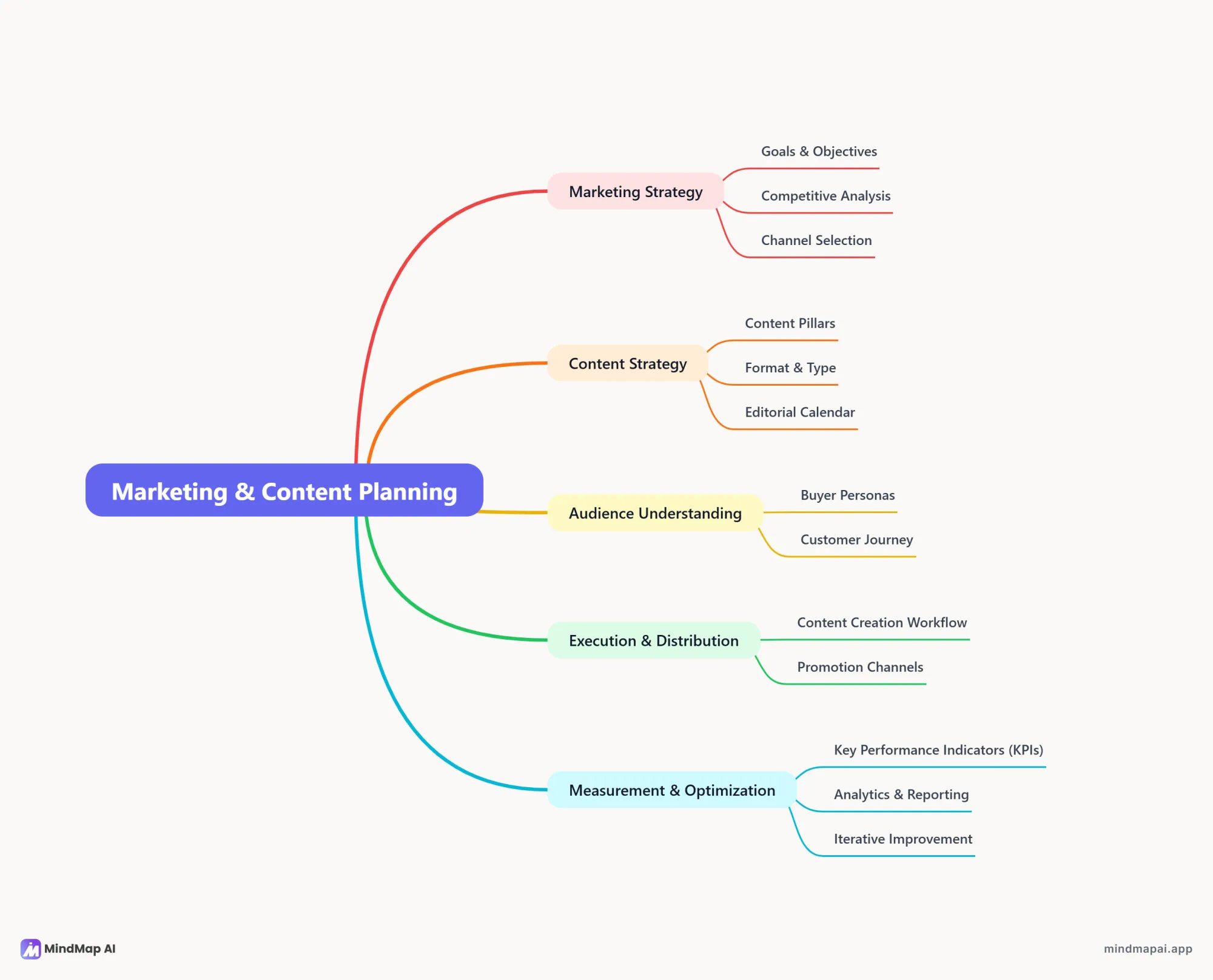
Marketing is one of the best areas to use mind maps. A marketing plan has many moving parts: audience research, keywords, content ideas, campaign themes, platforms, offers, landing pages, email sequences, social media posts, and performance tracking.
If you keep all of this in a long document, it can become hard to scan. If you put everything directly into a project management tool, the strategy may feel too task-focused too early.
A mind map gives you a better middle step.
You can first map the marketing strategy visually. Then, once the structure is clear, you can turn the strongest ideas into tasks.
For example, a business mind map can help you organize a product launch campaign into sections like audience pain points, launch message, content topics, ad angles, email flow, social media plan, and follow-up strategy.
MindMap AI also provides business-focused mind mapping use cases through its business mind map page, which is useful if you want to explore how visual planning can support business strategy, decision-making, and team planning.
In my experience, this kind of visual planning helps teams avoid random marketing activity. It makes the campaign more connected from the beginning.
Turning meetings and voice notes into action
A lot of business planning happens in meetings. The problem is that meetings often produce scattered ideas. Someone shares a customer insight.
Someone suggests a campaign. Someone raises a risk. Someone else mentions a product improvement. By the end of the meeting, the team may have useful points, but not always a clear plan.
This is where audio-based mind mapping can help. If you record meetings, interviews, or voice notes, you can use an audio to mind map workflow to turn spoken ideas into a structured visual map.
That can be useful for:
- Strategy discussions
- Customer interviews
- Sales calls
- Founder voice notes
- Team brainstorming sessions
- Training or workshop notes
Instead of letting useful ideas stay buried in audio files, you can convert them into a format that is easier to review and act on.
This is especially helpful for small teams where everyone is busy and no one wants to spend extra time rewriting meeting notes from scratch.
Improving team alignment
Business planning becomes stronger when everyone understands the same plan. This sounds obvious, but it is often where teams struggle.
A plan may be clear to the founder but not clear to the team. A campaign may make sense to the marketer but not to the sales team. A product direction may be obvious to the product manager but not to the customer support team.
Mind maps help by giving everyone a shared visual reference. When the plan is mapped out, people can see how their work connects to the bigger goal.
The sales team can understand the marketing message. The marketing team can understand the customer pain points. The operations team can see what needs to be ready before launch.
This reduces confusion and helps teams make faster decisions. It also makes planning meetings more productive. Instead of jumping between random topics, the team can move branch by branch and discuss one area at a time.
Where mind maps are strongest
Mind maps are strongest when the goal is to organize thinking. They are great for early-stage planning, brainstorming, strategy development, research organization, campaign planning, decision-making, and breaking down complex ideas.
They are especially useful for business owners, startup founders, marketers, consultants, project managers, students, and small teams that need clarity before execution.
Mind maps are not always the best tool for detailed financial forecasting, legal documentation, or final project tracking. For those tasks, spreadsheets, legal documents, and project management tools are still better.
But mind maps work very well before those tools. They help you understand the plan first. Then you can move the final tasks, numbers, or documents into the right system.
Limitations to keep in mind
Mind maps are helpful, but they are not a complete business strategy by themselves.
A mind map can organize your ideas, but it cannot decide your priorities for you.
It can show possible actions, but your team still needs to choose what matters most. It can make planning easier, but it will not replace market research, customer feedback, financial planning, or execution.
AI-generated mind maps also need review. If your input is too vague, the output may be broad. If your business goal is unclear, the mind map may need editing.
The best approach is to treat AI mind maps as a strong first draft. Let the tool organize the information, then refine it with your own experience and team knowledge. That balance feels realistic and useful.
A simple business planning workflow with MindMap AI
Here is a practical workflow you can follow. Start by collecting your raw planning material. This can include business ideas, PDFs, meeting notes, audio recordings, customer feedback, competitor research, and campaign thoughts.
Next, use MindMap AI to turn that content into a visual mind map. Then review the map and clean it up. Remove weak ideas, merge repeated points, and expand the areas that need more detail.
After that, identify the most important branches. These may become your main goals, strategies, projects, or campaigns.
Finally, turn those branches into action items. Add owners, deadlines, budgets, and tools for execution.
This workflow keeps planning clear and practical. You get the flexibility of brainstorming without losing the structure needed for action.
Final thoughts
Mind maps improve business planning because they make ideas easier to see, connect, and act on.
They help teams organize messy information, understand relationships between ideas, plan strategies, capture meeting insights, and move from broad goals to practical steps.
MindMap AI is a useful option for this because it helps turn different types of business content into structured mind maps.
Whether you are working from a PDF, planning a marketing campaign, organizing meeting notes, or building a business strategy, it gives you a faster way to create clarity.
And in business planning, clarity is not a small thing. When your team understands the plan faster, they can make better decisions, avoid wasted effort, and move toward action with more confidence.
























Sign in to leave a comment.