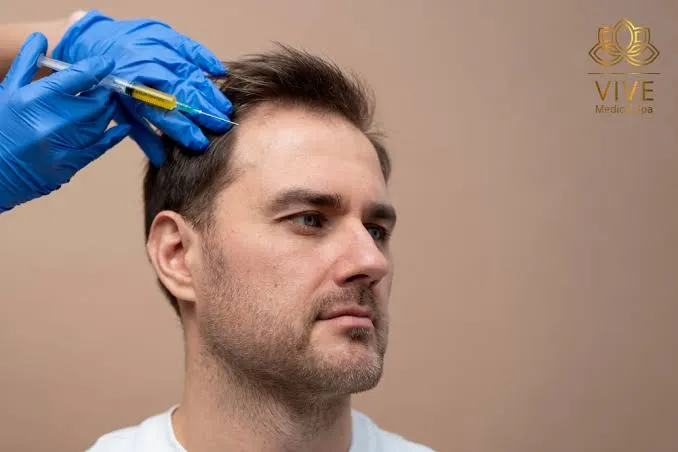

A receding hairline can be difficult to deal with, particularly when you start noticing more scalp around the temples or your hairline seems to be changing in photographs. PRP is sometimes discussed as a way to support hair growth, but it is not a treatment that simply moves the hairline forward again.
Its potential benefit depends on why the hair is thinning, whether the follicles are still active, and how advanced the hair loss has become.
That distinction is important before deciding if PRP is worth considering.
What happens to the hairline as hair loss progresses?
Hair loss around the temples often develops gradually. Individual hairs may become finer and shorter before they stop producing visible hair altogether.
In some forms of hair loss, particularly androgenetic alopecia, follicles can progressively miniaturise. The hair may still be present, but it becomes much less noticeable.
PRP is intended to work around existing hair follicles rather than create completely new ones. This means treatment is more likely to be useful where there are still viable follicles producing weak or thinning hairs.
If an area has been completely bald for a long time, PRP should not be presented as a way to recreate the original hairline.
Our guide to PRP hair treatment and how it works explains the treatment process, who may be considered for it and what patients should know before starting.
Can PRP actually grow hair around the temples?
It may help some patients, but the response is not predictable.
PRP is prepared from a sample of your own blood. The platelet-rich component contains biological factors involved in tissue repair and cell signalling. When injected into the scalp, the aim is to support the environment around the hair follicles.
The important word here is support.
PRP isn't the same as transplanting hair follicles into a receding hairline. It doesn't physically replace follicles that have been lost. Instead, the treatment may help selected follicles function more effectively and may improve the thickness or quality of existing hair.
The amount of improvement varies considerably between individuals.
What if the hairline has already receded significantly?
This is where expectations matter.
Someone with mild temple thinning and fine hairs that are still growing may be in a different position from someone with a long-established, completely bare area.
Age, pattern of hair loss, follicle condition, family history and the duration of thinning can all affect what is realistic.
A clinician should therefore examine the scalp rather than deciding on PRP from a photograph alone. The question isn't simply, “Do you have a receding hairline?” It is what is happening to the follicles underneath it?
That distinction can change the treatment recommendation.
How many PRP sessions might be needed?
PRP is generally approached as a course rather than a single injection.
The exact number and spacing of treatments depend on the individual treatment plan. Hair also grows slowly, so changes cannot be judged in the same way as an immediate cosmetic procedure.
A patient may notice changes in hair shedding or texture before any obvious increase in density. Other people may see relatively little improvement.
This is one reason taking photographs at consistent intervals can be more useful than checking the hairline in the mirror every few days.
If you're wondering whether the potential improvement justifies the treatment, our article on whether PRP treatment is worth it looks at the factors that should be considered rather than treating PRP as a guaranteed solution.
Does PRP work for every type of hair loss?
No.
Hair loss has many possible causes. Pattern hair loss is only one. Nutritional deficiencies, hormonal changes, certain illnesses, medications and inflammatory scalp conditions can also contribute to thinning.
Treating the scalp with PRP without understanding why the hair is being lost may miss the underlying problem.
A proper assessment should therefore come before deciding on treatment. Depending on the history and examination, further investigation may sometimes be appropriate.
PRP can have a place in a hair-loss treatment plan, but it should not be presented as the answer to every form of thinning.
Is PRP better for thinning hair than a receding hairline?
Not necessarily “better,” but the distinction is useful.
If there are still plenty of fine hairs across an area, there may be more follicles to support. A sharply receded hairline with a long-standing bald area is a different situation.
This doesn't mean PRP has no role for someone with a receding hairline. It means the expected outcome needs to be realistic.
The goal may be to support existing hair and improve its appearance rather than restore the exact hairline a person had years earlier.
What should you ask before having PRP for a receding hairline?
Ask what is actually causing your hair loss and whether the follicles in the affected area are still active.
It is also worth asking what improvement is realistically expected, how progress will be monitored and whether another treatment approach would make more sense for your particular pattern of hair loss.
PRP can be useful for selected patients, but good treatment starts with knowing what can realistically be changed.
Frequently Asked Questions
Can PRP bring back a completely bald hairline?
PRP is not a hair transplant and cannot reliably recreate follicles that have been permanently lost. Its potential role is more relevant where viable but weakened or thinning follicles remain.
How long does PRP take to show results for hair loss?
Hair growth is slow, so improvement is assessed over a period of months rather than days. Individual responses vary.
Is PRP suitable for a receding hairline?
It may be considered in selected patients, depending on the cause and extent of hair loss. A scalp assessment is needed before deciding.
Can PRP stop a receding hairline from getting worse?
It should not be described as a guaranteed way to stop progression. The underlying cause of the hair loss needs to be considered as part of the treatment plan.




























Sign in to leave a comment.