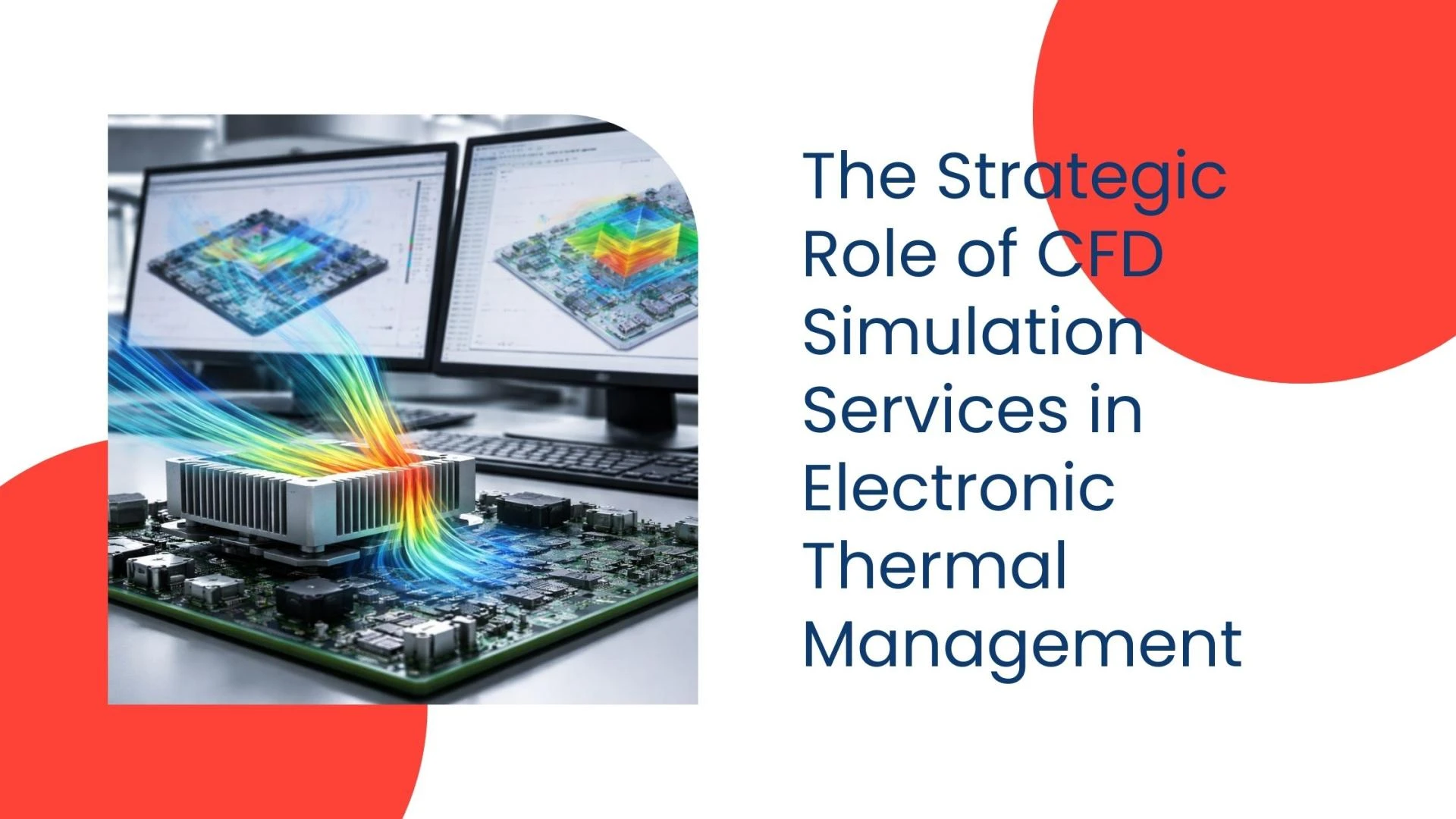

In the rapidly evolving landscape of high-performance electronics, heat is the primary adversary of hardware longevity and system reliability. As components shrink and power densities climb, traditional trial-and-error cooling methods have become obsolete. Modern engineering firms now rely on CFD simulation services to predict thermal behavior with mathematical precision before a single physical prototype is manufactured. By leveraging Computational Fluid Dynamics, designers can visualize complex airflow patterns and heat dissipation paths, ensuring that sensitive semiconductors remain within safe operating margins.
The Escalating Thermal Challenges in Modern Electronics
The demand for smaller, faster, and more powerful devices has pushed thermal management to the forefront of electronic design. High-density packaging in sectors such as aerospace, automotive, and telecommunications creates "hot spots" that can lead to catastrophic component failure or "throttling," where performance is intentionally degraded to prevent melting.
Effective thermal management is no longer just about adding a larger fan; it is about the sophisticated optimization of conduction, convection, and radiation. This is where professional simulation becomes an indispensable asset in the product development lifecycle.
How CFD Simulation Services Optimize Cooling Strategies
Computational Fluid Dynamics allows engineers to solve the Navier-Stokes equations, which govern fluid flow. In the context of electronics, this means simulating how air or liquid coolants move through a chassis and interact with heated surfaces.
Precision Airflow Analysis
CFD simulation services provide a granular look at air velocity and pressure drops. By identifying "dead zones"—areas where stagnant air traps heat—engineers can reposition components or redesign vents to facilitate natural or forced convection more effectively.
Evaluation of Heat Sink Efficiency
Selecting the right heat sink involves more than just surface area calculations. Simulation allows for the testing of various fin geometries, materials (such as aluminum vs. copper), and interface materials (TIMs) to determine the most cost-effective and thermally efficient configuration.
Integrating FEA Simulation Services for Structural Integrity
While fluid dynamics addresses the movement of heat through air or liquid, the physical impact of that heat on the hardware itself is equally critical. Integrating FEA simulation services alongside CFD provides a holistic view of "Thermo-Mechanical" stress.
Managing Thermal Expansion
Different materials on a Printed Circuit Board (PCB) expand at different rates when heated. This Coefficient of Thermal Expansion (CTE) mismatch can lead to:
- Solder joint fatigue.
- Trace cracking.
- Delamination of the board layers.
By utilizing Finite Element Analysis (FEA), engineers can predict where mechanical strain will occur due to thermal cycling, allowing for material adjustments that prevent long-term structural failure.
Vibration and Shock Resistance
Electronics in the automotive or defense sectors must survive harsh physical environments. FEA simulation services allow for the testing of structural resonances, ensuring that cooling hardware (like heavy heat sinks) does not vibrate loose or damage the board during operation.
The Economic Advantages of Professional Simulation Services
Adopting a "simulation-first" mentality is a strategic business decision that directly impacts the bottom line. Relying on specialized simulation services reduces the reliance on physical "build-and-break" cycles, which are both time-consuming and expensive.
Reducing Time-to-Market
In a competitive global market, the speed of delivery is a differentiator. Digital prototyping allows for dozens of design iterations to be tested in a virtual environment in the time it would take to manufacture one physical prototype. This accelerated feedback loop ensures that the final product is optimized for performance from day one.
Cost Mitigation and Material Optimization
Over-engineering a cooling system—such as using excessive copper or high-RPM fans—leads to unnecessary manufacturing costs and increased noise levels. Simulation identifies the exact amount of cooling required, allowing for leaner designs that save on material costs without compromising safety.
Advanced Applications: Beyond Basic Heat Sinks
As technology progresses, thermal management techniques are becoming increasingly exotic. Professional simulation services are essential for validating these advanced cooling solutions.
Liquid Cooling and Phase Change Materials
For high-performance computing (HPC) and data centers, air cooling is often insufficient. CFD is used to design liquid cold plates and immersion cooling systems, ensuring that coolant distribution is uniform and leak risks are minimized. Similarly, Phase Change Materials (PCMs), which absorb heat as they melt, require precise temporal simulations to manage transient heat loads.
Conjugate Heat Transfer (CHT)
The most accurate thermal models utilize CHT, which simultaneously calculates the temperature distribution in solids (the chips and boards) and the velocity/temperature fields in the fluids (the air). This level of sophistication provides a seamless view of how heat migrates from the silicon junction to the ambient environment.
Strategic Implementation of Simulation Data
The data derived from CFD simulation services is only as valuable as the expertise used to interpret it. Industry leaders utilize these insights to satisfy stringent regulatory requirements and safety standards, such as those set by UL or ISO.
"The transition from reactive troubleshooting to proactive thermal architectural design marks the difference between a product that survives and a product that leads the market."
By documenting the thermal safety of a device through simulation reports, companies provide a layer of "digital proof" to stakeholders and customers, reinforcing the brand's commitment to quality and reliability.
Choosing the Right Partner for Simulation
Not every organization has the internal infrastructure to maintain high-end liquid-cooled workstations and the specialized software licenses required for advanced analysis. Partnering with experts who offer comprehensive simulation services—including both CFD and FEA—grants access to high-fidelity results without the overhead of maintaining an internal department.
These services ensure that the nuances of turbulence models, radiation effects, and boundary conditions are handled by specialists who understand the physics of electronics. This collaborative approach allows internal design teams to focus on core functionality while the thermal experts ensure the device stays cool under pressure.
Future-Proofing Electronic Design
As we move toward a future of 5G integration, autonomous vehicle processing, and edge computing, thermal management will remain the ultimate bottleneck of innovation. Utilizing CFD simulation services is no longer a luxury for high-budget projects; it is a foundational requirement for any electronic device where reliability is paramount. By predicting thermal behavior, optimizing airflow, and mitigating mechanical stress through FEA, engineers can push the boundaries of what is possible, creating smaller, faster, and more durable technology for the modern world.






























Sign in to leave a comment.