
Digital transformation is one of the most overused phrases in modern business and yet, for manufacturers, it carries a weight that no other industry quite matches. Unlike retail or financial services, where digital initiatives often center on customer-facing apps or automated workflows, manufacturing transformation cuts directly into the core of how products are conceived, engineered, approved, produced, and retired. At the center of that journey sit PLM implementation services , the structured, expertise-driven process of deploying product lifecycle management systems that connect every stage of a product's existence into a single, authoritative source of truth.
The difference between a manufacturer that thrives over the next decade and one that quietly falls behind competitors will often come down not to which PLM platform they chose, but to how thoughtfully that platform was implemented and by whom.
Why PLM Has Become the Backbone of Industry 4.0
Industry 4.0 has redefined expectations around operational speed, data connectivity, and cross-functional visibility. Manufacturers are no longer simply competing on product quality; they are competing on the velocity of innovation, the accuracy of their compliance documentation, and their ability to bring engineering, quality, and supply chain teams into genuine alignment.
PLM systems platforms like PTC Windchill, for example, address all of these pressures simultaneously. They provide a centralized environment for managing CAD data, bills of materials, change orders, regulatory compliance records, and supplier collaboration. But here is the nuance that most technology vendors fail to communicate honestly: the software itself is only part of the equation. A poorly configured Windchill instance sitting on a company's servers does not automatically produce any of those outcomes. Without a disciplined, expert-led implementation, it simply becomes another siloed system more sophisticated than a shared drive, perhaps, but no less disorganized.
The Implementation Gap: Where Most Organizations Fall Short
In conversations with engineering leaders across aerospace, automotive, and medical device manufacturing, a recurring theme emerges: organizations routinely underestimate the gap between purchasing a PLM system and operating one effectively. They allocate a budget for software licensing and hardware infrastructure, then dramatically underfund the implementation phase of the configuration, workflow design, user adoption planning, integration architecture, and change management that collectively determine whether the system delivers on its promise.
This is not a minor oversight. Gartner has consistently reported that IT project failures are more often attributable to poor implementation practices than to inadequate technology. In the PLM space specifically, the complexity compounds because the system touches so many functions simultaneously. Engineering depends on it for CAD and document management. Quality relies on it for change control and CAPA tracking. Manufacturing needs it to validate that production documentation reflects the latest approved design. Each of these constituencies brings different vocabulary, different workflows, and critically different definitions of success.
What a High-Quality PLM Implementation Actually Looks Like
Genuinely effective PLM implementations share several characteristics that distinguish them from rushed or under-resourced deployments.
Deep Discovery Before a Single Line of Configuration
The most experienced implementation partners invest heavily in the discovery phase often more heavily than clients initially expect. This involves mapping existing workflows in granular detail, identifying where data currently lives (and in how many competing versions), understanding how change requests are managed today, and surfacing the informal processes that teams rely on but have never documented. This discovery work is slow, occasionally uncomfortable, and entirely irreplaceable. Organizations that skip or compress it almost invariably pay for that decision in rework costs and user frustration down the line.
Workflow Design That Reflects How People Actually Work
There is a meaningful distinction between configuring a PLM system to be theoretically correct and configuring it to be practically usable. The former produces a system that technically supports the right processes but that engineers work around because the interface friction is too high. The latter produces a system that people actually use which is, ultimately, the only meaningful measure of implementation success. This requires implementation specialists who understand not only the software but the operational context of manufacturing: the pressure of release deadlines, the reality of cross-site teams working in different time zones, the tendency of approval workflows to become bottlenecks if they are not designed with the right balance of rigor and agility.
The Critical Discipline of PLM Data Migration
Few aspects of a PLM implementation carry more risk or receive less structured attention than PLM data migration. When an organization transitions from a legacy PDM system, a network of shared drives, or a patchwork of disconnected tools into a unified PLM environment, the quality of that migration determines the usability of the entire system from day one. Orphaned CAD files, broken part-to-document relationships, inconsistent naming conventions, and incomplete revision histories can quietly undermine user confidence in ways that are extremely difficult to recover from.
A disciplined migration approach involves thorough data profiling, clear rules for handling legacy inconsistencies, validation checkpoints before and after cutover, and importantly honest conversations with stakeholders about what data is worth migrating versus archiving. Not everything needs to come forward. In fact, attempting to migrate everything indiscriminately is one of the most reliable ways to introduce debt into a new system before it has even gone live.
Integration: PLM as the Connective Tissue of the Digital Thread
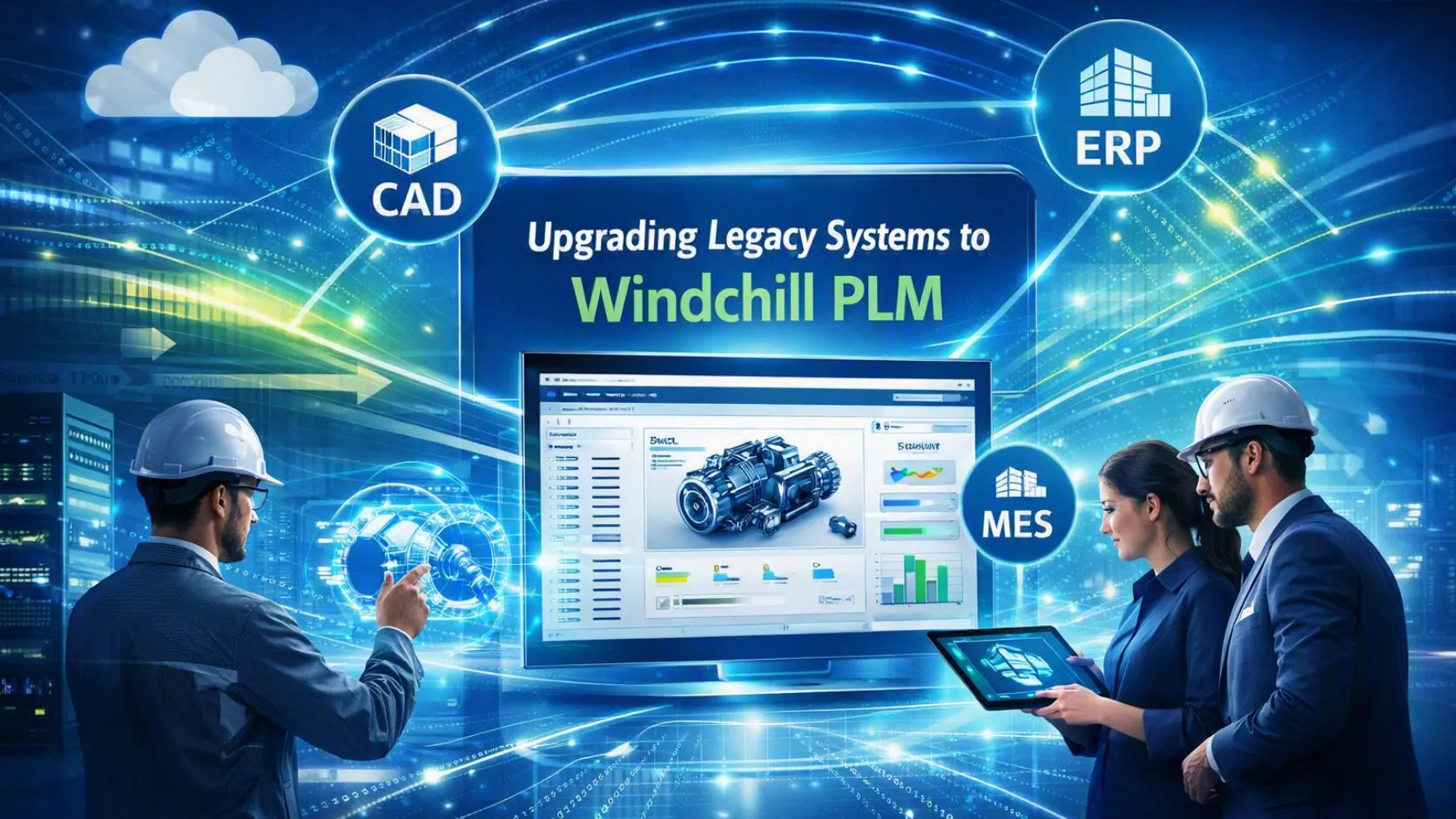
Modern manufacturers increasingly recognize that the full value of PLM is realized not in isolation but in integration. When a PLM system communicates reliably with an ERP system, the organization eliminates a persistent and costly problem: the lag between engineering releasing a new product structure and manufacturing receiving accurate BOMs with correct part numbers, lead times, and supplier data.
When PLM connects with MES platforms, quality management systems, and IoT-enabled production environments, the concept of the "digital thread" , a continuous, traceable link between design intent and manufacturing reality becomes genuinely achievable rather than aspirational. This level of integration does not happen automatically. It requires implementation expertise that spans both the PLM platform and the broader enterprise architecture, along with the organizational maturity to govern data standards across systems.
Choosing the Right Implementation Partner
The maturity of an implementation partner matters enormously, and it shows up in ways that are not always obvious during a vendor evaluation. Technical certifications are necessary but insufficient. What separates exceptional partners from adequate ones is the combination of platform depth, industry-specific experience, and the intellectual honesty to tell clients what they genuinely need rather than what will close the deal most quickly.
Partners who offer end-to-end services spanning implementation, configuration, integration, and training provide a continuity of accountability that point-solution vendors simply cannot match. When the same team that designed the system is also responsible for training the users who will operate it daily, the feedback loop is tighter, the handoffs are cleaner, and the long-term outcomes are measurably better.
For organizations evaluating PTC Windchill specifically, the expertise tier of the partner matters significantly. Platinum-level partners have deeper access to product roadmaps, escalation pathways, and specialized resources that directly benefit the implementation experience particularly for complex, multi-site deployments or highly regulated industries like medical devices and aerospace.
The Transformational Dividend
Organizations that implement PLM thoughtfully with rigorous discovery, disciplined data practices, well-designed workflows, and genuine integration into the broader enterprise report outcomes that go well beyond operational efficiency. They describe a qualitative shift in organizational confidence: the assurance that when an engineer releases a design, every downstream function is working from the same, current, approved version. That might sound unremarkable until you've spent years operating without it.
In a manufacturing environment, information integrity is not a luxury. It is the foundation on which speed, quality, compliance, and innovation all depend. PLM, implemented well, provides that foundation and the transformation that follows from it tends to be both measurable and durable.


























Sign in to leave a comment.