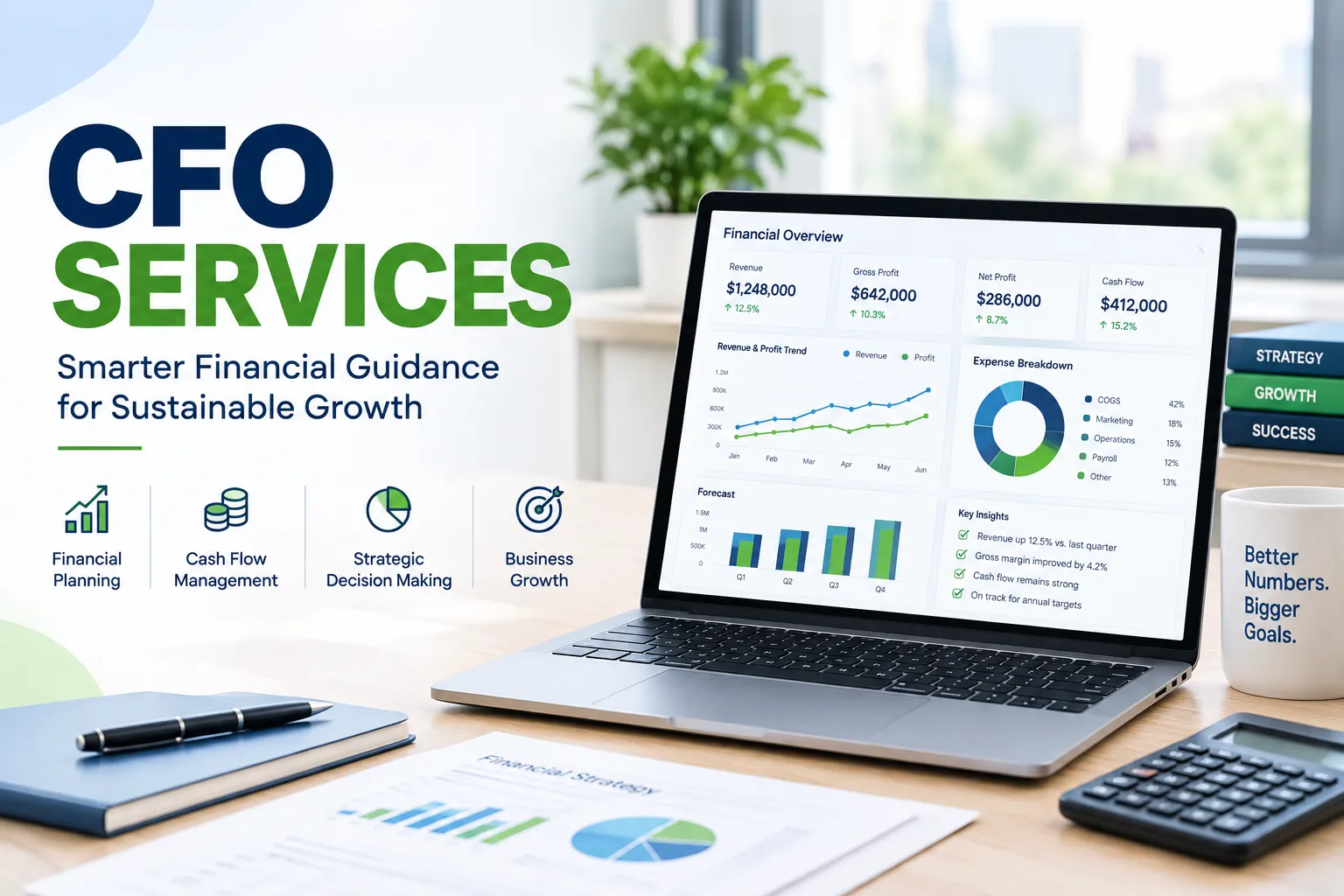

rowing a business involves much more than increasing revenue. As a company expands, financial decisions grow more complex, cash needs increase, and business owners need better visibility into what drives performance.
Bookkeeping and accounting can tell a business what happened financially. But many growing companies also need someone to answer a different set of questions: What should we do next? Can we afford to expand? Why are margins changing? How much cash will we need in the coming months? Which areas of the business are generating the strongest returns?
This is where CFO services add real value.
CFO support can provide financial analysis, forecasting, planning, reporting, and strategic guidance without requiring the company to hire a full-time Chief Financial Officer.
What Are CFO Services?
CFO services give businesses access to financial leadership and strategic expertise beyond routine bookkeeping and accounting.
A CFO's role is generally focused on understanding the company's financial position, identifying risks and opportunities, improving financial decision-making, and helping leadership plan for the future.
Depending on the business and its needs, CFO support may involve financial forecasting, cash-flow planning, budgeting, profitability analysis, management reporting, financial strategy, and support for major business decisions.
For smaller or growing companies, these services can be delivered on a fractional, outsourced, or virtual basis. This gives a business access to CFO-level expertise without the cost and commitment of a full-time executive position.
How Is a CFO Different From an Accountant?
The roles of accountants and CFOs are connected, but they serve different purposes.
An accountant generally focuses on maintaining accurate financial records and handling activities such as bookkeeping, reconciliations, financial statements, tax-related preparation, and compliance.
A CFO takes a broader perspective.
Instead of focusing primarily on what has already happened, CFO-level work often uses financial information to help determine what the business should do next.
For example, an accountant may prepare a company's income statement showing revenue and expenses for the previous month. A CFO may analyze those numbers to determine why margins changed, whether expenses are growing too quickly, and how those trends could affect the company's plans for the next quarter.
Both functions are important. Accurate accounting provides the financial foundation, while CFO guidance helps management use that information for strategic decision-making.
When Does a Business Need CFO Support?
Not every company needs CFO services from the beginning.
A small business with straightforward transactions and limited financial complexity may operate effectively with bookkeeping and accounting support.
The need for CFO-level guidance often becomes more apparent as the business grows.
A company may be reaching this stage when the owner regularly asks questions about cash flow, profitability, hiring, expansion, financing, or long-term planning but lacks the financial expertise or internal resources to answer them confidently.
Rapid growth can also create new financial challenges. Revenue may be increasing while cash remains tight. Inventory purchases may require significant working capital. New employees may increase operating expenses before they generate additional revenue. Multiple sales channels or business entities can complicate financial reporting.
At this point, CFO support can help turn financial data into actionable information.
Cash Flow Management Is a Major CFO Responsibility
Profitability does not always mean a business has sufficient cash available.
A growing company may be profitable but still experience cash-flow pressure because of inventory purchases, delayed customer payments, loan obligations, expansion costs, or other timing differences.
CFO services can help businesses understand these cash-flow patterns and plan accordingly.
For example, a CFO may develop cash-flow forecasts that show expected inflows and outflows over the coming weeks or months. This can help management anticipate periods of tighter liquidity instead of discovering a cash shortage after it occurs.
Better cash-flow visibility can also support decisions about inventory purchases, hiring, marketing budgets, capital investments, and expansion.
Financial Forecasting Helps Businesses Plan Ahead
Historical financial statements explain what has already happened. Forecasting helps businesses prepare for what might happen next.
A financial forecast can incorporate assumptions around revenue growth, expenses, hiring, inventory, customer acquisition, pricing, and other factors that influence the company's financial performance.
Rather than relying solely on optimistic or pessimistic assumptions, businesses can use different scenarios to understand potential outcomes.
For example, management might compare a conservative growth scenario with a more aggressive expansion plan. The analysis could show how each scenario affects revenue, operating expenses, cash requirements, and profitability.
This type of forward-looking analysis can make business planning more deliberate.
CFO Services Can Improve Profitability Visibility
Revenue is an important measure of business growth, but it doesn't necessarily tell owners whether the company is operating efficiently.
A business can increase sales while margins decline because of rising costs, discounts, advertising expenses, fulfillment costs, payroll, or other operating expenses.
CFO-level analysis can help management understand the factors behind profitability.
For example, an ecommerce company might generate strong sales but discover that rising inventory costs, payment processing fees, advertising costs, and returns are reducing its margins.
A SaaS company may have increasing recurring revenue but also experience rising customer acquisition costs or operating expenses.
Looking beyond revenue can help leadership identify where the business is actually creating value and where financial performance may need attention.
Management Reporting Gives Leaders Better Visibility
Financial statements are essential, but business leaders often need more than standard financial reports.
Management reporting can organize financial and operational information around the metrics that matter most to a specific company.
Depending on the business model, management may want visibility into revenue trends, gross margins, operating expenses, cash flow, customer acquisition costs, inventory, accounts receivable, or profitability by product or business segment.
The purpose isn't to create more reports for reporting's sake.
The goal is to give decision-makers the right information at the right time.
When reporting is timely and understandable, leadership can identify trends earlier and make decisions based on data rather than assumptions.
Budgeting and Financial Planning
Budgeting provides businesses with a framework for managing expected revenue and expenses.
However, a budget should not be treated as a document that is prepared once and then ignored.
Actual performance can differ from the original assumptions. Revenue may grow faster or slower than expected, costs may change, and business priorities may shift.
CFO support can help businesses compare actual performance with budgets and understand the reasons behind significant variances.
This creates a more dynamic planning process and lets management adjust spending or priorities as circumstances change.
CFO Services for Ecommerce Businesses
Ecommerce businesses can face particularly complex financial challenges because they often operate across multiple platforms and sales channels.
An ecommerce company may sell through Shopify, Amazon, marketplaces, wholesale channels, or its own website. It may also manage inventory, fulfillment costs, payment processing fees, advertising expenses, refunds, and returns.
CFO-level financial analysis can help owners understand how these factors affect profitability and cash flow.
Instead of focusing only on total sales, management can evaluate margins, inventory investment, channel performance, operating expenses, and other financial indicators to determine whether growth is sustainable.
This can be particularly valuable when an ecommerce company is deciding whether to introduce new products, expand into another channel, increase advertising spending, or invest in additional inventory.
CFO Services for SaaS and Technology Companies
SaaS and technology businesses have their own financial considerations.
Recurring revenue, customer acquisition costs, churn, pricing, employee expenses, product development, and growth investments can all influence financial performance.
A CFO can help leadership connect these operational metrics with financial outcomes.
For example, increasing revenue may appear positive, but if customer acquisition costs are rising at the same time, the economics of that growth may need closer examination.
Financial planning can help SaaS businesses evaluate growth strategies, understand cash requirements, and determine how different operating decisions could affect future performance.
Fractional CFO vs. Full-Time CFO
Hiring a full-time CFO can be a significant investment, especially for a smaller company that doesn't yet need a full-time executive.
A fractional CFO provides CFO-level expertise on a part-time or flexible basis.
This model can help businesses that need strategic financial guidance but don't have enough complexity or budget to justify a full-time position.
A fractional CFO can support areas such as forecasting, budgeting, cash-flow planning, management reporting, profitability analysis, and strategic financial decisions as the company's needs evolve.
As the business grows, the organization can reassess whether fractional support remains appropriate or whether it needs a full-time financial executive.
What to Look for in CFO Services
Businesses should evaluate CFO support based on their financial needs rather than simply looking for a provider with the longest list of services.
Industry experience matters because the financial challenges of an ecommerce business may differ significantly from those of a SaaS or manufacturing company.
Businesses should also consider whether the CFO service provider understands their accounting systems, reporting requirements, financial goals, and growth plans.
Communication is equally important. CFO-level advice is only useful when financial information can be translated into practical recommendations that business owners and leadership teams can understand and act upon.
When Outsourced CFO Services Make Sense
Outsourced CFO support can be particularly useful when a company has reached a stage where bookkeeping alone is no longer enough but hiring a full-time CFO would be premature.
A business may need help preparing for a major expansion, improving financial reporting, managing cash flow, developing forecasts, evaluating investments, or understanding profitability.
In these situations, CFO services can provide access to financial expertise while letting the business choose a level of support that fits its current needs.
The right arrangement should complement the company's existing accounting function rather than replace the importance of accurate bookkeeping and financial records.
Final Thoughts
CFO services are not only for large corporations.
As small and mid-sized businesses grow, financial decisions become more important and harder to manage using historical accounting information alone.
A CFO can help leadership move from simply understanding what happened to thinking more strategically about what should happen next.
Whether the need is cash-flow forecasting, profitability analysis, budgeting, management reporting, financial planning, or support for a major business decision, CFO-level guidance can give growing companies greater financial visibility.
The most valuable outcome is not simply another financial report. It is a clearer understanding of the numbers behind the business and the ability to use that information to make better decisions.
For growing companies, that combination of accurate accounting and strategic financial guidance can provide a stronger foundation for sustainable growth.






















Sign in to leave a comment.