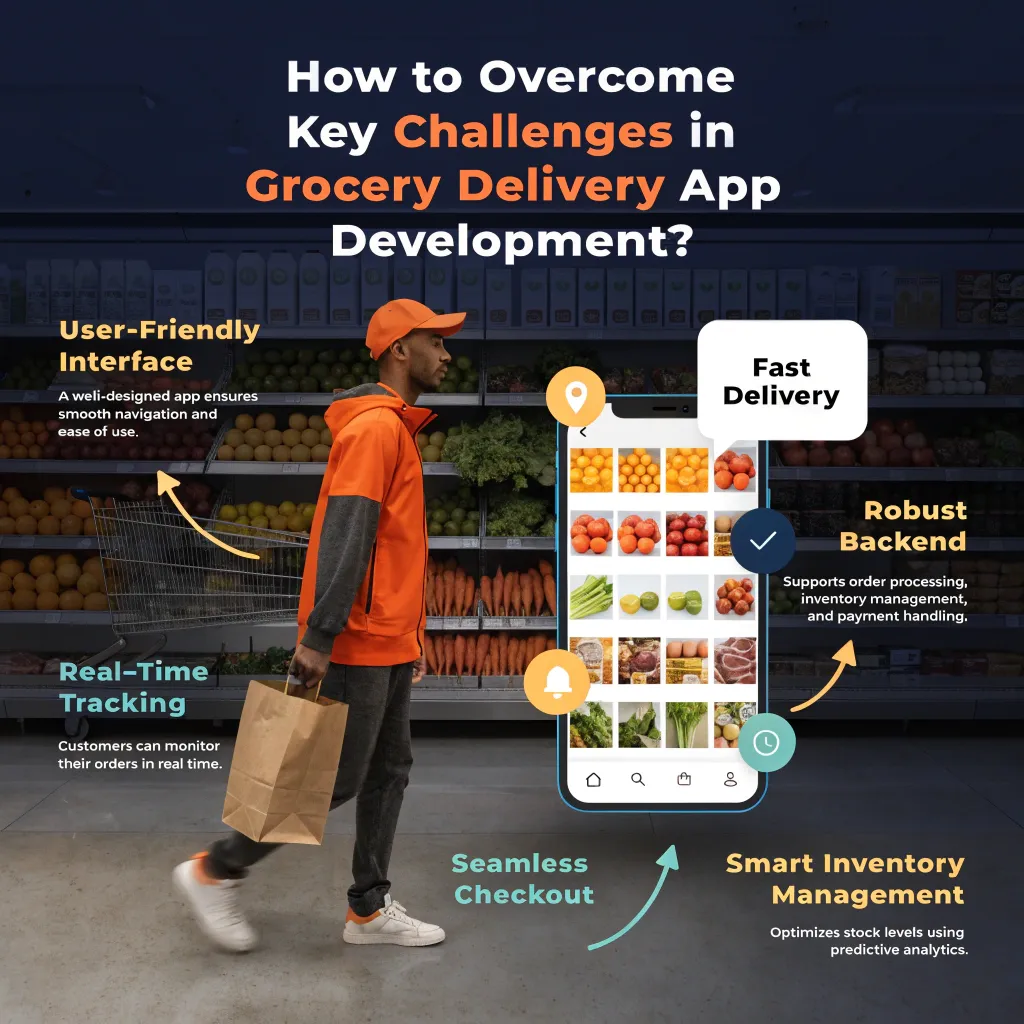

Over the past few years, there has been an exponential rise in the grocery delivery market. This is because of the need for faster and easier shopping experiences in terms of everyday groceries by the customers. With or without any competition from their rivals, companies are now making investments in on-demand grocery delivery app development in order to meet the demands of their potential customers.
But this isn't always easy, as it involves dealing with several technological and operational obstacles. Here in this blog, we will explore some of the major problems in developing an on-demand grocery delivery application and how to overcome these problems.
1. Real-Time Inventory Management
The Challenge
The frustration of finding a particular item in your shopping cart missing from the stock at checkout is one of the worst feelings for an end-user. The issue of synchronization of inventories in both offline and online modes is one of the biggest challenges in the development of grocery delivery software.
How to Overcome It
- Integrate a centralized inventory management system (IMS) that syncs stock levels across all warehouses and store locations in real time.
- Use WebSocket technology or event-driven architecture to push live updates instantly.
- Implement smart substitution logic when a product is unavailable, the app can suggest the nearest alternative automatically.
- Leverage machine learning models to predict demand surges and pre-update inventory thresholds.
A reputable grocery delivery app development agency will be able to integrate your inventory APIs with ERP/WMS right from the beginning.
2. Efficient Route Optimization and Delivery Logistics
The Challenge
Delivering perishable goods within a promised time window often 30 to 60 minutes requires sophisticated logistics planning. Poor route management leads to delayed deliveries, unhappy customers, and increased operational costs.
How to Overcome It
- Integrate AI-powered route optimization engines like Google Maps Platform, HERE, or proprietary algorithms that factor in traffic, distance, and delivery windows.
- Implement dynamic slot management to avoid delivery congestion during peak hours.
- Use geofencing to trigger automatic notifications for both delivery agents and customers.
- Build a dedicated driver app with turn-by-turn navigation, order batching capabilities, and live status updates.
When you engage professional grocery app development services, experienced developers build the logistics layer to handle multi-stop routes, priority orders, and real-time re-routing all critical for a scalable operation.
3. Handling Perishable Product Categories
The Challenge
Unlike standard e-commerce, grocery apps must handle fresh produce, dairy, meat, and frozen goods all of which have strict storage and handling requirements. Mismanagement leads to spoilage, product returns, and customer dissatisfaction.
How to Overcome It
- Categorize products by temperature sensitivity (ambient, chilled, frozen) within the app's product catalog.
- Design the checkout and dispatch workflow to group orders by storage category, ensuring cold-chain integrity.
- Integrate smart packaging prompts for delivery agents to ensure proper handling.
- Offer customers real-time quality ratings and an easy return/refund flow for perishable items.
Expert grocery delivery app development services account for these nuances at the architecture level not as an afterthought.
4. Scalability Under Peak Demand
The Challenge
Traffic spikes during weekends, holidays, or festive seasons can cripple an underprepared backend. A platform that crashes during peak hours loses revenue and customer trust simultaneously.
How to Overcome It
- Build on a microservices architecture so that individual services (orders, payments, notifications) can scale independently.
- Deploy the application on cloud infrastructure (AWS, Google Cloud, or Azure) with auto-scaling configured for compute and database tiers.
- Use CDN (Content Delivery Network) for static assets and caching layers like Redis to reduce database load.
- Conduct regular load testing using tools like Apache JMeter or Locust to identify bottlenecks before they hit production.
A seasoned mobile app development company will design the system architecture with scalability as a core requirement, not a retrofit.
5. Multi-Vendor and Multi-Store Management
The Challenge
Many grocery platforms operate with multiple vendors, store chains, or dark stores. Managing catalog consistency, pricing rules, commission structures, and order routing across these entities is a complex orchestration challenge.
How to Overcome It
- Build a dedicated vendor/admin panel with granular controls for product listings, pricing, promotions, and analytics.
- Implement rule-based order routing that automatically assigns orders to the nearest or highest-rated fulfillment center.
- Use a unified product taxonomy with standardized attributes so customers get a consistent experience regardless of the vendor.
- Create vendor-specific dashboards with real-time performance metrics orders fulfilled, cancellation rates, and customer ratings.
The architecture for the multi-vendor layer is designed by the app development team when you hire them. They make sure that the design is such that adding more vendors in the future will not necessitate any re-engineering.
6. Payment Gateway Integration and Security
The Challenge
Grocery apps deal with high transaction volumes and diverse customer preferences from credit cards and digital wallets to cash on delivery and buy-now-pay-later options. Security vulnerabilities or failed transactions erode user trust fast.
How to Overcome It
- Integrate multiple payment gateways (Stripe, Razorpay, PayPal, Braintree) with fallback options to minimize transaction failures.
- Implement PCI-DSS-compliant payment flows to protect cardholder data.
- Use tokenization and 3D Secure authentication to reduce fraud.
- Build an in-app wallet feature for loyalty credits, refunds, and seamless repeat purchases.
- Display a real-time payment status tracker to keep users informed through every step.
7. User Experience and Retention
The Challenge
The grocery delivery market is fiercely competitive. Customers will abandon an app that's slow, confusing, or unreliable. Poor UX is often the silent killer of otherwise technically sound platforms.
How to Overcome It
- Design intuitive search with smart filters, predictive search, and barcode scanning for quick product discovery.
- Implement personalized recommendation engines based on purchase history and browsing behavior.
- Build a frictionless checkout flow fewer steps mean higher conversion rates.
- Send context-aware push notifications (order confirmation, delivery ETA, special offers) without overwhelming users.
- Introduce gamified loyalty programs, subscription plans (like a Grocery Prime model), and referral incentives to boost retention.
Top-tier grocery delivery app development firm combine UX research with technical execution to deliver interfaces that are not just beautiful, but genuinely easy to use.
8. Driver/Delivery Partner Management
The Challenge
Building a reliable delivery fleet whether in-house or gig-based requires tools for onboarding, tracking, incentivization, and performance management. Without these, service quality becomes inconsistent.
How to Overcome It
- Develop a dedicated driver app with order management, earnings dashboard, navigation, and support chat.
- Implement a dynamic earnings model with surge pricing and bonus incentives to retain top-performing drivers during peak hours.
- Build automated performance scoring based on delivery time, customer ratings, and cancellation rates.
- Integrate a background verification system during driver onboarding for safety assurance.
9. Compliance and Data Privacy
The Challenge
With extensive expertise in developing an end-to-end grocery delivery application development solution. Be it from designing the architecture and integrating APIs or going live with your business to the next level, our experts at Helpful Insight possess the skills to make your grocery delivery business thrive.
How to Overcome It
- Conduct a compliance audit before and after development with legal and technical teams aligned.
- Implement role-based access control (RBAC) and data minimization principles in your data architecture.
- Give users transparent control over their data what's collected, how it's used, and the ability to delete it.
- Use end-to-end encryption for sensitive user data both in transit and at rest.
A responsible grocery delivery software development partner will bake compliance into the development process, not bolt it on at the end.
10. Choosing the Right Technology Partner
Perhaps the single biggest challenge is finding a development partner who understands both the technical complexity and the business nuances of the grocery delivery domain.
What to Look For in a Grocery Delivery App Development Company:
- A proven portfolio of on-demand grocery delivery app projects across iOS, Android, and web platforms.
- Deep expertise in cloud-native, microservices-based architectures.
- Strong UX/UI design capabilities backed by user research.
- Post-launch support, maintenance, and iterative development commitment.
- Transparent communication and agile development methodology.
With extensive expertise in developing an end-to-end grocery delivery application development solution. Be it from designing the architecture and integrating APIs or going live with your business to the next level, our experts at Helpful Insight possess the skills to make your grocery delivery business thrive.
Final Thoughts
Building a grocery delivery app isn’t a walk in the park. From inventory management, routing, scalability, and designing the app interface, all these require engineering and product design aspects.
But cheer up since each problem identified above has its corresponding solution and partnering with the best app development company will definitely be of great help.
When making plans to develop a grocery delivery application or upgrading the existing application, working in partnership with an app development company such as Helpful Insight ensures that your application is fit for both present and future use.
Do you have plans to create a food delivery app? Contact Helpful Insight – the best choice for quality grocery app development in the USA, UK, and UAE.
























Sign in to leave a comment.