
If you ask anyone which holiday matters most in Chinese culture, the answer will always be Chinese New Year. Also known as the Spring Festival or Lunar New Year, this iconic celebration boasts over 3,000 years of history. It first began in the Shang Dynasty, starting out as simple farming rituals and ancestor honoring ceremonies. Today, Chinese New Year has grown into a global celebration, uniting billions of people of Chinese heritage worldwide to mark new beginnings and embrace fresh hopes for the year ahead.
A lot of people new to this festival are confused by its floating date. Unlike Western holidays fixed on the solar Gregorian calendar, Chinese New Year follows the traditional lunisolar calendar unique to China. That’s why Chinese New Year never lands on the same day every year, generally falling between January 21 and February 20. The exact date is determined by the second new moon that appears after the winter solstice — an ancient rule that still sets the official start of Chinese New Year today.
What makes every Chinese New Year extra special is its exclusive zodiac sign. There are 12 zodiac animals in total: Rat, Ox, Tiger, Rabbit, Dragon, Snake, Horse, Goat, Monkey, Rooster, Dog, and Pig, rotating in a fixed endless cycle. Paired with the five natural elements — Wood, Fire, Earth, Metal, and Water — they form a 60-year grand cycle. This unique system gives each year’s Chinese New Year its own distinct personality and cultural meaning.
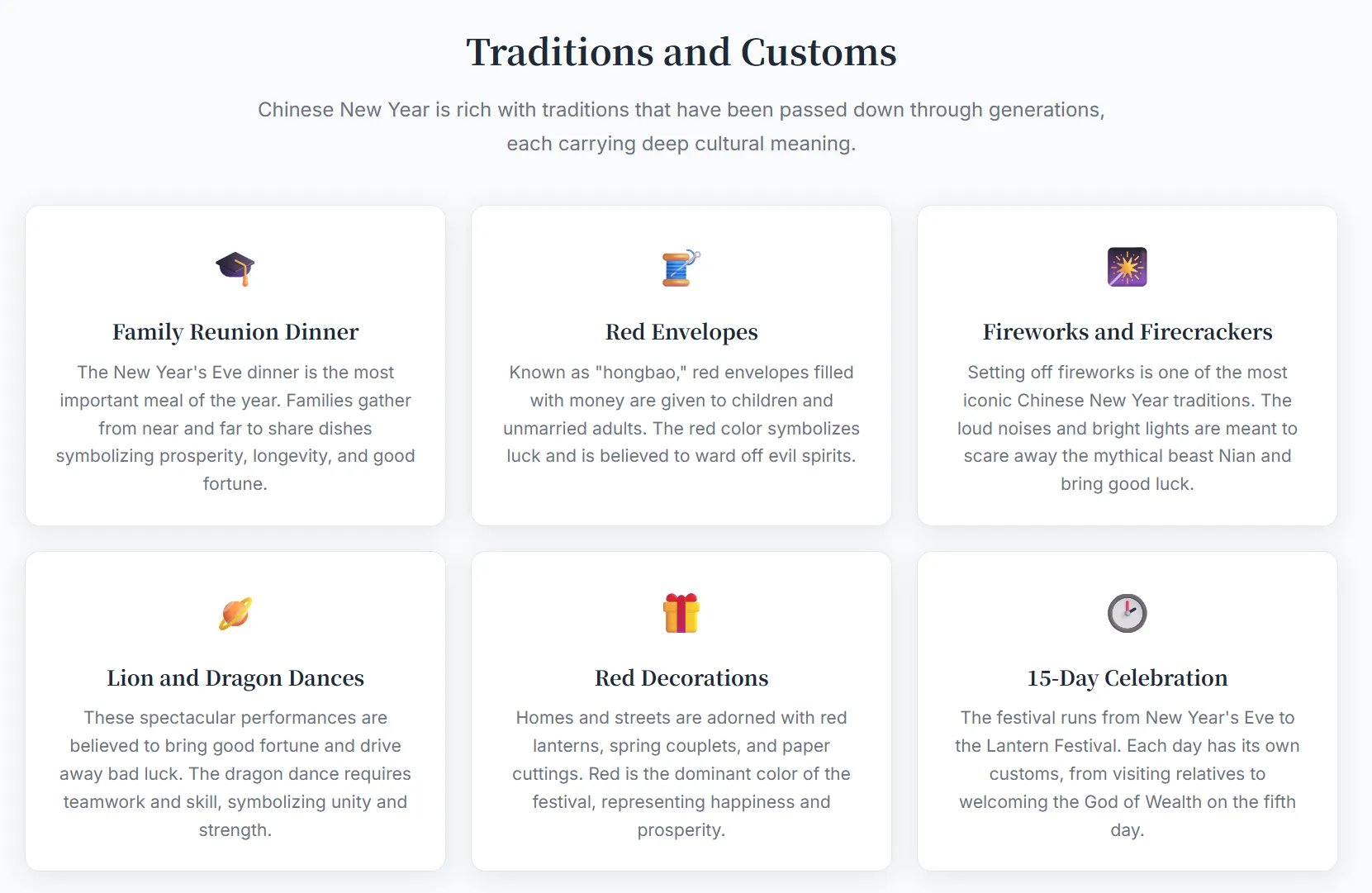
Chinese New Year isn’t just a one-day celebration. The fun and rituals stretch for 15 whole days, kicking off on New Year’s Eve and wrapping up with the lively Lantern Festival. These two weeks are all about family bonding, remembering ancestors, and letting go of all the bad luck and stress from the past year. Every day of Chinese New Year has its own little tradition too. For example, people welcome the God of Wealth on the fifth day, hoping for a prosperous year ahead.
Popular Chinese New Year Traditions Everyone Loves
All the beloved customs we practice during Chinese New Year have been passed down through countless generations. Every single ritual carries a heartfelt wish for happiness, health, and good fortune.
The New Year’s Eve family dinner is absolutely the highlight of Chinese New Year. No matter how far away relatives live, they’ll travel back home for this special feast. Every dish on the table has a special meaning, standing for long life, good health and future success. It’s truly the core moment of Chinese New Year, embodying the importance of family reunion.
Red envelopes, locally called “hongbao”, are another unmissable part of Chinese New Year. Elders will prepare red envelopes stuffed with cash for kids and unmarried young adults. Red is an auspicious color in Chinese culture. People believe it can keep evil spirits away and bring good luck to whoever receives these festive gifts during Chinese New Year.
Setting off fireworks and firecrackers has been a classic Chinese New Year tradition for thousands of years. It all comes from the ancient legend of scaring off the fierce Nian monster. To this day, the loud crackling sounds and bright fireworks lighting up the sky are still everyone’s favorite way to kick off Chinese New Year, chasing away bad energy and welcoming good fortune.
Lion and dragon dances are the most eye-catching scenes during Chinese New Year. These dynamic, energetic performances are believed to clear away bad luck and attract good blessings. The dragon dance, in particular, requires perfect teamwork and coordination, symbolizing unity and strength — exactly the positive spirit that Chinese New Year stands for.
Walk down any street or step into any home during Chinese New Year, and you’ll be surrounded by vibrant red decorations. Red lanterns, festive spring couplets, and delicate paper cuttings adorn every corner. As the signature color of Chinese New Year, red perfectly symbolizes joy, happiness, and abundant prosperity for the new year.
Chinese New Year Dates From 1936 to 2042
Want to check the exact date of past or future Chinese New Year? We’ve put together a full, easy-to-navigate date list covering Chinese New Year celebrations from 1936 all the way through 2042. We’ve sorted the years into neat groups: 1936–1947, 1948–1959, 1960–1971, 1972–1983, 1984–1995, 1996–2007, 2008–2019, and 2020–2031. Just click on any year you’re curious about, and you’ll get its precise Chinese New Year date, matching zodiac animal, elemental attribute, and detailed festival celebration information.






























Sign in to leave a comment.