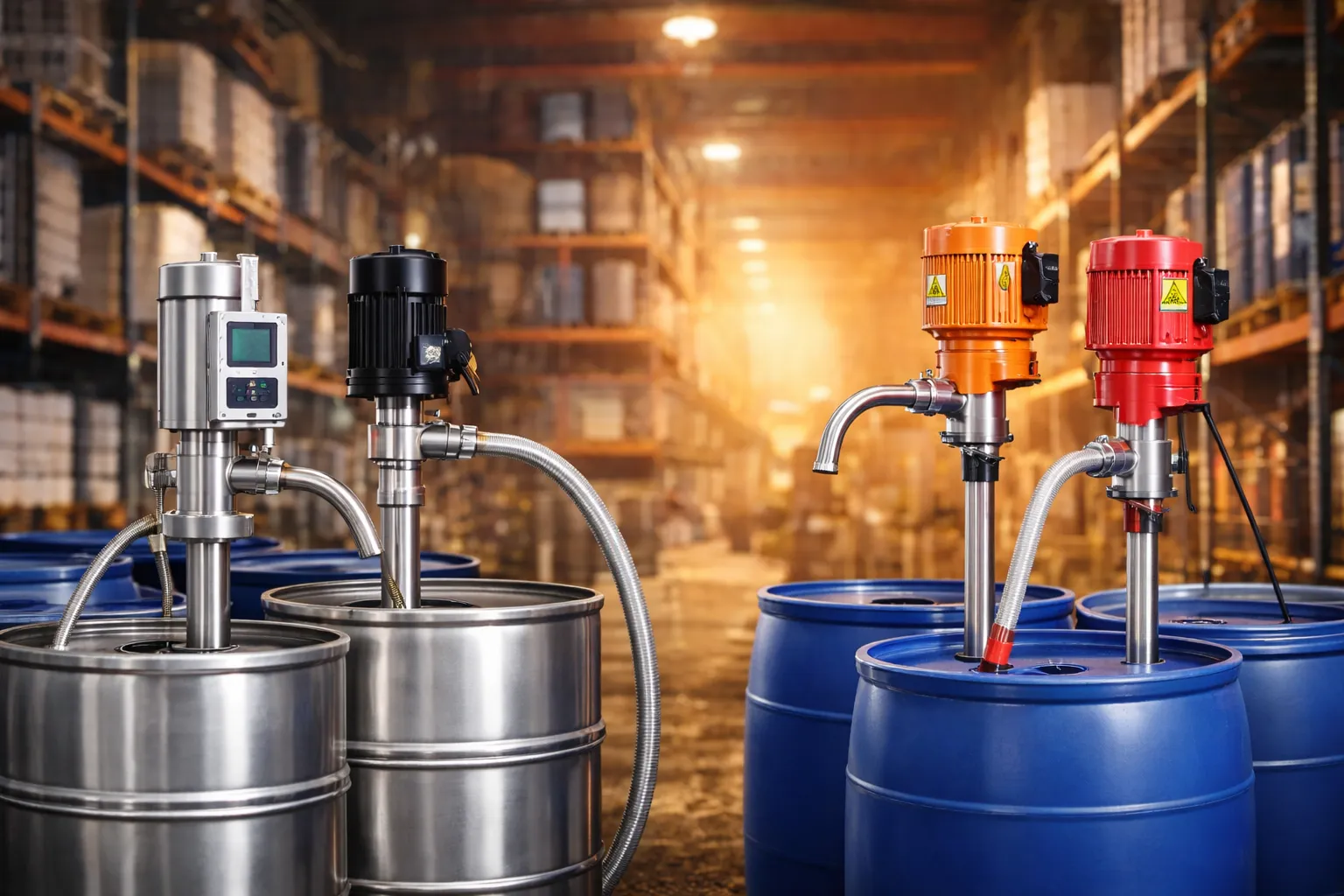

It usually starts after a failed trial run—your Stainless Steel Electric Gear Pump heats up, flow drops, and suddenly the supplier stops picking calls. That’s when most buyers realize they didn’t really evaluate the manufacturer; they just compared prices.
And yet, pumps are not interchangeable hardware. A mismatch in viscosity handling or motor protection rating can cost you an entire batch, not just a spare part. Most procurement teams learn this the hard way—after installation, not before.
The Spec Detail Most Buyers Skip
Material Grade & Internal Tolerances
Most suppliers will say “SS304 or SS316.” That’s surface-level. What actually matters is internal gear tolerance—typically between 0.02 mm to 0.05 mm for high-efficiency transfer. A sloppy tolerance increases slip, especially with low-viscosity fluids.
Flow Rate vs. Viscosity Curve
Here’s where datasheets mislead. A pump rated at 60 LPM for oil at 100 cSt may drop below 35 LPM at 500 cSt. That’s not a defect—it’s physics. Yet suppliers rarely share full viscosity curves unless asked directly.
Motor Type & Flame Proof Certification
For Flame Proof Electric Barrel Pump, check certification standards like ATEX or IECEx. If the vendor says “flameproof type” without documentation, walk away. That’s not compliance—it’s marketing language.
Seal Type & Leakage Risk
Mechanical seals vs. gland packing—each has trade-offs. Mechanical seals reduce leakage but fail abruptly. Gland packing leaks slowly but gives warning. Buyers often ignore this until maintenance teams complain.
Priming Capability
Yes, most gear pumps are self-priming. But “self-priming” doesn’t mean dry-run capable. Run it dry for even 90 seconds, and internal wear begins.
What a Weak Supplier Answer Sounds Like
- Delivery Time Clarity
Good: “18–21 days ex-works, tested before dispatch.”
Bad: “We’ll try to deliver fast.”
That’s not a timeline—it’s a hedge. - Material Traceability
Good: Heat number traceable to mill certificate.
Bad: “We use standard stainless steel.”
Which standard? From where? Silence follows. - Testing Protocols
Good: Hydro test + flow test report shared before dispatch.
Bad: “We test everything internally.”
No documentation means no accountability. - After-Sales Policy
Good: Defined warranty—typically 12 months with clear exclusions.
Bad: “We’ll handle issues case by case.”
That’s a negotiation you’ll lose after delivery. - Spare Parts Availability
Good: Spares stocked for 5+ years.
Bad: “You can reorder anytime.”
Which means long downtime later.
Why the Right Pump Protects Your Margins
A correctly selected pump doesn’t just move fluid—it protects your process economics.
First, consistent flow rate reduces batch variation. In industries like chemicals or food processing, even a 5% deviation can mean rework or rejection.
Second, proper material selection avoids corrosion. Replacing a failed pump every 8 months instead of 3 years isn’t bad luck—it’s bad sourcing.
Third, flameproof compliance isn’t optional in hazardous zones. One incident can shut down operations for weeks, not hours.
Fourth, energy efficiency matters more than buyers admit. A poorly matched pump can draw 12–18% more power over time.
Finally, downtime is the hidden cost. Waiting 10 days for a spare gear set is more expensive than paying 15% extra upfront for a reliable supplier.
Where Most Buyers Actually Source From (And Why It Matters)
India has clusters for pump manufacturing—Ahmedabad, Coimbatore, and parts of Maharashtra dominate production.
Which means location isn’t just about proximity. It affects lead time, raw material sourcing, and even testing standards. For instance, manufacturers in Gujarat often have better access to stainless steel casting suppliers, reducing dependency delays.
That’s why Stainless Steel Electric Gear Pump Suppliers in these regions can offer faster turnaround—sometimes 3–5 days shorter than competitors elsewhere.
And when it comes to Flame Proof Electric Barrel Pump Dealers, regional compliance knowledge matters. A dealer unfamiliar with hazardous zone classifications can recommend the wrong model entirely.
About Us — What We’ve Learned the Hard Way
We’ve been supplying industrial pumps since 2013, and not everything worked from day one.
We still remember a shipment in 2019 where three units came back due to seal failure in high-temperature oil transfer. We didn’t argue with the client—we changed the seal supplier and re-tested every unit before dispatch. That shift reduced our failure rate by nearly 7% over the next year.
We don’t guess specs. We ask questions most buyers don’t expect—fluid type, operating hours, temperature range—because those details decide whether the pump lasts 6 months or 3 years.
If you’re sourcing from Giza Pumps, don’t just send “need gear pump.”
Send us:
- Fluid type and viscosity (if known)
- Required flow rate (LPM)
- Operating temperature
- Application (transfer, circulation, dosing)
We respond within 24 hours. Typical MOQ is 1 unit for standard models.
And here’s what you’ll get back: a spec-matched recommendation, not a generic catalogue PDF.
Conclusion
Choosing the right Stainless Steel Electric Gear Pump is less about price and more about how well the supplier understands your application. Most failures trace back to skipped questions, not defective products. The same applies when selecting Flame Proof Electric Barrel Pump Manufacturers in India—compliance and clarity matter more than speed. Buyers who invest time upfront avoid expensive corrections later.
FAQs
1. Are all Stainless Steel Electric Gear Pump Manufacturers the same in India?
Not even close. Some focus on volume, others on custom engineering. A manufacturer supplying 500 units monthly may not handle niche viscosity requirements well.
2. How do I verify Stainless Steel Electric Gear Pump Suppliers before ordering?
Ask for test reports and client references. If they hesitate, assume those don’t exist. Also check how detailed their technical responses are—that reveals more than certifications.
3. What makes Flame Proof Electric Barrel Pump Manufacturers in India reliable?
Documented compliance. If they provide ATEX or equivalent certification with traceable serial numbers, that’s a good sign. If not, you’re taking a risk.
4. Do Flame Proof Electric Barrel Pump Dealers provide installation support?
Some do, some don’t. Many dealers only handle sales. Clarify this early, especially for hazardous environments.
5. Are Stainless Steel Electric Gear Pump Suppliers responsible for performance issues?
Only if specs were clearly defined. If you didn’t specify viscosity or temperature, responsibility becomes unclear. That’s where disputes start.
6. How long do Flame Proof Electric Barrel Pumps typically last?
With proper use, 2–4 years. But running incompatible fluids or ignoring maintenance can cut that in half.
























Sign in to leave a comment.