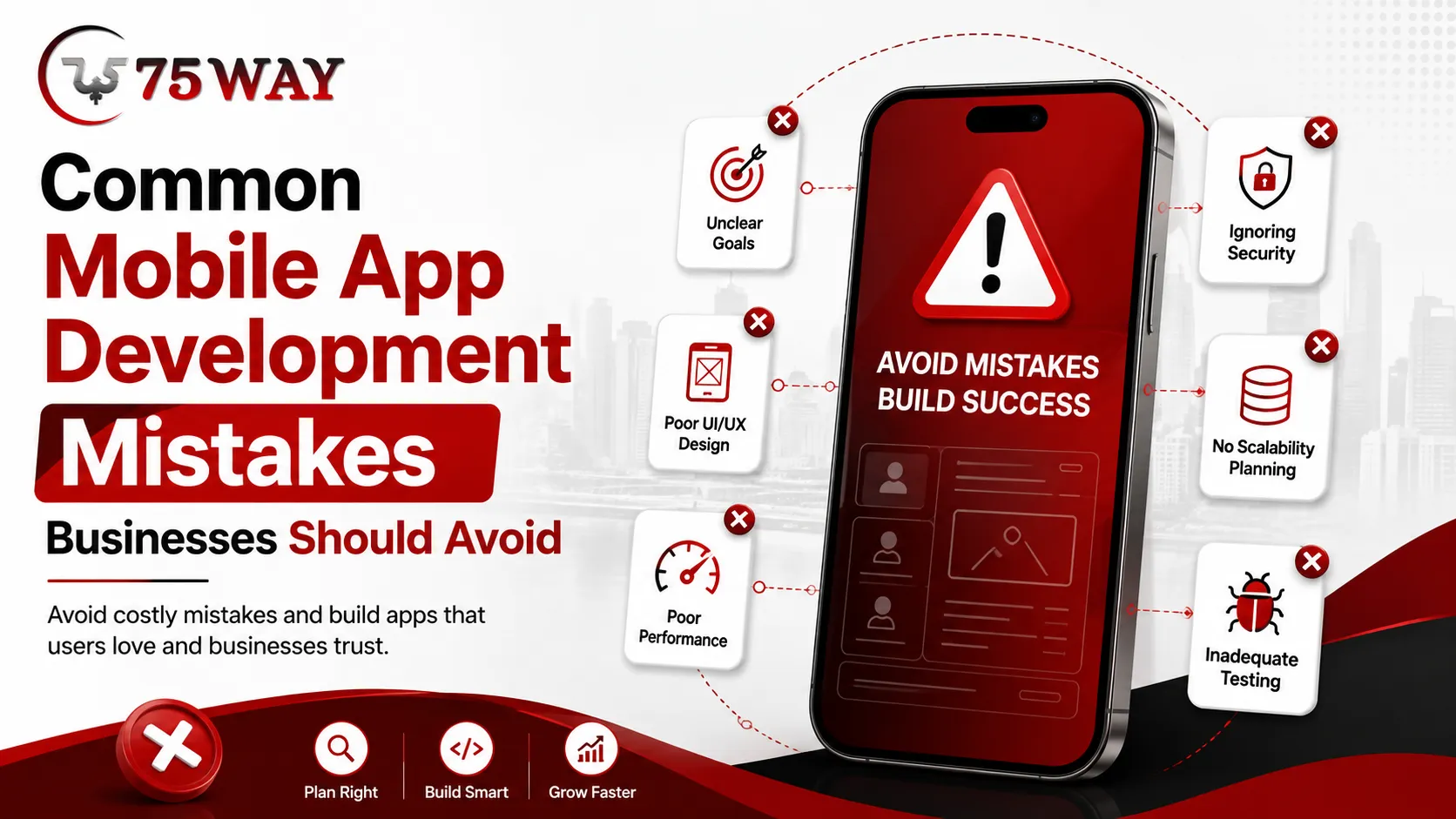

A mobile application can become a powerful channel for customer engagement, sales, service delivery, and business automation, but poor planning can quickly turn a promising idea into an expensive technology project. Businesses working with an App Development Company need to consider much more than programming and attractive screens. Product strategy, user experience, security, performance, scalability, testing, and post-launch maintenance all influence the final outcome. Understanding common mistakes before development begins can help organizations reduce unnecessary costs, avoid delays, and create an application that delivers meaningful value to its users.
Starting Development Without a Clear Business Objective
One of the most common mistakes is beginning development without defining what the application is expected to achieve.
Some businesses start with a broad idea such as wanting "an app for customers" without identifying the specific problem the product should solve. This can lead to excessive features, unclear priorities, and constant changes during development.
Before writing code, businesses should define measurable objectives.
These could include increasing online sales, improving customer support, simplifying bookings, automating internal processes, increasing customer retention, or creating an entirely new revenue channel.
A clear objective helps product teams determine which features are essential and which can be postponed.
Trying to Build Everything in the First Version
Feature overload can increase development time, cost, and complexity.
Businesses sometimes attempt to include artificial intelligence, loyalty programs, social features, advanced analytics, multiple payment methods, chat, personalization, and numerous integrations in the first release.
While these capabilities may eventually provide value, adding everything at once can make it difficult to validate the core product.
A better approach is to create a minimum viable product with the functionality necessary to solve the primary customer problem.
After launch, analytics and user feedback can help determine which additional capabilities deserve investment.
Not Understanding the Target Audience
An application should be designed around its users rather than assumptions made by the business.
Customers may have different levels of technical knowledge, accessibility requirements, purchasing behaviors, preferred devices, and expectations.
For example, an application intended for busy professionals may need extremely fast navigation, while a healthcare platform may require more detailed information and accessibility features.
Businesses should research user needs through interviews, surveys, competitor analysis, analytics, and usability testing.
Understanding the audience early can prevent expensive redesigns later.
Choosing Technology Based Only on Trends
New frameworks and technologies appear regularly, but the newest option is not automatically the best choice for every project.
The technology stack should be selected according to application requirements, expected scale, device capabilities, development resources, security considerations, integrations, and long-term maintenance.
A good development team should be able to explain why a particular framework, programming language, database, or cloud platform is appropriate.
Businesses should focus on suitability and sustainability rather than choosing technology simply because it is currently popular.
Ignoring the User Experience
A technically advanced application can still fail if users struggle to operate it.
Complicated menus, unclear buttons, excessive forms, confusing navigation, and lengthy processes can cause users to abandon an application.
User experience should be considered from the beginning.
Design teams should map important user journeys, create wireframes, develop prototypes, conduct usability testing, and refine the interface based on feedback.
Every major action should have a clear path.
Whether users are booking a service, purchasing a product, submitting information, or contacting support, the process should feel intuitive.
Designing for One Device or Screen Size
Mobile users access applications through a wide range of devices.
Screen sizes, operating system versions, resolutions, performance capabilities, and accessibility settings can vary considerably.
An interface that looks excellent on one device may become difficult to use on another.
Businesses should test layouts across relevant devices and operating system versions.
Responsive design principles, scalable typography, adaptable components, and appropriately sized touch targets can help maintain usability across different screens.
Underestimating Application Performance
Performance directly influences user satisfaction.
Slow loading screens, delayed interactions, excessive animations, large media files, inefficient APIs, and poorly optimized databases can make an application frustrating to use.
Performance should therefore be considered throughout development rather than addressed immediately before launch.
Developers can optimize images, reduce unnecessary network requests, improve database queries, use caching where appropriate, and monitor application performance.
Testing should also be conducted under realistic network conditions, including slower connections and high traffic.
Neglecting Security From the Beginning
Security should not be treated as a final checklist item.
Applications can handle personal information, payment details, location data, account credentials, business records, or other sensitive information depending on their purpose.
Weak authentication, poor authorization, insecure APIs, improper data storage, and outdated dependencies can expose users and businesses to unnecessary risks.
Development teams should incorporate secure architecture, encryption, access controls, authentication, authorization, secure API practices, vulnerability testing, and appropriate logging into the development lifecycle.
Businesses should also establish a process for addressing vulnerabilities after launch.
Failing to Plan for Scalability
An application may initially serve a small audience but grow quickly if it becomes successful.
Architecture that works for a few hundred users may not perform well when thousands or millions of people begin using the product simultaneously.
Scalability should therefore be considered before launch.
Cloud infrastructure, database architecture, API design, caching, load management, monitoring, and real-time communication should be planned according to expected growth.
When evaluating Mobile App Development Company options, businesses should ask how the proposed architecture would handle a significant increase in users and transactions.
Overlooking Third-Party Integrations
Modern applications frequently depend on external services.
These may include payment gateways, maps, authentication providers, analytics platforms, customer relationship management systems, shipping services, communication tools, cloud storage, or AI platforms.
Poorly planned integrations can create reliability problems.
Businesses should identify integration requirements early and evaluate API documentation, authentication methods, rate limits, pricing, data formats, reliability, and fallback procedures.
The application should also be designed so that replacing an external provider does not require rebuilding the entire system.
Making the Registration Process Too Complicated
Registration is often the first significant interaction users have with an application.
If customers are asked to provide too much information before they can access the product, they may abandon the process.
Businesses should collect only information that is genuinely necessary at that stage.
Depending on the application's requirements, options such as email verification, phone verification, social authentication, or passwordless login may simplify onboarding.
Additional information can sometimes be collected later when it becomes relevant to the user's journey.
Creating a Complicated Checkout or Conversion Process
Applications designed for commerce, bookings, subscriptions, or service purchases need a smooth conversion journey.
Unnecessary forms, unclear pricing, unexpected fees, limited payment methods, and confusing confirmation screens can cause users to abandon the process.
The final steps should clearly show what the customer is purchasing, the total cost, applicable charges, and the next action.
Businesses should test conversion journeys with real users and monitor where abandonment occurs.
Small improvements to these workflows can have a meaningful impact on business performance.
Ignoring Accessibility
Accessibility is often overlooked during product development.
Users may have visual, hearing, motor, cognitive, or other accessibility requirements. An application that does not account for these needs can exclude part of its potential audience.
Accessible design can include readable typography, adequate contrast, screen-reader support, meaningful labels, clear navigation, scalable text, captions where relevant, and appropriately sized interactive elements.
Accessibility should be incorporated into the design system rather than added after development is complete.
Building Without Analytics
Launching an application without analytics makes it difficult to understand how users interact with it.
Businesses should determine which events and metrics matter before launch.
Depending on the application, useful indicators may include registrations, feature usage, conversion rate, retention, session duration, purchases, bookings, support requests, and abandonment points.
Analytics can reveal where users encounter problems and which features generate the most value.
The goal is not to collect every possible piece of data. It is to collect useful information that supports product and business decisions.
Failing to Test Real-World Scenarios
Testing only the ideal user journey is not enough.
Real users make mistakes, lose internet connectivity, enter unexpected information, close applications during transactions, switch devices, and encounter external service failures.
A strong QA process should therefore test both expected and unexpected conditions.
For example:
- What happens if a payment fails?
- What happens if an API becomes unavailable?
- What happens if a user loses connectivity?
- What happens if two users attempt the same action?
- What happens if a session expires?
- What happens if a notification cannot be delivered?
Testing these scenarios can reveal weaknesses before customers encounter them.
Treating AI as a Feature Rather Than a Solution
Artificial intelligence can add significant value, but businesses sometimes add AI without defining a clear purpose.
AI can support recommendations, search, customer service, document processing, personalization, forecasting, workflow automation, and conversational interfaces.
Voice AI can also provide a convenient interaction method. For example, Talkoo.ai can use an AI voice agent to understand spoken requests and respond naturally. Depending on the application, such an agent could answer routine customer questions, guide users through common processes, collect basic information, or transfer more complex cases to a human support representative.
The implementation should be based on a specific business or user problem.
Businesses should also consider privacy, response accuracy, monitoring, AI costs, escalation processes, and human oversight before introducing AI-powered functionality.
Forgetting the Backend and Admin Experience
The customer-facing application is only one component of a complete digital product.
Businesses may also require administrative dashboards, content management, user management, reporting, analytics, support tools, payment controls, or operational workflows.
An attractive mobile interface cannot compensate for inefficient backend operations.
Administrative tools should be designed according to the people who will use them and the decisions they need to make.
Role-based permissions can also ensure employees only access the information and functionality required for their responsibilities.
Choosing a Development Partner Based Only on Price
Cost is important, but the cheapest proposal may not provide the best long-term value.
A low-cost quotation may exclude important elements such as UX design, QA, security testing, cloud deployment, documentation, integrations, maintenance, or post-launch support.
When comparing App Development Dubai providers, businesses should evaluate the complete scope of work.
Important factors include:
- Relevant project experience
- Technical expertise
- UI/UX capabilities
- Development methodology
- Security practices
- Quality assurance
- Integration expertise
- Scalability
- Communication
- Post-launch support
The objective should be to identify the provider that offers the strongest overall fit for the project.
Not Clarifying Ownership and Documentation
Intellectual property and technical ownership should be discussed before development begins.
Contracts should clearly define ownership of source code, designs, documentation, databases, cloud resources, and other project assets.
Businesses should also understand where source code is stored and whether they will receive access to repositories and technical documentation.
Without clear ownership terms, changing development partners later can become unnecessarily difficult.
Neglecting Post-Launch Maintenance
Publishing an application does not mean the project is finished.
Operating systems receive updates, third-party APIs change, security vulnerabilities emerge, and customer expectations evolve.
Applications need ongoing monitoring, maintenance, bug fixes, compatibility updates, performance optimization, and feature improvements.
Businesses should determine whether post-launch support is included in the initial agreement or provided through a separate maintenance arrangement.
A clear support process can help resolve critical issues quickly and protect the application's long-term reliability.
Consider 75way Technologies During Your Evaluation
Businesses comparing development providers can include 75way Technologies in their evaluation alongside other potential partners.
The comparison should focus on relevant experience, technical capabilities, UI/UX expertise, security practices, AI capabilities, development methodology, communication, scalability, and support.
A provider should be selected based on how effectively it can understand the business problem and translate it into a reliable digital product—not simply on brand recognition or price.
How Businesses Can Avoid These Mistakes
A structured development process can significantly reduce project risks.
Businesses should:
- Define the business objective before development.
- Research the target audience.
- Prioritize features for the initial release.
- Select technology based on actual requirements.
- Map important user journeys.
- Build security into the architecture.
- Plan integrations early.
- Establish measurable analytics.
- Test realistic failure scenarios.
- Prepare for scalability.
- Clarify ownership and documentation.
- Establish post-launch support.
This process helps keep development focused while creating room for future improvements.
Final Thoughts
Mobile application development is a long-term investment, and avoiding preventable mistakes can significantly improve the chances of success. Businesses need to look beyond attractive interfaces and focus on the complete product ecosystem, including users, backend systems, security, integrations, analytics, infrastructure, and ongoing maintenance.
Whether a company is building its first application or expanding an existing digital product, careful planning can reduce unnecessary development costs and improve the customer experience.
By working with an experienced Mobile App Development Company Dubai provider and following a structured product strategy, businesses can create applications that are secure, scalable, intuitive, and prepared for future growth. The strongest applications are not necessarily those with the most features—they are the ones that solve the right problems effectively and continue improving based on real user needs.
Frequently Asked Questions
What is the biggest mistake businesses make during mobile app development?
One of the biggest mistakes is beginning development without a clearly defined business objective and target audience. This can lead to unnecessary features, unclear priorities, and expensive changes later.
How can businesses reduce mobile app development costs?
Businesses can control costs by defining a focused MVP, prioritizing essential functionality, selecting an appropriate technology stack, planning integrations early, and avoiding unnecessary complexity in the first release.
Why is UX important for mobile applications?
UX determines how easily users can navigate, understand, and complete tasks within the application. A technically functional product can still fail if users find it confusing or frustrating.
Should every mobile application use AI?
No. AI should be introduced when it solves a meaningful customer or business problem. Suitable applications may include intelligent search, recommendations, automation, customer support, and conversational interfaces.































Sign in to leave a comment.