
Patio cleaning sounds simple: find a cleaner, apply it, rinse everything down, and enjoy the results.
In reality, patios are made from different materials, develop different types of staining, and respond differently to chemicals, pressure and treatments. Advice that works perfectly on a concrete patio could damage natural stone or affect porcelain paving.
That is why some of the most common patio-cleaning advice deserves a closer look.
Here are the myths worth ignoring and what you should actually know before cleaning your patio.
Myth 1: “Bleach Is Fine for Cleaning Any Patio”
Not necessarily.
Bleach can help with certain organic staining, but it isn't a universal solution for every paving material.
Natural stone, concrete, porcelain and other surfaces have different properties. Strong chemicals can affect the appearance of some materials, and runoff can also harm nearby plants or grass.
The important question isn't “Will bleach remove the stain?”
It is:
“Is bleach appropriate for this particular surface and stain?”
Before using a chemical cleaner, check the paving manufacturer's guidance where available. If you don't know what your paving is made from, testing a small, inconspicuous area is safer than treating the entire patio.
Myth 2: “Pressure Washing Always Damages Patio Joints”
Poor pressure washing can. Proper pressure washing doesn't have to.
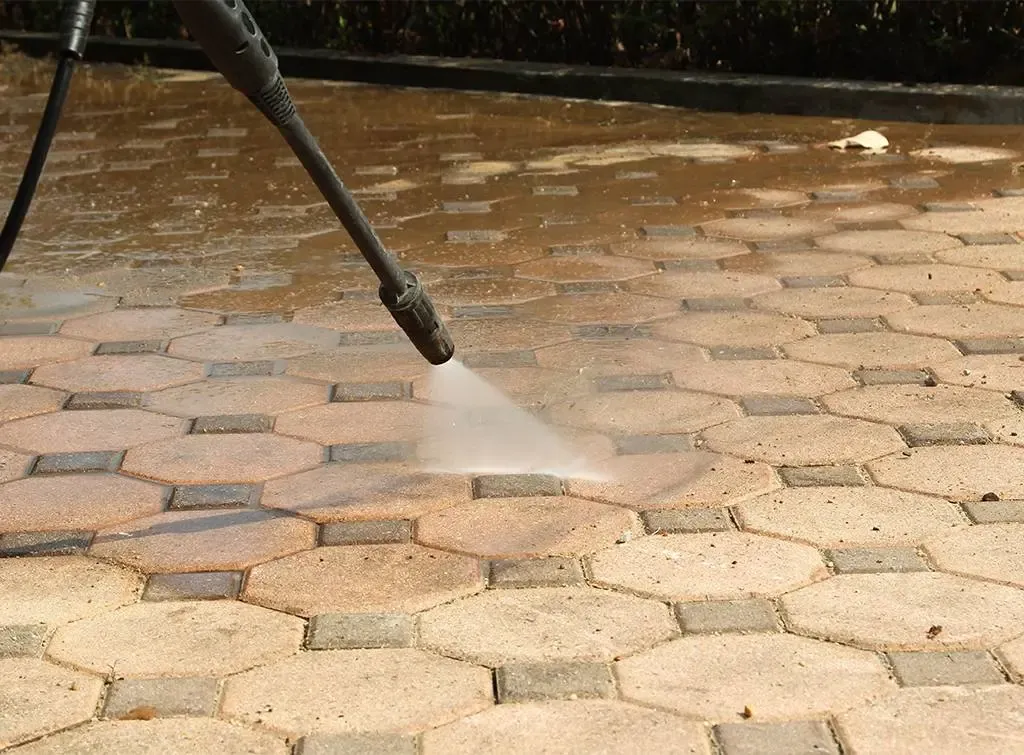
A pressure washer isn't automatically harmful to paving. The problem usually comes from using excessive pressure, holding the nozzle too close, choosing an unsuitable nozzle or directing the water incorrectly.
Jointing material can be disturbed when water is forced directly into joints at high pressure.
A careful approach uses the lowest effective pressure and considers the condition of the paving and joints.
If the joints are already loose, cracked or missing, pressure washing may make the problem more obvious. In that situation, repairing the joints may need to be part of the job rather than simply increasing cleaning pressure.
Myth 3: “The Stronger the Patio Cleaner, the Better the Result”
Strength isn't the same as effectiveness.
Different stains require different treatments.
Algae, moss, oil, rust, organic debris and general dirt don't respond to the same cleaning products. Using a stronger chemical than necessary can create additional problems without improving the result.
Experienced patio cleaning is less about finding the most aggressive product and more about identifying the type of contamination first.
For example, a biological growth problem may require a different treatment from an oil stain. Trying several increasingly strong chemicals without knowing what you're treating can damage the surface while leaving the underlying problem unresolved.
Myth 4: “Sealing Automatically Makes Stone Slippery”
A suitable sealer shouldn't automatically make a patio slippery.
This myth probably comes from glossy or poorly applied coatings that alter the surface finish.
Sealants vary considerably. Some are designed to penetrate the paving, while others create a more visible surface finish. The wrong product or too much product, can affect how a patio looks and behaves when wet.
Sealing also isn't automatically necessary after patio cleaning.
Before applying anything, consider:
- What is the paving material?
- Is it already sealed?
- What does the manufacturer recommend?
- What finish do you want?
- Will the patio regularly become wet?
A sealer should solve a specific problem or provide a specific benefit, not simply be applied because the cleaning is finished.
Myth 5: “More Pressure Means a Cleaner Patio”
Not quite.
High pressure can remove dirt quickly, but the objective isn't to use the highest setting available.
Excessive pressure can damage softer paving, remove jointing material, expose aggregates in concrete or create an uneven appearance.
Cleaning effectiveness depends on several factors:
Pressure + water flow + nozzle + distance + technique + appropriate treatment.
An experienced patio cleaner should adjust these factors according to the surface rather than treating every patio identically.
If a surface needs extreme pressure to become clean, it is worth asking whether the cleaning method is appropriate in the first place.
Myth 6: “Every Patio Can Be Cleaned the Same Way”
This is one of the most important myths to avoid.
Paving materials have different characteristics.
Porcelain is relatively non-porous and can require a different approach from porous natural stone. Sandstone, limestone and concrete can also differ in hardness, porosity and sensitivity to particular treatments.
Even two patios made from the same material may require different approaches because of age, weathering, previous repairs or existing sealants.
This matters particularly for patio tile cleaning. A method suitable for one type of tile shouldn't automatically be transferred to another.
When in doubt, identify the material before choosing the cleaning method.
Myth 7: “DIY Patio Cleaning Is Always Cheaper”
Sometimes it is. Sometimes it isn't.
For light dirt on durable paving, basic DIY cleaning may be all that's needed.
The costs and risks increase when the patio is heavily stained, delicate, large or already damaged.
A homeowner may need to buy or hire equipment, purchase cleaning products and spend considerable time learning how to use them. More importantly, an incorrect technique can create repair costs.
Common DIY mistakes include:
- Using excessive pressure
- Cleaning too close to the surface
- Applying unsuitable chemicals
- Failing to protect nearby plants
- Leaving cleaning solutions on the paving
- Removing jointing material
- Creating visible streaks or patches
DIY isn't inherently bad. It simply requires knowing the limitations of the equipment and the surface.
Myth 8: “If It Looks Clean, the Problem Is Solved”
A clean-looking patio isn't necessarily a properly maintained patio.
Visible dirt is only one part of the problem.
Algae and moss can establish themselves in damp areas and joints. Organic debris can also remain in corners and drainage points even when the main surface looks clean.
A good cleaning process should consider why the growth or staining occurred.
For example, a shaded patio with poor drainage may become dirty again much faster than a sunny, well-drained area.
Cleaning removes the current problem. Maintenance addresses the conditions that allow it to return.
Myth 9: “You Should Pressure Wash Your Patio Regularly”
Routine maintenance doesn't necessarily mean routine pressure washing.
Sweeping, removing leaves, dealing with spills promptly and keeping drainage areas clear can often reduce the need for aggressive cleaning.
Pressure washing every few weeks simply because the equipment is available isn't usually necessary.
Over-cleaning can also become counterproductive if the wrong technique repeatedly disturbs joints or wears the surface.
Think of pressure washing as a cleaning method, not a maintenance schedule.
Myth 10: “You Only Need Patio Cleaning in Spring”
Spring is convenient, but it isn't the only time patios need attention.
After autumn and winter, patios often have accumulated leaves, moisture-related growth and general grime, making spring a sensible time for a deeper clean.
However, leaving heavy growth untreated for months can make removal more difficult.
Simple year-round maintenance helps:
- Sweep regularly.
- Remove fallen leaves.
- Keep joints and drainage areas clear.
- Deal with spills quickly.
- Watch for early moss and algae growth.
The aim isn't to keep a patio spotless all year. It is to prevent small problems from becoming difficult ones.

What Should You Check Before Cleaning Your Patio?
Before choosing a product, pressure washer or contractor, ask five straightforward questions:
1. What is the patio made from?
Different materials tolerate different cleaning methods.
2. What exactly am I trying to remove?
Dirt, algae, moss, oil and rust aren't the same problem.
3. What condition are the joints in?
Loose or damaged joints may require attention before cleaning.
4. Has the patio been sealed before?
Existing treatments can affect cleaning and determine what can safely be applied afterwards.
5. Is the proposed method appropriate for the surface?
If someone recommends maximum pressure or a strong chemical without first considering the paving, ask why.
The Bottom Line
The biggest patio-cleaning myth is that there is one method that works for everything.
There isn't.
Effective Patio Cleaning is about matching the treatment to the material, the condition of the surface and the type of contamination. Sometimes that means pressure washing. Sometimes it means a gentler cleaning method. Sometimes the best solution is simply regular maintenance.
If you're considering patio cleaning services, don't judge the approach solely by how powerful the equipment looks. Ask what will be used, why it is suitable for your paving and how the joints and surrounding areas will be protected.
A good professional patio cleaner should be able to explain the process clearly and, just as importantly, tell you when a particular treatment isn't necessary.
That is usually a much better sign of expertise than simply promising the cleanest-looking patio possible.


























Sign in to leave a comment.