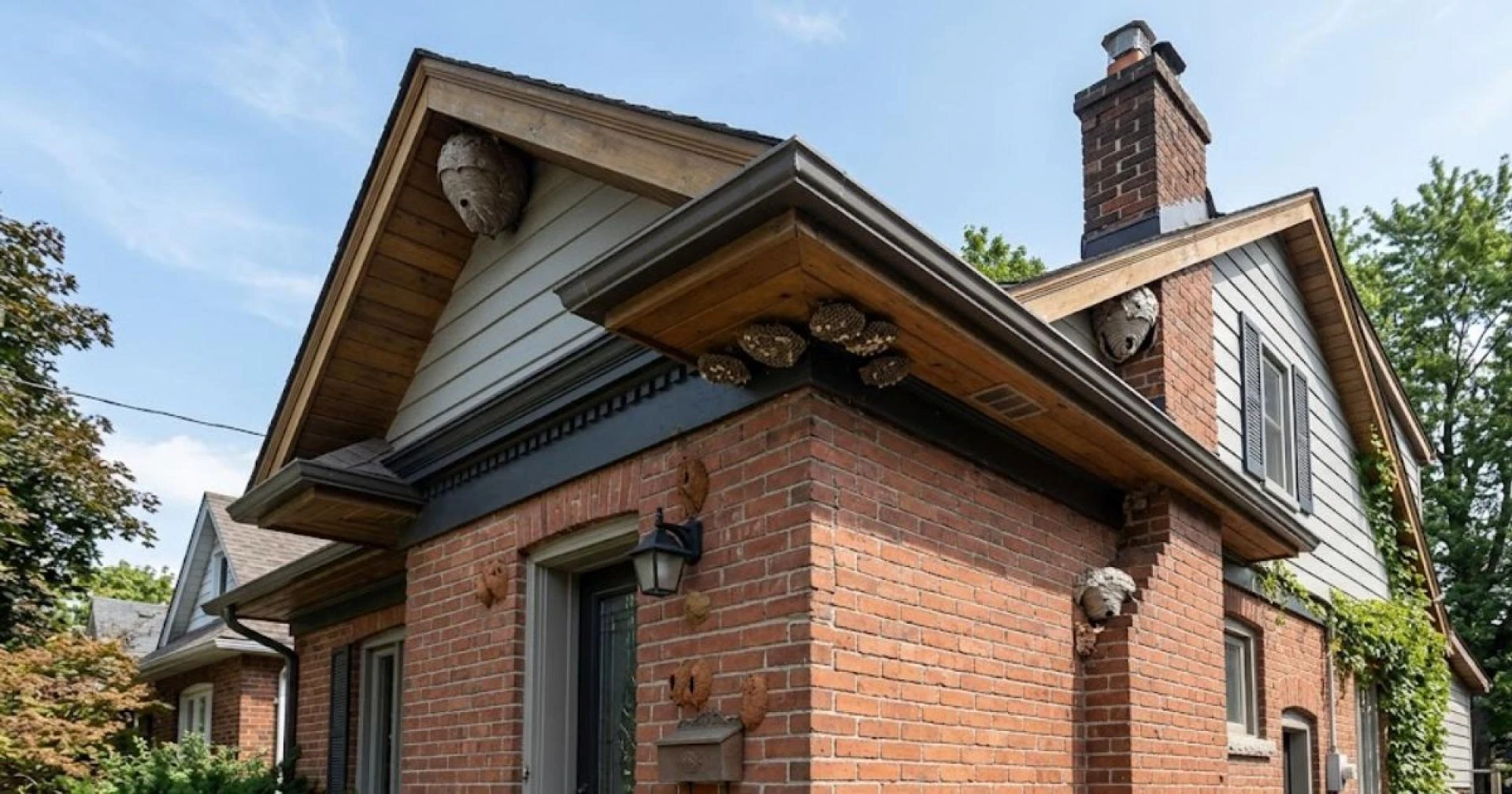

Wasps don't pick random spots. They scout your home like a contractor checking square footage. Queen wasps emerge every spring season and target warm, sheltered zones. Nesting sites follow a pattern we've tracked across hundreds of residential properties. Roof overhangs, wall voids, and deck frames are top picks for colony establishment. Spotting wasps near your roofline usually means a pest control problem is already growing inside a structural gap nearby.
Why Wasp Nest Location Determines Your Risk Level
What the Nest Location Tells You About the Species Inside
The nest location is your first clue. Over years of handling wasp removal calls across Toronto, ON, we've learned that nest architecture tells the story before you even spot the wasp. An enclosed nest tucked inside a wall void almost always points to Yellowjackets. Spot an open comb nest hanging under an eave like an upside down umbrella, and you're almost certainly looking at Paper Wasps. This location to species shortcut cuts out guesswork fast.
Getting the species identification right changes everything about your next move. Bald Faced Hornets build large grey enclosed nests high up in trees or on building overhangs their territorial defense is sharp and fast. Mud Daubers, on the other hand, pack mud tubes onto walls or ceilings and rarely sting unless grabbed. Misreading the nest type triggers the wrong response, and that's where DIY removal goes wrong. Knowing the nest shape and spot gives you an aggression behavior profile before you take a single step closer.
Structural, Electrical, and Sting Risks Vary by Zone
A wasp nest inside a wall cavity does more than sting. It quietly causes insulation damage, holds moisture, and in Toronto homes with older wiring, it creates a real fire hazard. We have personally removed nests built directly against electrical wiring in wall voids; the chewed material and nest mass sitting on live wires is a genuine ignition risk.
Sting exposure rises near entries and eaves, structural damage and moisture damage build silently inside walls, and mold growth follows water trapped by a soaked nest mass. Electrical wiring contact turns a pest issue into a fire hazard fast. Property liability in Toronto grows the longer a nest stays. Each zone carries a different risk sting, property, or fire and each needs a different response.
Where Eaves Meet Fascia Boards The Gap Wasps Love Most
Paper wasps and other social wasps don't just pick any spot. They target the exact junction where fascia boards connect to soffit panels. That seam traps heat, blocks wind, and gives wasps a dry sheltered surface to anchor nest attachment points. We've inspected Toronto homes where wood rot at that junction had quietly opened a path straight into the wall system no one noticed until the colony was already inside.
Wood fiber softened by moisture lets wasps chew through and carry saliva pulp inside to build an umbrella nest deep in the structure. What starts as a small grey cone under a roof overhang can migrate inward fast. That inside out pathway is exactly why a roofline check needs to go beyond just looking up.
Wall Voids, Siding Gaps, and Utility Entry Points
Yellowjackets pick entry points that nobody checks. Weep holes in brick veneer sit low on the wall and stay open year round. Vinyl siding pulls away at corners and bottom edges over time. We have found fully enclosed colonies behind siding on Toronto homes where the owners had zero idea wasps were even inside.
Utility conduits, plumbing penetrations, and electrical conduit gaps leave small open spaces around pipes and cables. Wall voids fill slowly and silently by the time you notice indoor wasp emergence, the nest is already large.
Attic Spaces, Soffits, and Chimney Structures
Soffit Voids Versus Attic Interiors Two Very Different Risk Profiles
A soffit void nest sits close to the exterior. It stays accessible, and with the right product and timing, DIY treatment is often a real option. An attic interior nest is a completely different problem. Once wasps build deep inside a rafter space or touch the insulation contact zone, that space traps heat, sound, and defensive energy all at once.
We have walked Toronto attics where a nest sat buried in blown insulation totally inaccessible without disturbing the colony first. Colony containment becomes nearly impossible in a sealed attic with no exit route. Professional treatment handles inaccessible nest situations because the enclosed space turns a routine job into a serious sting risk. Treating a soffit void and an attic interior as the same mistake costs people badly.
Chimney Caps, Mortar Gaps, and the Indoor Displacement Hazard
Cracked mortar joints and a missing chimney cap give wasps a direct path inside. Once a nest forms near the flue gap, lighting the fireplace forces smoke pressure downward. That pressure pushes wasps straight into your living space through the fireplace opening. We have responded to exactly this scenario in Toronto homes; it is a real emergency, not a rare one.
Masonry gaps also collect moisture and weaken mortar joints faster each winter. A proper chimney inspection catches nest activity before the indoor wasp entry risk turns dangerous. Skipping it also raises displacement risk when the heating season starts. Treat chimney inspection as pest prevention, not just home maintenance.
Shutters, Exterior Trim, and Decorative Architectural Features
How Mounting Gap Depth Predicts Nest Risk Behind Shutters
Most Toronto homeowners never check behind their shutters. That air gap between the shutter and siding looks harmless, but cavity depth tells a different story. A non flush mounting with a one inch or greater standoff gives a queen exactly the queen shelter she needs to start a colony. We have pulled mature nests from behind decorative millwork where the mounting bracket gap measured just over an inch wide.
Nest initiation happens fast inside a siding recess that stays warm and hidden. The real problem is nest discovery delay by the time you notice, the colony has reached colony maturity. Older Toronto homes with decorative trim and wide shutter hardware standoffs are the most common spots we find this. A half inch gap usually stops queens. Anything deeper than that invites trouble straight away.
Light Fixture Backings, Mailbox Mounts, and Address Sign Brackets
A small nest near your front door exterior light fixture causes more stings than a large nest in your yard. The fixture backing cavity sits right where people walk, open doors, and grab mail daily. Nocturnal foraging wasps near porch lights get triggered every single time the door opens at night. We have found active nests tucked behind mailbox mount brackets on Toronto homes, disturbed three or more times daily without the homeowner knowing.
That hardware gap behind an address sign or wall bracket gives wasps a sheltered, hidden start point. Colony proximity to entry is what makes these spots dangerous, not colony size. The entry gap stays small, so most people never spot it. Insect attraction near lit entry points adds to the risk lights draw wasps in, and the mailbox mount or sign bracket gives them a reason to stay.
Why Choose Pestiseed Pest Control for Wasp Nest Removal in Toronto
Pestiseed Pest Control handles wasp nest removal across all Toronto neighbourhoods as a full home safety check, not just a single point fix. From residential properties, we start with species identification, read the aggression profile, and map the nest architecture before touching anything. Entry points hide inside wall voids, soffit voids, attic interiors, chimney caps, and mortar gaps spots most companies skip. Wasps chewing through electrical wiring create a real fire hazard, while trapped moisture causes insulation damage, moisture damage, mold growth, and serious property liability. Indoor displacement colonies show up near porch light fixtures and mailbox brackets too. Colony containment near sting exposure zones demands careful professional treatment and that's exactly what Pestiseed Pest Control delivers across every structural gap in Toronto.
Ready to Protect Your Home? Call Pestiseed Pest Control Today
Toronto homeowners face real sting risk every season, and Pestiseed Pest Control is the trusted local company built to stop it fast. Our licensed pest technicians cover indoor and outdoor zones, handling wasp nest removal and full residential pest control with a safe removal guarantee across all Toronto neighbourhoods. One call triggers a same day inspection, a free assessment, and emergency pest response handled by local pest experts who know exactly where a wasp colony hides and what structural damage it causes. Certified treatment and eco friendly treatment protect your entire property, while our fast response time and service booking make property safety simple. Call today and let family safety drive every decision toward a true pest free home built on real home protection.























Sign in to leave a comment.