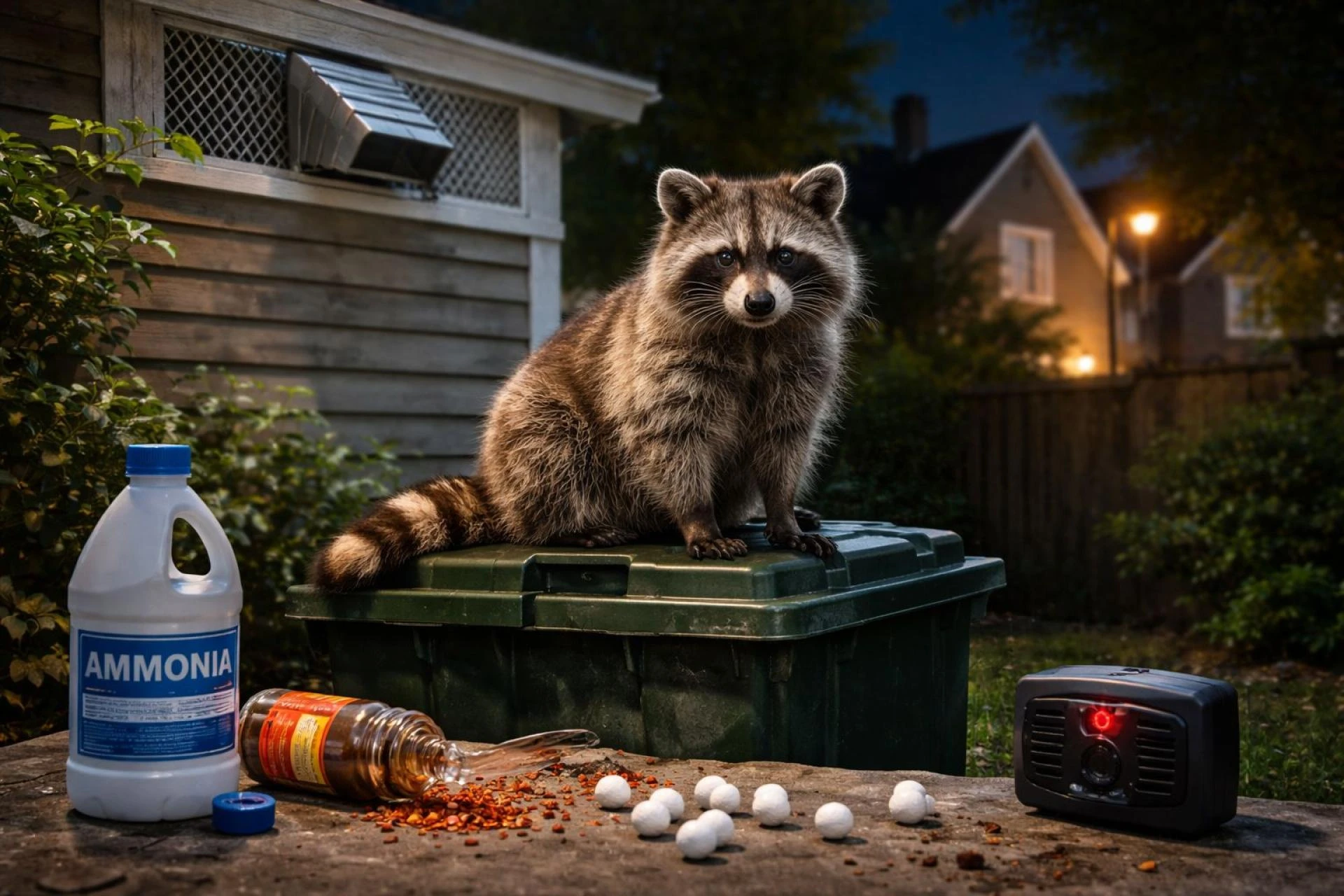

Urban raccoons are not scared of you because they grew up next to you in the city. That is why every home remedy in your cupboard is about to fail completely today. Raccoons in urban neighborhoods behave differently than rural animals living in forests and fields. They are food conditioned, comfortable and adapted to ignore every scare tactic around. Your grandmother's ammonia trick and cayenne pepper myths don't work in modern cities at all.
We have watched homeowners spend one hundred fifty dollars yearly on repellents that accomplish nothing. Urban raccoons keep coming back because they learned to ignore smells and sounds within days. This is a waste of money that we see across hundreds of GTA properties every single year. Based on professional wildlife control data, only physical barriers actually stop these smart city animals. The science behind why each remedy fails explains what really works instead of wasting more cash.
The Science Behind Why Raccoon Repellents Fail
How Raccoon Intelligence Defeats Scent and Sound Deterrents
Raccoon brains contain 438-512 million neurons which makes them smarter than most cats today. Their scent receptors 5x human capability lets them detect and analyze odors not just smell them. Intelligence drives a cognitive loop where the raccoon investigates the repellents and then determines that no real threat exists. Learning and adaptation mean the animal comes back anyway after figuring it out within hours.
We have watched repellents fail because urban raccoon populations habituate to smells in three to five encounters. Scent deterrents break down from rain, wind, and UV light, needing reapplication every day or two. The animal is not scared because repeated exposure creates complete behavioral normalization quickly over time. Professional trappers confirm intelligent animals outsmart odors by removing them or working around obstacles instead. Habituated responses mean your spray is boring noise to city wildlife that solved humans before.
Why Urban Raccoons Behave Differently Than Rural Ones
Urban raccoons are not wild animals visiting your city at all today. They are city raccoons that grew up near people and never knew anything else in life. Toronto has 100,000+ raccoons living across the city with ten to twenty five per square kilometer. Food conditioned animals learn garbage schedules, restaurant dumpster timing and garden harvest cycles perfectly each week.
Human exposure makes urban raccoons bolder, larger and healthier than their rural cousins living in forests. Behavior and adaptation show these urban animals are different from wild raccoons in every measurable way. Human habituated raccoon populations reproduce faster because garbage dependency provides steady year round nutrition easily. Population density means one homeowner's deterrent fails when fifty raccoons share the same block. Every deterrent designed for rural wildlife fails against animals that evolved IN your neighborhoods completely.
Home Remedies That Never Work Against Raccoons
Why Ammonia Mothballs and Cayenne Pepper Always Fail
Does ammonia work against raccoons? No because ammonia smells like urine and triggers investigation not flight. The animal approaches to check for a territorial rival then returns within hours after finding nothing. Ammonia also creates toxic fumes that become a health hazard for your family and pets indoors. We have seen this scent repellent fail hundreds of times across GTA properties over many years.
Do mothballs work any better? Mothballs contain naphthalene which is dangerous to humans and pets in enclosed spaces. Outdoors the scent disperses within twenty four hours making reapplication required constantly for any effect. The hot pepper trick using cayenne pepper seems clever but wash off in rain within one storm cycle. Cayenne pepper fails because raccoons learn to approach from upwind after two or three visits easily. All three share the same temporary fate with annoyance disappearing in one to three days completely. Homeowners spend one hundred fifty dollars yearly on these myth products for zero lasting results at all.
Why Predator Urine and Sonic Devices Waste Your Money
Does predator urine work to scare raccoons away from your property? Coyote urine and other predator urine products actually create a backfire effect we see constantly in the field. Raccoons smell the urine and investigate the source to check for a real coyote nearby instead. After confirming no lasting impact from an actual predator, they return and ignore it permanently forever.
Do sonic repellers work better than scent products? Sonic devices costing $50-$180 emit ultrasonic frequency sounds that raccoons become habituated to within three to five days. Electronic repeller products have little scientific evidence of lasting success against urban wildlife anywhere. Will raccoons avoid human hair? This myth fails because urban raccoons live surrounded by human scent constantly. Human hair might spook a rural animal but city wildlife is human habituated with zero fear response. Ultrasonic products and predator urine are a waste of money designed for animals that fear humans.
Physical Exclusion: Raccoons Cannot Outsmart
What Actually Stops Raccoons Permanently
Exclusion is the only method that actually works against raccoons every single time. Repellents target senses but physical barriers can't adapt to by any animal no matter how smart. You cannot outsmart a wall and that is the paradigm shift we teach homeowners daily. Steel mesh and hardware cloth 1/2 inch gauge create permanent barriers that block all entry points completely.
We use one way door devices that let raccoons exit voluntarily but prevent re-entry after leaving. Sealing with exclusion materials stops animals at roof vents soffits fascia and chimneys effectively. Spray foam gets torn through in hours so we never recommend it for wildlife control purposes. Hardware cloth and metal flashing are the only deterrents rated permanent by wildlife professionals everywhere.
Removing What Draws Raccoons In
Habitat modification works as the perfect complement to exclusion for complete property protection always. Remove what draws them by eliminating attractants like unsecured garbage and outdoor pet food bowls. Stop feeding them accidentally and you make your yard unappealing to wildlife searching for easy meals.
Raccoons dig lawns for grubs so grub treatment eliminates the digging reason within two weeks. Wildlife proof bins and bird feeder guards stop food sources that keep raccoons visiting your property nightly. Habitat modification combined with exclusion creates the professional standard known as the IPM framework today. We have tracked this approach and raccoon visits drop sixty to eighty percent within two weeks.
Stop Wasting Money on Repellents That Raccoons Ignore
Every dollar spent on ammonia, cayenne pepper, and sonic devices accomplishes nothing against smart urban raccoons. One professional assessment costs less than one year of failed home remedies you keep buying. Get a property vulnerability assessment today from Pestiseed Pest Control. We seal entry points, permanently remove raccoons humanely and keep them gone for good across the GTA.
























Sign in to leave a comment.