
As voice-enabled technologies continue to evolve, businesses are increasingly relying on accurate audio datasets to train artificial intelligence systems. From virtual assistants and speech recognition tools to customer service automation and healthcare voice monitoring, high-quality annotated audio data is essential for reliable AI performance. However, maintaining quality standards in audio annotation remains one of the biggest challenges for organizations developing speech-based AI models.
As a trusted Annotera, we understand that even minor inconsistencies in annotation can significantly affect model accuracy. This is why quality control plays a critical role in every stage of the annotation process. In this article, we explore the most common quality control challenges in audio annotation and how businesses can overcome them through effective processes, expert annotators, and advanced validation strategies.
Understanding Audio Annotation Quality Control
Audio annotation involves labeling speech, sounds, speaker identities, emotions, pauses, background noise, and other audio elements to help machine learning systems understand and interpret sound accurately. Quality control ensures that these annotations remain consistent, accurate, and aligned with project guidelines.
For any professional data annotation company, maintaining annotation quality is essential because poor-quality datasets lead to unreliable AI models, reduced speech recognition accuracy, and increased retraining costs.
Despite technological advancements, audio annotation still faces multiple quality-related challenges due to the complexity of human speech and environmental audio variations.
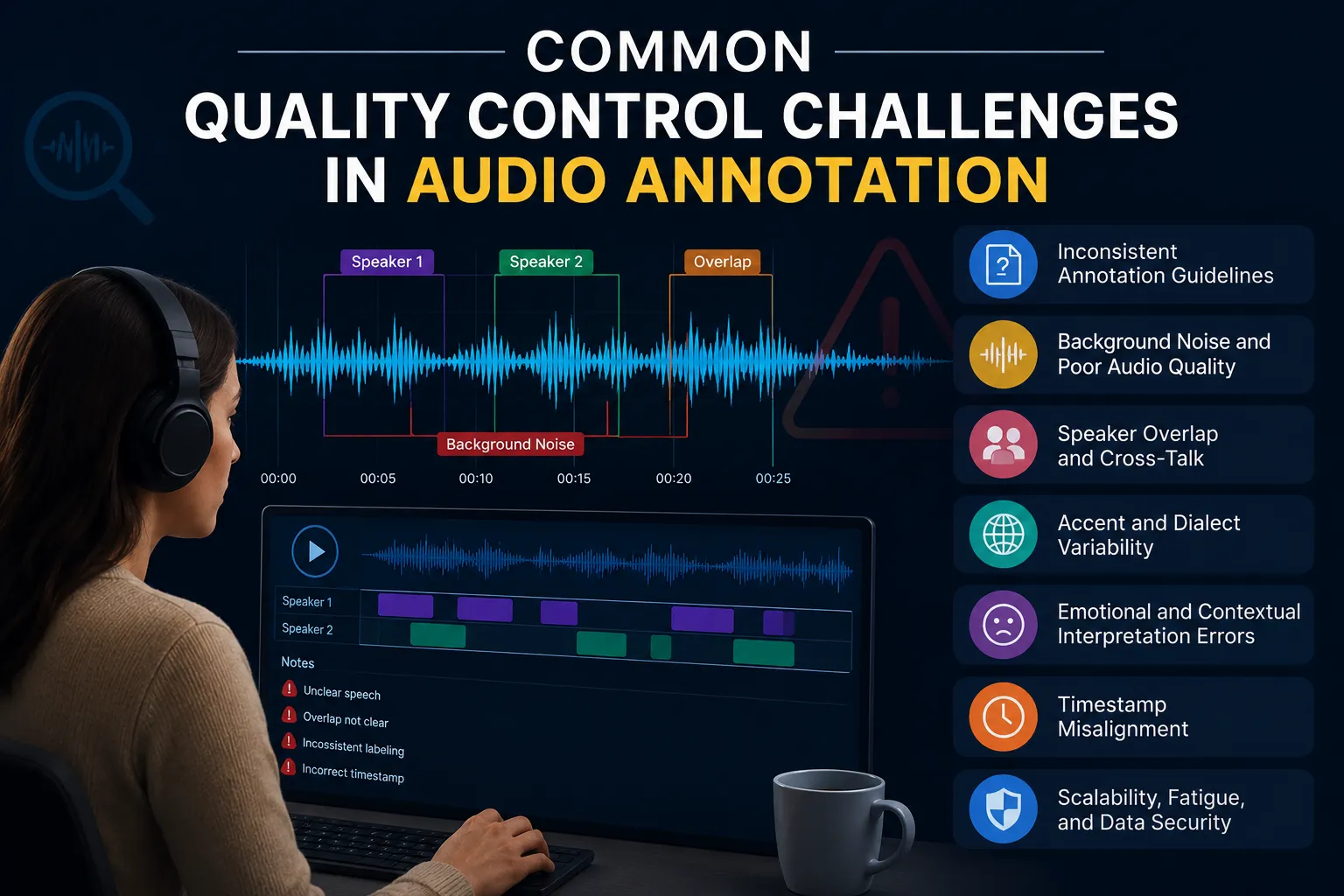
Inconsistent Annotation Guidelines
One of the most common quality control issues in audio annotation is inconsistent interpretation of labeling guidelines. When annotators misunderstand instructions or apply them differently, datasets become fragmented and unreliable.
For example, one annotator may classify overlapping speech differently from another. Similarly, interpretations of pauses, filler words, or emotional tone may vary between team members.
This inconsistency often occurs when annotation guidelines are vague, overly technical, or insufficiently detailed. Without standardized protocols, annotation accuracy declines rapidly.
Professional teams providing audio annotation outsourcing services address this challenge by creating highly detailed annotation manuals, conducting calibration sessions, and continuously updating instructions based on edge cases identified during projects.
Background Noise and Poor Audio Quality
Audio recordings frequently contain environmental disturbances such as traffic sounds, crowd conversations, microphone distortion, echoes, and static interference. These background noises make it difficult for annotators to accurately identify speech components.
Poor audio quality becomes even more problematic when AI models require speaker diarization, emotion detection, or multilingual transcription. Annotators may struggle to distinguish words, accents, or speaker transitions in noisy recordings.
A reliable audio annotation company uses advanced preprocessing techniques, noise reduction tools, and multi-level quality checks to improve annotation accuracy in difficult audio environments.
Additionally, experienced annotators are trained to identify contextual cues that help interpret distorted or partially inaudible speech.
Speaker Overlap and Cross-Talk
In real-world audio datasets, multiple speakers often talk simultaneously. Overlapping conversations are common in call center recordings, meetings, podcasts, and social interactions. This creates major annotation difficulties because distinguishing speaker boundaries becomes extremely complex.
Cross-talk can lead to:
- Incorrect speaker labeling
- Misidentified timestamps
- Partial transcription errors
- Incomplete emotional tagging
Without proper segmentation strategies, AI systems trained on such data may fail to separate speakers accurately in live applications.
Companies specializing in data annotation outsourcing typically implement multi-pass validation workflows where separate reviewers verify speaker segmentation and transcription alignment before final dataset approval.
Accent and Dialect Variability
Human speech differs significantly across regions, cultures, and languages. Accents, dialects, pronunciation styles, and local vocabulary often create substantial challenges for annotation teams.
For example, English spoken in India, the United States, Australia, and the United Kingdom contains pronunciation differences that may confuse inexperienced annotators. Similarly, regional slang and mixed-language speech patterns further complicate transcription accuracy.
AI systems trained on poorly annotated accented speech may perform poorly in global deployments.
To overcome this issue, experienced annotation providers employ linguistically diverse teams with native language expertise. A professional data annotation company also uses region-specific quality reviewers to ensure cultural and linguistic consistency throughout the project lifecycle.
Emotional and Contextual Interpretation Errors
Modern AI applications increasingly rely on emotional intelligence capabilities. Voice assistants, healthcare monitoring tools, and customer service analytics platforms often require annotations related to sentiment, emotion, stress levels, or intent.
However, emotional interpretation is highly subjective.
Annotators may disagree on whether a speaker sounds frustrated, excited, sarcastic, or neutral. Contextual ambiguity further increases annotation inconsistencies.
For example, identical phrases may convey completely different meanings depending on tone, pacing, or conversation context.
Leading providers of audio annotation outsourcing solve this challenge through consensus-based annotation systems where multiple annotators review emotionally sensitive recordings before final labeling decisions are made.
Timestamp Misalignment
Accurate timestamping is essential for training speech recognition and audio-event detection systems. Even small synchronization errors can negatively impact machine learning model performance.
Timestamp misalignment usually occurs due to:
- Fast speech patterns
- Overlapping words
- Delayed annotator reactions
- Complex background audio
Incorrect timestamps reduce the effectiveness of keyword spotting, speech segmentation, and conversational AI systems.
To maintain precision, experienced annotation teams use waveform visualization tools and automated synchronization support systems that allow frame-level timestamp verification.
An established audio annotation company also performs secondary timestamp audits to identify discrepancies before dataset delivery.
Scalability and Workforce Management
As AI adoption grows, organizations require increasingly large audio datasets. Scaling annotation operations while maintaining consistent quality becomes a major operational challenge.
Large projects often involve hundreds of annotators working simultaneously across multiple languages and domains. Without proper coordination, quality variations become unavoidable.
Some common scalability issues include:
- Inconsistent reviewer standards
- Uneven annotator skill levels
- Reduced oversight in high-volume projects
- Delayed feedback loops
Professional providers offering data annotation outsourcing address scalability challenges through structured quality assurance frameworks, layered review systems, and continuous workforce training programs.
Project managers also monitor annotator performance metrics to identify recurring quality issues early.
Data Privacy and Security Risks
Many audio annotation projects involve sensitive information, including healthcare conversations, financial records, customer support interactions, and legal communications. Quality control is not limited to annotation accuracy alone; it also includes secure data handling practices.
Security lapses can compromise compliance requirements and damage client trust.
Reliable annotation partners implement:
- Secure data transfer protocols
- Restricted access environments
- NDA-protected annotation teams
- GDPR and HIPAA compliance measures
- Encrypted storage systems
A trusted audio annotation company combines strong security standards with rigorous quality management processes to ensure both accuracy and confidentiality.
Human Fatigue and Annotation Burnout
Audio annotation is highly detail-oriented and mentally demanding. Annotators often spend long hours reviewing repetitive recordings, leading to fatigue-related errors.
Common burnout-related quality issues include:
- Missed speech segments
- Incorrect speaker labels
- Reduced concentration
- Inconsistent emotional tagging
- Timestamp inaccuracies
Fatigue becomes particularly problematic in large-scale transcription and multilingual annotation projects.
To minimize human error, experienced providers use rotational work schedules, shorter annotation cycles, and automated quality monitoring systems that flag potential inconsistencies for reviewer verification.
The Role of AI-Assisted Quality Control
Many modern annotation workflows now incorporate AI-assisted quality assurance tools. These systems help identify anomalies, detect missing labels, and highlight inconsistent annotations automatically.
AI-powered validation tools can improve:
- Transcription consistency
- Timestamp alignment
- Speaker segmentation
- Annotation speed
- Error detection rates
However, automation alone cannot fully replace human expertise. Human reviewers remain essential for contextual understanding, emotional interpretation, and complex linguistic analysis.
At Annotera, we combine skilled human annotators with advanced quality control technologies to deliver accurate, scalable, and reliable audio datasets for AI development.
Why Quality Control Matters in Audio Annotation
Poor annotation quality directly impacts AI model performance. Inaccurate datasets can lead to:
- Reduced speech recognition accuracy
- Higher false-positive detection rates
- Ineffective conversational AI responses
- Poor multilingual support
- Increased retraining costs
Strong quality assurance practices ensure that AI systems perform effectively across diverse real-world environments.
Organizations seeking dependable annotation outcomes should partner with an experienced data annotation company that prioritizes precision, consistency, scalability, and security throughout the annotation lifecycle.
Conclusion
Audio annotation is a foundational component of modern speech AI systems, but maintaining annotation quality presents numerous challenges. From noisy audio and overlapping conversations to dialect diversity and emotional interpretation, every stage of the annotation workflow requires careful quality management.
Businesses investing in AI voice technologies must prioritize accurate annotation processes to ensure reliable model performance. Partnering with a trusted audio annotation outsourcing provider can help organizations overcome quality control obstacles while accelerating dataset development efficiently and securely.
As an experienced Annotera, we deliver high-quality audio annotation solutions designed to support advanced AI applications across industries. Our expert-driven quality assurance processes help businesses build accurate, scalable, and future-ready speech recognition systems.


























Sign in to leave a comment.