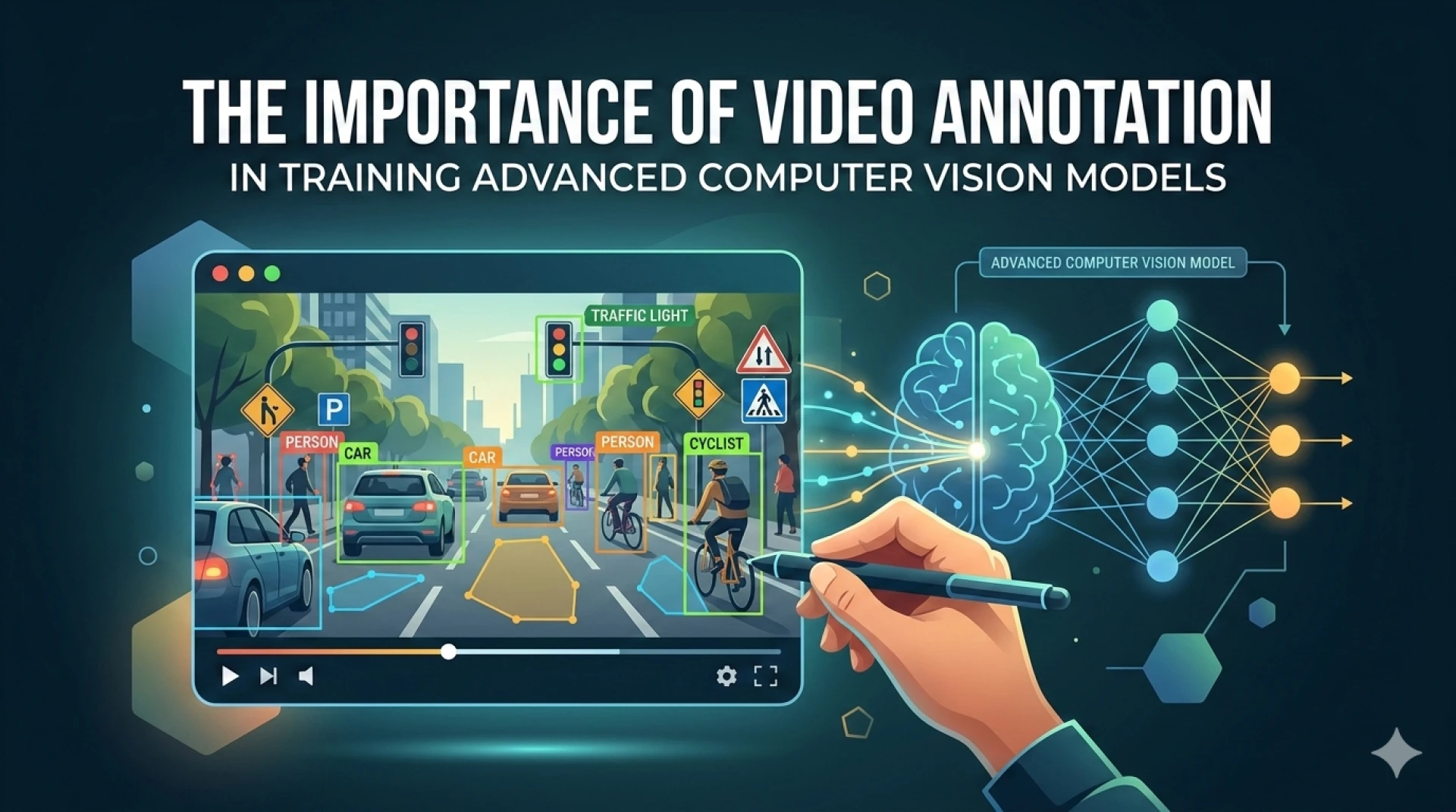

Artificial Intelligence (AI) and computer vision technologies are transforming industries such as autonomous driving, healthcare, retail, security, and smart cities. At the core of these advancements lies high-quality training data. For computer vision systems to accurately interpret dynamic environments, they require precisely labeled video datasets. This is where video annotation plays a crucial role.
Video annotation involves labeling objects, actions, and events within video frames so machine learning models can learn to recognize patterns and behaviors. Without properly annotated video data, even the most advanced algorithms struggle to understand real-world scenarios. As organizations increasingly rely on AI-driven automation, the demand for specialized annotation services has grown rapidly, prompting businesses to collaborate with a professional data annotation company to ensure quality and scalability.
This article explores the importance of video annotation, its role in developing advanced computer vision models, and why many organizations choose data annotation outsourcing to accelerate AI innovation.
Understanding Video Annotation
Video annotation is the process of labeling objects, movements, and contextual information within a sequence of video frames. Unlike static image annotation, video annotation involves tracking objects across multiple frames while maintaining spatial and temporal accuracy.
Common annotation techniques used in video datasets include:
- Bounding boxes for identifying objects such as vehicles, pedestrians, or animals
- Polygon annotation for outlining irregular shapes and complex objects
- Semantic segmentation for labeling every pixel within a frame
- Object tracking to follow the movement of objects across frames
- Action recognition to identify human or object activities within videos
These annotations allow machine learning models to learn how objects move, interact, and evolve over time. A specialized video annotation company ensures that the labeling process maintains frame-to-frame consistency, which is essential for training reliable computer vision systems.
Why Video Annotation Matters for Computer Vision
Computer vision models rely heavily on large volumes of annotated data to learn effectively. Video annotation provides the temporal context necessary for machines to understand real-world scenarios beyond static imagery.
1. Capturing Temporal Information
Videos contain sequences of frames that capture motion and changes over time. Annotating these frames allows AI systems to learn patterns such as object movement, behavior, and interactions.
For example, in autonomous driving systems, it is not enough to identify a pedestrian in a single frame. The system must understand how the pedestrian moves across frames to predict future motion and ensure safe navigation.
Video annotation enables machine learning models to analyze motion patterns, which significantly improves prediction accuracy.
2. Improving Object Tracking Accuracy
Object tracking is a key component of many computer vision applications. In surveillance, traffic monitoring, or robotics, systems must follow objects across multiple frames.
Through precise annotation of object trajectories, AI models learn how objects move in dynamic environments. A professional video annotation company ensures consistent object identification across frames, which reduces training errors and improves model reliability.
3. Enabling Action and Event Recognition
Beyond identifying objects, computer vision models often need to understand actions and behaviors. Video annotation helps machines recognize activities such as walking, running, falling, or interacting with objects.
This capability is particularly important in sectors like:
- Healthcare, where AI systems monitor patient movement and detect falls
- Retail, where behavior analysis helps optimize store layouts
- Security, where systems detect suspicious activities in surveillance footage
Annotated video datasets provide the contextual information needed for models to interpret complex actions and events.
4. Supporting Autonomous Systems
Autonomous systems such as self-driving cars, drones, and delivery robots rely heavily on video data to navigate real-world environments.
Video annotation helps these systems identify:
- Road lanes and traffic signals
- Pedestrians and cyclists
- Other vehicles and obstacles
- Environmental conditions such as rain or fog
High-quality annotation ensures that AI models can safely interpret surroundings and make informed decisions in real time. Many organizations rely on data annotation outsourcing to handle the massive volumes of video data required for training autonomous technologies.
Challenges in Video Annotation
While video annotation is essential for AI development, it also presents several technical and operational challenges.
Massive Data Volumes
Video datasets can consist of thousands of frames per sequence, making manual annotation extremely time-consuming. A single minute of video may require labeling hundreds or even thousands of frames.
Maintaining Temporal Consistency
Annotations must remain consistent across frames to accurately track objects. Any inconsistencies can introduce noise into the training dataset, reducing model accuracy.
Complex Scenes
Real-world environments often include overlapping objects, motion blur, occlusions, and lighting variations. Annotating such complex scenes requires skilled annotators and advanced tools.
Scalability Requirements
AI companies often need to process large-scale datasets within tight development timelines. Managing large annotation projects internally can become inefficient and costly.
For these reasons, many organizations partner with a specialized data annotation company that can provide scalable and accurate labeling solutions.
Benefits of Data Annotation Outsourcing
To overcome the challenges of video annotation, businesses frequently turn to data annotation outsourcing providers that offer expertise, advanced tools, and dedicated annotation teams.
Access to Skilled Annotation Teams
Experienced annotators understand how to label complex video datasets with precision. They are trained in handling object tracking, segmentation, and motion analysis tasks.
A professional video annotation company ensures that datasets are annotated according to strict quality standards, which directly impacts model performance.
Scalability for Large AI Projects
AI training datasets can quickly grow to millions of frames. Outsourcing allows organizations to scale annotation efforts without building large in-house teams.
Annotation providers can allocate additional resources to handle high-volume projects while maintaining consistent quality.
Faster Project Turnaround
Time-to-market is critical in AI development. Outsourcing enables faster dataset preparation by leveraging dedicated annotation workflows and automated tools.
This allows data scientists to focus on model development rather than data preparation.
Cost Efficiency
Building an internal annotation infrastructure requires significant investment in training, tools, and workforce management. Data annotation outsourcing helps reduce operational costs while maintaining high-quality outputs.
Organizations benefit from flexible pricing models that align with project requirements.
Key Industries Leveraging Video Annotation
Video annotation is widely used across multiple industries that rely on computer vision technologies.
Autonomous Vehicles
Self-driving systems rely on annotated video data to detect vehicles, pedestrians, road signs, and lane markings.
Healthcare
AI-powered medical systems use annotated videos to analyze surgical procedures, monitor patient activity, and assist in diagnostics.
Smart Cities and Traffic Management
Municipalities use video analytics to monitor traffic flow, detect accidents, and optimize urban mobility.
Retail Analytics
Retailers analyze customer behavior within stores using video data to improve product placement and enhance customer experience.
Security and Surveillance
Video annotation enables AI systems to detect unusual activities, identify threats, and automate surveillance monitoring.
In all these sectors, accurate labeling is critical for developing reliable AI applications.
How Annotera Supports Video Annotation Projects
As a trusted data annotation company, Annotera provides end-to-end video annotation services designed to support advanced AI and computer vision initiatives.
Annotera specializes in:
- Object detection and tracking
- Polygon and semantic segmentation
- Action and event labeling
- Multi-frame annotation workflows
- Quality assurance and dataset validation
The company combines skilled annotators with advanced annotation tools to deliver precise and scalable datasets for AI training.
Through efficient video annotation outsourcing services, Annotera helps organizations accelerate the development of computer vision models while maintaining high data quality standards.
Conclusion
Video annotation plays a fundamental role in training advanced computer vision models. By providing structured, labeled video data, it enables AI systems to understand motion, recognize actions, and analyze dynamic environments.
However, the complexity and scale of video datasets require specialized expertise and infrastructure. Partnering with a professional data annotation company allows businesses to access skilled teams, scalable workflows, and high-quality datasets.
As industries continue adopting AI-driven technologies, the demand for accurate video annotation will only increase. Through strategic data annotation outsourcing and collaboration with experienced providers like Annotera, organizations can build more reliable computer vision models and accelerate innovation in the rapidly evolving AI landscape.



























Sign in to leave a comment.