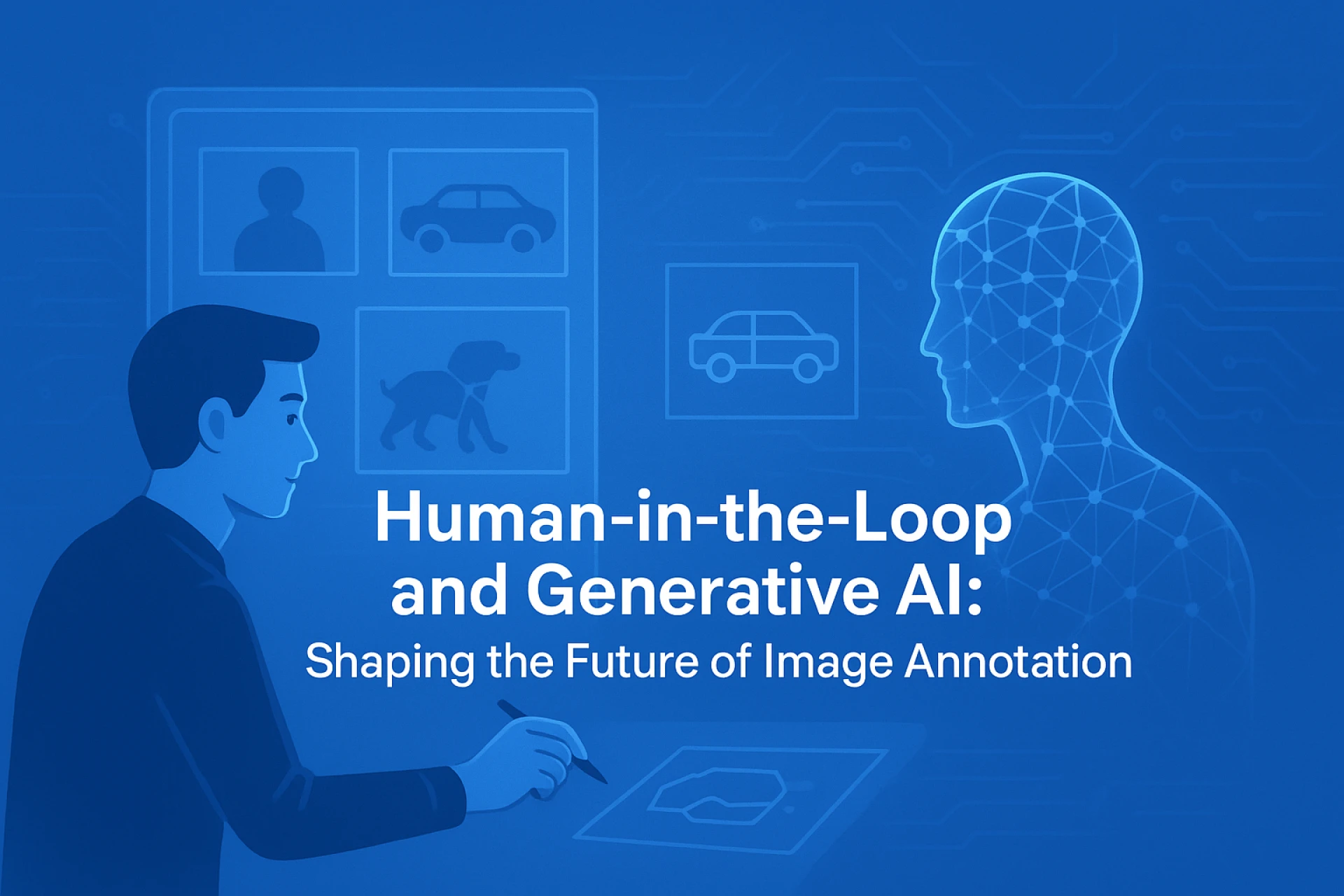

In the fast-evolving world of artificial intelligence (AI), image annotation has become one of the most vital processes for developing accurate and intelligent computer vision models. From autonomous driving to healthcare diagnostics and retail automation, annotated images form the foundation upon which AI systems learn to “see” and interpret the world. However, as data volumes grow exponentially, the demand for faster, more efficient, and highly accurate annotation methods is reshaping how the industry approaches this critical task.
Today, the future of image annotation lies in the perfect balance between human intelligence and generative AI — a model often referred to as Human-in-the-Loop (HITL) annotation. Companies like Annotera, a leading data annotation company in the US, are redefining the landscape by integrating human expertise with AI-powered automation to deliver scalable, accurate, and cost-efficient image annotation services.
Understanding the Changing Landscape of Image Annotation
Traditionally, image annotation required large teams of human labelers manually drawing bounding boxes, polygons, or semantic masks around objects within images. While this approach ensures accuracy, it is often time-consuming, resource-intensive, and expensive to scale for large datasets.
With the rise of deep learning and generative AI technologies, automated labeling tools have become more capable of assisting in repetitive and low-complexity tasks. However, complete automation still faces challenges in edge cases — especially when images involve complex objects, occlusions, or ambiguous contexts. That’s where the Human-in-the-Loop approach comes in — combining the best of both worlds.
What Is Human-in-the-Loop (HITL) Image Annotation?
Human-in-the-Loop (HITL) is an AI training model that keeps human experts actively involved in the annotation and validation process. In this model, AI tools generate initial annotations, and humans review, correct, and validate them. This collaborative workflow ensures that while AI speeds up the process, humans maintain the quality and contextual understanding that machines alone often lack.
In essence, HITL systems make annotation faster without compromising accuracy. It’s not about replacing humans — it’s about empowering them with smarter tools.
The Rise of Generative AI in Image Annotation
Generative AI, powered by advanced architectures like diffusion models and large vision-language models (VLMs), is rapidly changing the annotation landscape. Unlike traditional machine learning models, generative AI can create synthetic data, predict labels for unseen categories, and even fill in missing visual details.
For instance, generative models can simulate rare scenarios — like nighttime traffic conditions or rare diseases in medical imaging — that would otherwise be difficult to collect in real life. These synthetic images, once validated by human annotators, become invaluable training data for AI models.
By integrating generative AI into annotation workflows, Annotera and similar innovators can produce labeled data at unprecedented speed and scale while ensuring that humans maintain final oversight.
Why the Future Belongs to Human + AI Collaboration
1. Enhanced Accuracy and Quality Control
AI can process thousands of images in minutes, but it may misinterpret complex visual cues. Human reviewers ensure that annotations meet industry-specific accuracy benchmarks. For sectors like autonomous driving or healthcare, where precision is non-negotiable, human validation remains critical.
2. Speed and Scalability
Combining human intelligence with generative AI dramatically reduces turnaround time. AI tools perform pre-labeling, while human teams focus on quality assurance. This hybrid approach makes image annotation outsourcing far more efficient and scalable than traditional manual labeling.
3. Cost Efficiency Through Smart Outsourcing
When businesses outsource image annotation to specialized providers like Annotera, they benefit from optimized workflows, lower labor costs, and faster project delivery. The inclusion of AI-driven pre-annotation further enhances cost efficiency, making large-scale projects financially viable without compromising accuracy.
4. Continuous Learning and Improvement
Generative AI models improve over time. As human annotators correct errors, these feedback loops refine AI performance, making future annotations more accurate and automated. This creates a continuous cycle of improvement — the more data you annotate, the smarter your systems become.
The Role of Image Annotation Outsourcing in the AI Era
For many enterprises, building an in-house annotation team is not practical. It requires infrastructure, specialized talent, and constant quality control. Image annotation outsourcing offers a more strategic and cost-effective solution.
By partnering with a trusted image annotation company like Annotera, businesses gain access to:
- Trained professionals experienced in diverse industries
- AI-assisted annotation platforms
- Scalable project management for large datasets
- End-to-end quality assurance and data security
Outsourcing allows organizations to focus on core AI innovation while experts handle the complex and time-consuming process of data labeling.
Generative AI: A Force Multiplier for Outsourced Image Annotation
In the coming years, generative AI will play a pivotal role in transforming how annotation service providers operate. For example:
- Synthetic data generation will address data scarcity in specialized domains.
- AI-assisted auto-labeling will reduce manual effort and accelerate delivery.
- Adaptive learning systems will enable annotators to focus on high-value data while AI manages repetitive tasks.
Annotera’s use of AI-assisted workflows ensures that clients who outsource image annotation receive high-quality, ready-to-train datasets faster and more affordably.
Balancing Automation and Human Oversight
Despite AI’s growing capabilities, complete automation isn’t the goal — reliability is. The most successful annotation strategies balance automation with human intelligence. AI can identify patterns and speed up workflows, but humans bring context, ethical judgment, and cultural understanding to the data.
This balance ensures AI systems are not only accurate but also fair, unbiased, and safe — essential for applications that directly affect human lives.
The Road Ahead: Intelligent Annotation Ecosystems
As AI systems evolve, image annotation will become part of a larger, intelligent ecosystem where data collection, labeling, validation, and deployment are seamlessly integrated. Tools will become smarter, feedback loops tighter, and human roles more strategic.
The next generation of annotation will not be about drawing boxes or labeling pixels — it will be about teaching machines to understand the world as humans do. And this vision is achievable only through the synergy of human-in-the-loop workflows and generative AI innovation.
Conclusion
The future of image annotation is neither fully human nor fully automated — it’s collaborative. By combining generative AI with human expertise, companies can achieve unprecedented accuracy, scalability, and cost-efficiency in their data annotation pipelines.
For organizations looking to outsource image annotation, the key lies in choosing partners that leverage both human intelligence and cutting-edge AI technology.
At Annotera, we believe that the future of AI depends on the quality of its training data — and that quality comes from the perfect harmony between humans and machines. As pioneers in image annotation outsourcing, Annotera continues to empower AI-driven enterprises with smarter, faster, and more reliable data solutions.


























Sign in to leave a comment.