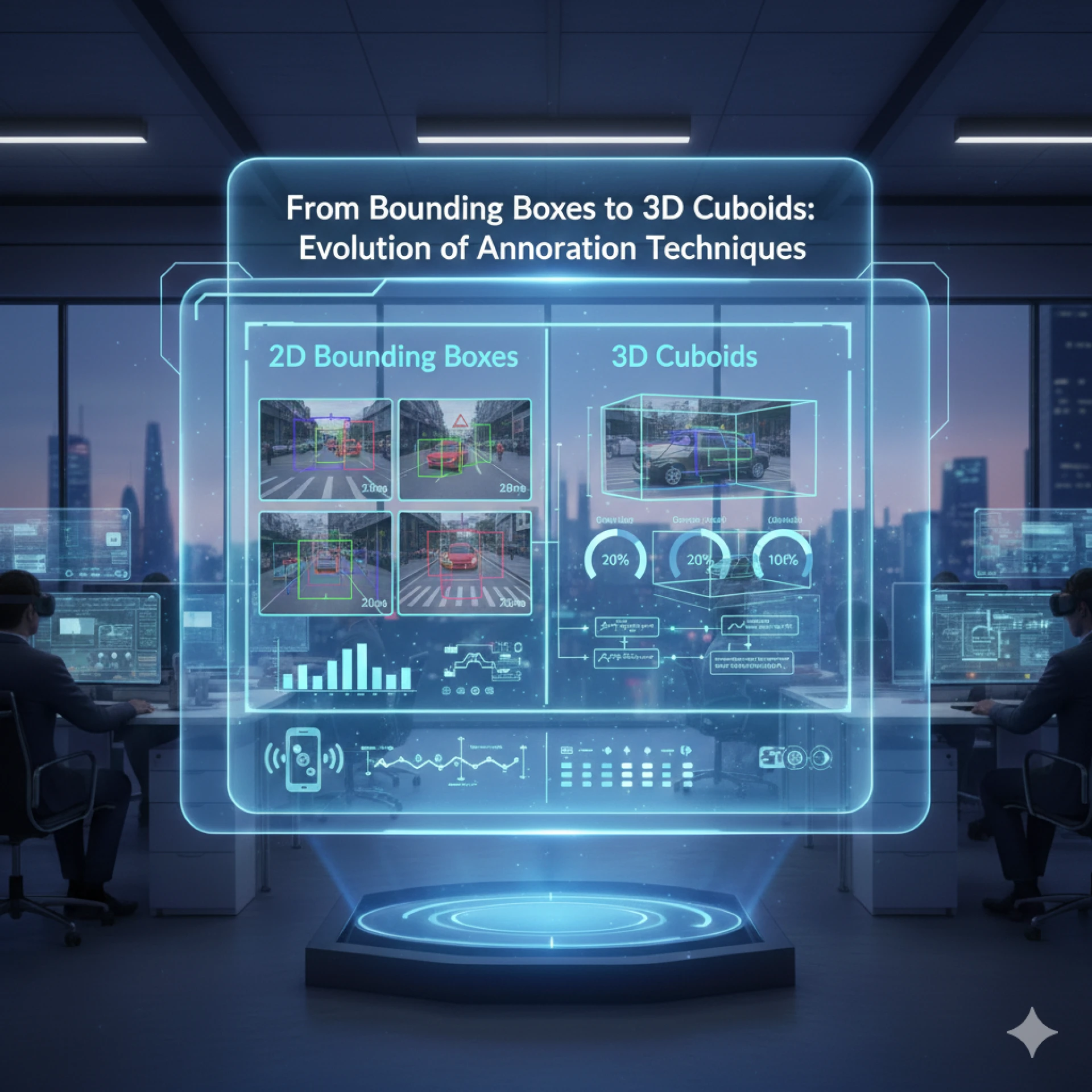

In the rapidly evolving landscape of artificial intelligence, data annotation has transitioned from a supporting task to a strategic enabler of model performance. At Annotera, we have witnessed firsthand how annotation methodologies have matured—driven by the increasing complexity of computer vision applications. From the early reliance on 2D Bounding Boxes to the adoption of sophisticated 3D cuboids, annotation techniques have evolved to meet the demands of real-world environments, particularly in autonomous systems, robotics, and smart surveillance.
As a leading data annotation company, Annotera recognizes that the shift from 2D to 3D annotation is not just a technological upgrade—it is a paradigm shift in how machines perceive and interpret the world.
The Foundation: 2D Bounding Boxes
The journey begins with 2D Bounding Boxes, one of the most fundamental and widely used annotation techniques in computer vision. These rectangular boxes are drawn around objects in images to define their location and class label.
2D bounding boxes gained popularity because of their simplicity and scalability. For early-stage computer vision models—such as object detection systems used in retail analytics, traffic monitoring, and basic surveillance—this approach provided an efficient way to train algorithms with relatively low annotation cost.
However, despite their advantages, 2D bounding boxes come with inherent limitations:
- They lack depth information
- They struggle with occlusions and overlapping objects
- They do not capture object orientation or spatial context
For applications that require spatial awareness—such as autonomous driving—these constraints become significant bottlenecks. As industries demanded higher precision and contextual understanding, the limitations of 2D approaches became increasingly evident.
The Need for Evolution in Annotation
As AI systems began operating in dynamic, real-world environments, the expectations from annotated datasets expanded dramatically. Modern use cases—such as ADAS (Advanced Driver Assistance Systems), drone navigation, and AR/VR—require a more comprehensive understanding of object geometry and spatial relationships.
This shift created a growing demand for advanced annotation techniques that go beyond flat image representations. Businesses began turning to data annotation outsourcing partners like Annotera to handle these complex requirements efficiently and at scale.
The key drivers behind this evolution include:
- Depth perception requirements in autonomous systems
- Multi-sensor data integration (LiDAR, radar, stereo cameras)
- Real-time decision-making constraints
- Higher accuracy thresholds for safety-critical applications
These factors paved the way for 3D annotation methodologies.
Transition Phase: From 2D to 3D Thinking
Before fully adopting 3D cuboids, many organizations experimented with hybrid approaches—combining 2D annotations with depth estimation techniques. While these methods provided incremental improvements, they often relied heavily on inference rather than explicit labeling.
This transition phase highlighted a critical insight: true spatial understanding requires native 3D annotation, not approximations derived from 2D data.
As an experienced image annotation company, Annotera emphasizes the importance of aligning annotation strategies with the intended deployment environment of AI models. For systems operating in three-dimensional space, annotations must reflect that reality.
The Rise of 3D Cuboids
3D cuboids represent a significant advancement in annotation techniques. Unlike 2D bounding boxes, cuboids encapsulate objects in three-dimensional space, capturing not only position but also depth, orientation, and volume.
A 3D cuboid typically includes:
- Length, width, and height
- Rotation angle (yaw, pitch, roll)
- Precise spatial coordinates
- Object tracking across frames (in video or LiDAR sequences)
This richer representation enables AI models to better understand the physical world, making it indispensable for applications such as:
- Autonomous vehicles
- Robotics and warehouse automation
- Smart city infrastructure
- Industrial inspection systems
By leveraging 3D cuboids, models can accurately estimate distances, predict object trajectories, and make context-aware decisions.
Comparing 2D Bounding Boxes and 3D Cuboids
While both techniques serve the purpose of object annotation, their capabilities differ significantly:
1. Dimensionality
- 2D Bounding Boxes: Operate on image planes (x, y)
- 3D Cuboids: Extend to (x, y, z) with depth and orientation
2. Context Awareness
- 2D annotations provide limited context
- 3D cuboids capture spatial relationships between objects
3. Use Case Suitability
- 2D is ideal for basic object detection tasks
- 3D is essential for navigation, tracking, and interaction
4. Annotation Complexity
- 2D is faster and more cost-effective
- 3D requires specialized tools, expertise, and quality control
Despite the complexity, the value delivered by 3D annotation often outweighs the additional investment—especially in high-stakes applications.
Challenges in 3D Annotation
The transition to 3D cuboids is not without challenges. Organizations often encounter several operational and technical hurdles:
1. Tooling and Infrastructure
3D annotation requires advanced platforms capable of handling point clouds, multi-camera inputs, and sensor fusion data. These tools must support precision editing and visualization.
2. Skilled Workforce
Annotators need specialized training to interpret 3D data correctly. Misalignment or incorrect cuboid placement can significantly degrade model performance.
3. Quality Assurance
Maintaining consistency across large datasets is more complex in 3D annotation. Robust QA workflows and validation mechanisms are essential.
4. Cost Considerations
Compared to 2D bounding boxes, 3D annotation involves higher costs due to increased time, expertise, and computational requirements.
This is where data annotation outsourcing becomes a strategic advantage. Partnering with an experienced provider like Annotera allows organizations to access skilled teams, optimized workflows, and scalable infrastructure without incurring excessive overhead.
Annotera’s Approach to Advanced Annotation
At Annotera, we bridge the gap between traditional annotation techniques and next-generation requirements. As a trusted data annotation company, we offer end-to-end solutions tailored to both 2D and 3D annotation needs.
Our approach includes:
1. Hybrid Annotation Pipelines
We integrate 2D and 3D workflows to ensure seamless data transitions, especially for projects migrating from legacy systems.
2. Human-in-the-Loop Validation
Even with advanced tools, human oversight remains critical. Our human-in-the-loop processes ensure high accuracy and consistency across datasets.
3. Scalable Operations
We support large-scale annotation projects through optimized processes and distributed teams, enabling faster turnaround times.
4. Domain-Specific Expertise
From autonomous driving to healthcare imaging, our annotators are trained to understand domain-specific requirements, ensuring context-aware labeling.
As an image annotation company, Annotera continuously invests in technology and training to stay ahead of industry demands.
The Future of Annotation: Beyond 3D Cuboids
While 3D cuboids represent a major milestone, the evolution of annotation techniques is far from complete. Emerging trends indicate a shift toward even more sophisticated methods, including:
- Semantic and instance segmentation in 3D
- 4D annotation (spatiotemporal labeling)
- Automated annotation assisted by AI models
- Synthetic data generation for edge cases
These innovations aim to reduce manual effort while increasing annotation accuracy and scalability.
However, as annotation becomes more automated, the role of human expertise will remain indispensable—particularly for edge cases, ambiguity resolution, and quality assurance.
Conclusion
The progression from 2D Bounding Boxes to 3D cuboids reflects the broader evolution of artificial intelligence—from simple pattern recognition to comprehensive environmental understanding. As AI systems become more integrated into real-world applications, the need for precise, context-rich annotation continues to grow.
For organizations looking to stay competitive, investing in advanced annotation techniques is no longer optional—it is essential. By partnering with a reliable data annotation company like Annotera, businesses can navigate this transition efficiently, leveraging both expertise and scalable infrastructure.
In a world where data defines intelligence, the quality of annotation determines success. Whether through data annotation outsourcing or in-house efforts, embracing the evolution from 2D to 3D is a critical step toward building smarter, safer, and more capable AI systems.



























Sign in to leave a comment.