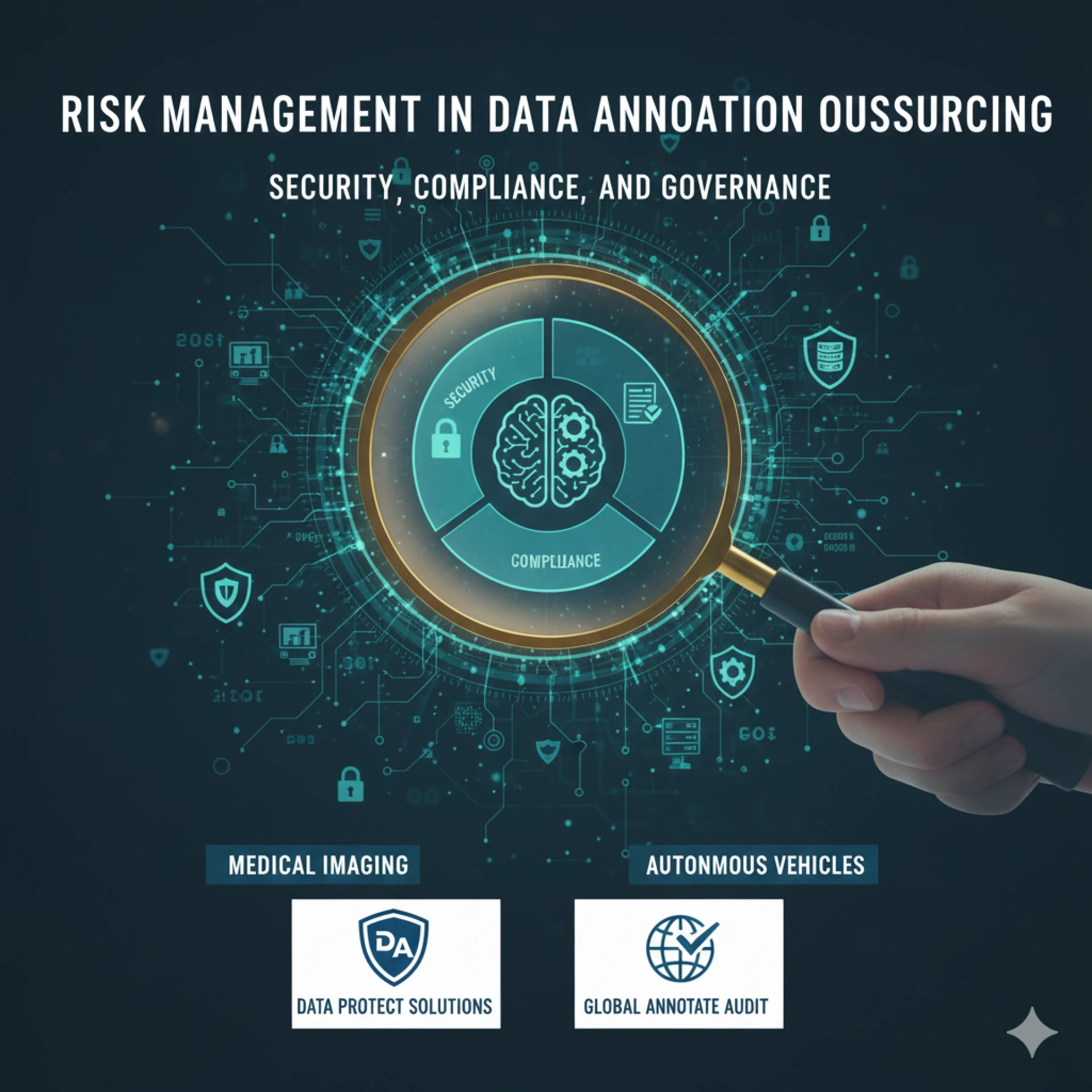

As organizations scale their AI initiatives, data annotation outsourcing has become a foundational strategy for accelerating model development while controlling operational costs. However, the decision to externalize such a critical function introduces a range of risks—especially in environments governed by strict privacy regulations, sector-specific compliance mandates, and enterprise-grade security expectations. The quality of your AI systems is inseparable from the integrity, safety, and governance of the data used to train them. Therefore, selecting the right data annotation company is not simply a procurement decision; it is an exercise in risk management.
At Annotera, we view risk mitigation as a core operational philosophy. This article examines the pillars of effective risk management in data annotation outsourcing and outlines how security, compliance, and governance must converge to protect organizational assets and ensure long-term viability of AI programs.
The Expanding Risk Surface in Outsourced Annotation
Data annotation workflows touch raw, often sensitive, datasets before they are transformed into structured training inputs. These datasets may include personal identifiers, geolocation data, transaction histories, medical images, and proprietary operational information. When outsourced, the risk perimeter expands across geographic boundaries, third-party systems, and distributed teams. Key risks include:
- Data leakage through unauthorized access or insecure delivery channels
- Non-compliance with global privacy regimes such as GDPR, CCPA, HIPAA, or industry-specific regulations
- Operational inconsistencies stemming from insufficient process governance
- Quality degradation resulting from unmanaged workforce practices
- Lack of auditability across annotation workflows and model-training pipelines
Every one of these risk points has downstream consequences—from regulatory exposure to model bias, reduced accuracy, and reputational damage. A mature data annotation company must therefore demonstrate not only technical capability, but also institutional discipline around governance structures.
Security: The First Line of Defense
Security is the foundation of any risk-aware outsourcing arrangement. Given the sensitivity of data used for AI model training, enterprises must verify that annotation partners implement multilayered security protocols. Annotera’s approach centers on three core security pillars.
1. Infrastructure Security
Secure infrastructure is non-negotiable. A responsible vendor should offer:
- Encrypted data storage (at rest and in transit) using industry-standard protocols
- Segmented networks to eliminate lateral movement risks
- Hardened access controls backed by MFA and role-based permissions
- Zero-trust access philosophies for all operational tools
These measures ensure that the annotation environment is isolated, auditable, and protected from unauthorized manipulation.
2. Workforce and Endpoint Security
Even when infrastructure is secure, human endpoints can become threat vectors. Proper mitigation demands:
- Secure, monitored workstations
- Background-verified annotation teams
- No-phone, no-device production floors when working with highly sensitive datasets
- Continuous monitoring of user activity
- Mandatory security training tailored to annotation workflows
At Annotera, workforce segmentation is applied based on project sensitivity, meaning only trained and cleared annotators handle regulated or confidential data.
3. Data Handling Controls
The annotation provider must clearly document:
- Data retention and deletion policies
- Version-controlled storage of annotated outputs
- Controlled access to metadata and labeling tools
- Prevention of local data downloads
These controls reduce the chance of unauthorized replication or data persistence beyond the project lifecycle.
Compliance: Meeting Regulatory and Sector-Driven Requirements
As AI adoption accelerates, compliance obligations are becoming more complex. Enterprises engaging in data annotation outsourcing must be confident that their supplier understands and adheres to all applicable standards. Annotera embeds compliance requirements into every stage of project planning and execution.
1. Alignment with Global Data Privacy Regulations
Regulatory frameworks like GDPR and CCPA impose strict accountability on how data is collected, processed, and stored. A compliant annotation partner should:
- Provide mechanisms for data minimization and pseudonymization
- Ensure traceability of processing activities
- Demonstrate clear consent and data-usage boundaries
- Support right-to-erasure workflows
Non-compliance is not an option; regulatory penalties can be severe, and lack of diligence can compromise the legal defensibility of your AI systems.
2. Support for Industry-Specific Compliance Programs
Certain industries require additional levels of protection:
- Healthcare datasets must meet HIPAA and PHI protection criteria.
- Financial data may fall under PCI-DSS, GLBA, or regional banking regulations.
- Autonomous vehicle data must align with safety and model-governance standards such as ISO 26262 or emerging AI risk frameworks.
Annotera maintains compliance-ready workflows that adapt to the regulatory context of each client.
3. Transparent Audits and Documentation
Compliance is not simply about meeting standards; it is about demonstrating that you meet them. This requires:
- Audit logs for every annotation transaction
- Data lineage documentation
- Incident reporting protocols
- Traceability of quality checks and error corrections
These artifacts strengthen governance and simplify regulatory reporting.
Governance: Ensuring Accountability Across the Annotation Lifecycle
Governance bridges the gap between operational execution and strategic oversight. Without strong governance frameworks, security and compliance controls become fragmented and reactive. Annotera’s governance model ensures consistency, accountability, and predictability throughout outsourced annotation programs.
1. Defining Clear Data Governance Policies
Enterprises must understand how data flows between internal teams, cloud environments, and annotation vendors. Governance policies should address:
- Data classification and sensitivity levels
- Access privileges and segmentation
- Quality thresholds and acceptance criteria
- Escalation paths for exceptions
Annotera integrates these policies into our workflow architecture, enabling clients to maintain end-to-end control.
2. Establishing Robust Quality Governance
Low-quality annotations can introduce bias, reduce model performance, and inflate downstream engineering costs. Effective governance includes:
- Multi-layered quality assurance
- Calibrated reviewer teams
- Continuous feedback loops
- Benchmarking through gold-standard datasets
Quality governance is a critical risk mitigation mechanism because it reduces variance and improves predictability in model training outcomes.
3. Building a Culture of Accountability
Governance must be cultural, not merely procedural. A mature data annotation company demonstrates:
- Transparency in reporting
- Predictability in delivery
- Ownership of errors and root-cause analysis
- Continuous improvement of processes and tools
Annotera maintains governance frameworks that combine structured process management with collaborative client engagement.
How Annotera Reduces Risk in Outsourced Annotation
At Annotera, our risk management approach is purpose-built for enterprises operating in complex regulatory and data environments. We mitigate risk through:
- Secure, enterprise-grade annotation infrastructure
- Workforce segmentation and vetted annotator pools
- Compliance-attuned workflows tailored to healthcare, finance, retail, autonomous systems, and other regulated sectors
- End-to-end governance models with detailed reporting, quality metrics, and audit logs
- Confidentiality enforcement through contractual, technical, and operational safeguards
Our philosophy is simple: AI teams should not have to compromise on security or compliance to achieve scale. Annotera ensures that clients can outsource annotation confidently and responsibly.
Conclusion
Risk management in data annotation outsourcing is not a peripheral concern—it is central to the long-term success of AI initiatives. As regulations evolve and data ecosystems grow more complex, enterprises must align themselves with partners who demonstrate operational maturity across security, compliance, and governance.
A reliable data annotation company is not only a vendor but a strategic ally in protecting data integrity, ensuring regulatory adherence, and enabling scalable AI model development. At Annotera, we are committed to delivering a secure, compliant, and governance-driven annotation ecosystem that supports responsible AI innovation.



























Sign in to leave a comment.