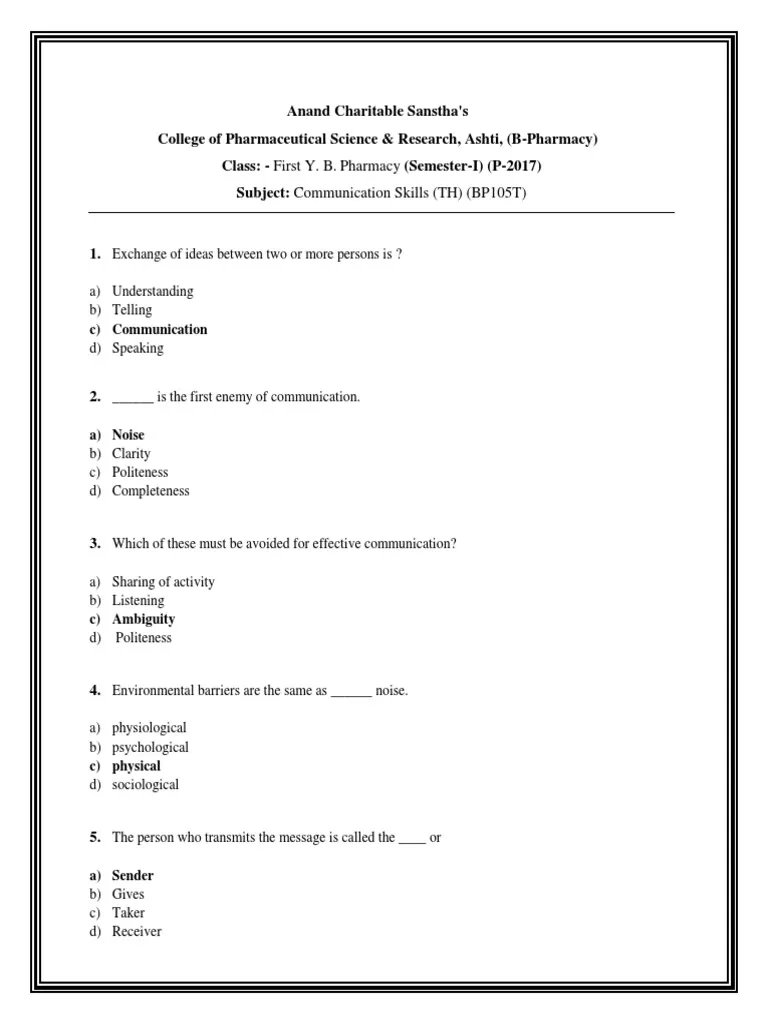

In today’s interconnected world, strong communication abilities are no longer optional — they’re essential. Whether you’re preparing for competitive exams, job interviews, or corporate assessments, mastering the art of communication can set you apart. That’s where Communication Skills MCQs with Answers play a vital role. At Read MCQs, we understand that learning through interactive, question-based practice enhances understanding far more effectively than passive reading.
Why Communication Skills Matter
Communication is at the core of every successful relationship — personal or professional. It involves not just speaking clearly, but also listening actively, interpreting body language, and conveying ideas persuasively. Strong communication skills are highly valued across industries, helping professionals collaborate effectively, resolve conflicts, and build lasting connections.
In academic and professional tests, communication-based questions often evaluate a candidate’s ability to express ideas logically, choose the right tone, and interpret non-verbal signals. That’s why Read MCQs provides comprehensive collections of Communication Skills MCQs with Answers — designed to test both theoretical knowledge and practical application.
Understanding the Structure of Communication Skills MCQs
Most communication-related multiple-choice questions (MCQs) assess understanding in areas like:
- Verbal communication: vocabulary, tone, grammar, and clarity.
- Non-verbal communication: gestures, posture, facial expressions, and eye contact.
- Listening skills: identifying main ideas, paraphrasing, and comprehension.
- Written communication: structure, coherence, and formal tone.
- Interpersonal communication: empathy, feedback, and conflict resolution.
Each MCQ typically presents a real-world scenario followed by multiple options, requiring candidates to choose the most appropriate response. Reviewing Communication Skills MCQs with Answers helps learners analyze why certain choices are correct, reinforcing their conceptual understanding.
Example: Communication Skills MCQs and Their Explanations
1. Which of the following is an example of non-verbal communication?
A) Email correspondence
B) A formal report
C) A smile during a conversation
D) A telephone discussion
Answer: C) A smile during a conversation
Explanation: Non-verbal communication involves gestures, expressions, and other body language signals that convey meaning without words.
2. Active listening involves:
A) Interrupting to share your opinion
B) Maintaining silence throughout the discussion
C) Paying full attention and giving feedback
D) Avoiding eye contact to stay focused
Answer: C) Paying full attention and giving feedback
Explanation: Active listening includes understanding, responding, and remembering information shared by the speaker. It shows respect and engagement.
These are just a glimpse of what you’ll find in our curated Communication Skills MCQs with Answers series at Read MCQs. Each question is developed with educational accuracy and practical relevance, making it suitable for students, job aspirants, and professionals alike.
Benefits of Practicing Communication Skills MCQs
Engaging with topic-specific MCQs isn’t just about scoring well in exams; it’s about building lasting proficiency. Here are a few key benefits:
- Concept Reinforcement:
- Practicing objective questions helps strengthen your understanding of verbal and non-verbal communication principles.
- Exam Preparation:
- Many competitive exams and corporate aptitude tests include sections on communication. Regular practice helps improve speed and accuracy.
- Real-World Application:
- Understanding communication dynamics through structured questions translates into better performance in meetings, interviews, and teamwork settings.
- Self-Assessment:
- MCQs with answers provide immediate feedback, helping you identify weak areas and track your progress over time.
How Read MCQs Makes Learning Easier
At Read MCQs, we aim to simplify preparation by offering categorized sets of questions that are accurate, practical, and easy to understand. Our Communication Skills MCQs with Answers collections are designed to balance difficulty levels — from beginner-friendly basics to advanced workplace communication scenarios.
We regularly update our question banks based on the latest communication theories, professional standards, and exam patterns. Each answer comes with a concise explanation to ensure that learners grasp both the concept and its real-life application.
Tips for Improving Communication Skills
While MCQs help strengthen conceptual understanding, real improvement comes through consistent practice. Here are a few effective ways to enhance your communication skills alongside your test preparation:
- Read actively: Exposure to professional articles, speeches, and reports improves vocabulary and comprehension.
- Practice speaking: Participate in discussions or mock interviews to build confidence.
- Observe non-verbal cues: Notice how gestures and tone influence meaning.
- Seek feedback: Constructive feedback helps identify communication gaps.
Combining these habits with regular MCQ practice ensures steady and measurable growth.
Final Thoughts
Mastering communication skills requires both knowledge and practical application. With the help of Communication Skills MCQs with Answers from Read MCQs, learners can strengthen their foundation, assess their understanding, and gain the confidence to perform effectively in any environment.
At Read MCQs, we’re committed to making learning interactive, insightful, and result-driven. Whether you’re preparing for an interview, academic exam, or professional certification, our curated question sets provide the tools you need to communicate with clarity, confidence, and precision.
























Sign in to leave a comment.