

As cloud adoption, digital banking, and smart-government initiatives accelerate across the region, Data Center Security Qatar standards are rising sharply to match international expectations. This guide breaks down every layer of Data Center Security that operators across Qatar and the wider GCC need to understand, from the perimeter fence to the data itself, so facility managers and security planners can evaluate exactly where their current posture is strong and where it leaves risk unaddressed.

Why Data Centers Across the GCC Are Under Growing Pressure to Harden Security
The GCC region's rapid digitalization across banking, government, healthcare, and energy sectors has concentrated enormous volumes of sensitive data and mission-critical applications into a relatively small number of data center facilities. This concentration makes those facilities high-value targets for both physical intruders and sophisticated cyber actors. National data residency requirements across Qatar, the UAE, Saudi Arabia, and Bahrain are simultaneously increasing the amount of locally stored data, which means a breach at one facility can have consequences that ripple across entire sectors of the national economy.
Understanding the Six Layers of Data Center Security
The most defensible approach to data center security treats protection as a sequence of concentric layers, each of which assumes the one before it may eventually be compromised. A facility that secures only the building perimeter but leaves racks accessible with a single shared PIN, or that encrypts data but leaves the network flat, has not built a resilient posture — it has built a single point of failure at a larger scale. Tektronix LLC's six-layered data center security framework provides a structured model for addressing each layer systematically, which is the approach regional operators are increasingly specifying as their baseline standard.
Layer One: Cybersecurity for Data Center Networks
The first layer of protection that most operators focus on is the network itself. Cybersecurity for Data Center environments covers perimeter defence, internal network segmentation between tenant zones, patch management across every system, vulnerability scanning of management interfaces, and continuous monitoring of east-west traffic between racks, not just inbound connections from outside. Many of the most damaging GCC data center incidents in recent years have originated from poorly managed internal interfaces or third-party vendor connections rather than from a direct external attack on the perimeter firewall.
Layer Two: Data Center Encryption Protecting Information at Every Stage
Even when every other layer holds, the data itself must be protected against the scenario where hardware is physically removed or network traffic is intercepted. Data Center Encryption applied at rest across every storage system and in transit across every network connection ensures that an attacker who overcomes physical or network controls still cannot read the data without the cryptographic keys, which are stored and managed separately under their own access controls and rotated on a defined schedule to limit the window of exposure if a key is ever compromised.
Layer Three: Data Center Firewalls Controlling Traffic at Every Boundary
A flat network inside a data center is a critical vulnerability: lateral movement from one compromised tenant or system can reach every other system with minimal obstruction. Data Center Firewalls enforced at the external perimeter and between internal segments create defined traffic boundaries enforced by policy, with deep packet inspection extending filtering from simple port rules to behavioural analysis of the content moving between systems. Each firewall boundary acts as an independent checkpoint, meaning a breach that crosses one boundary is contained before it reaches the next.
Layer Four: Data Center Access Control Governing Physical Entry
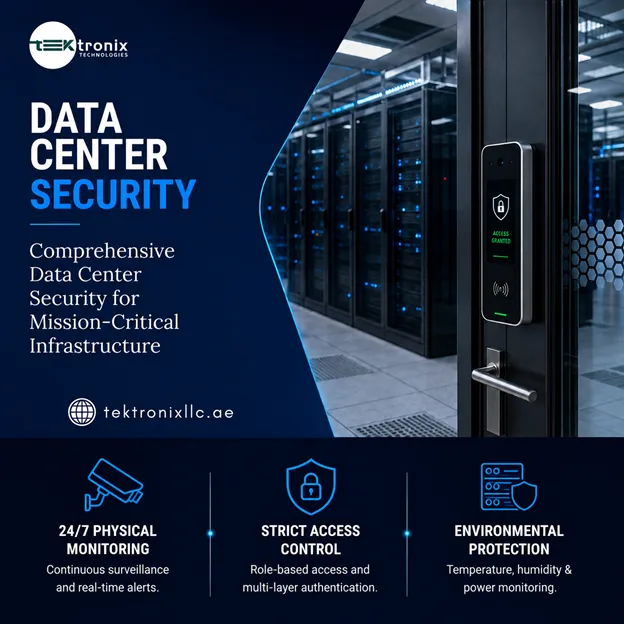
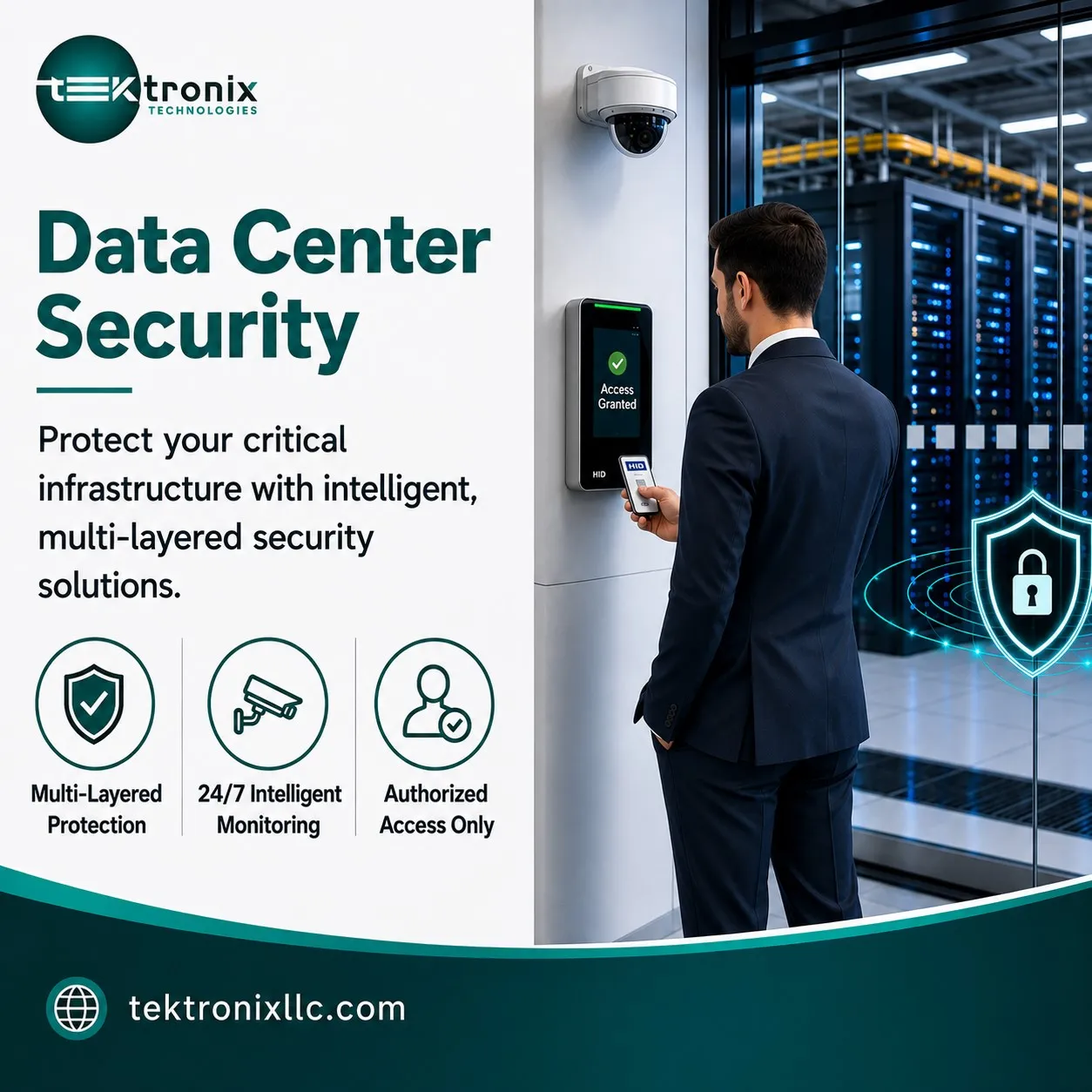
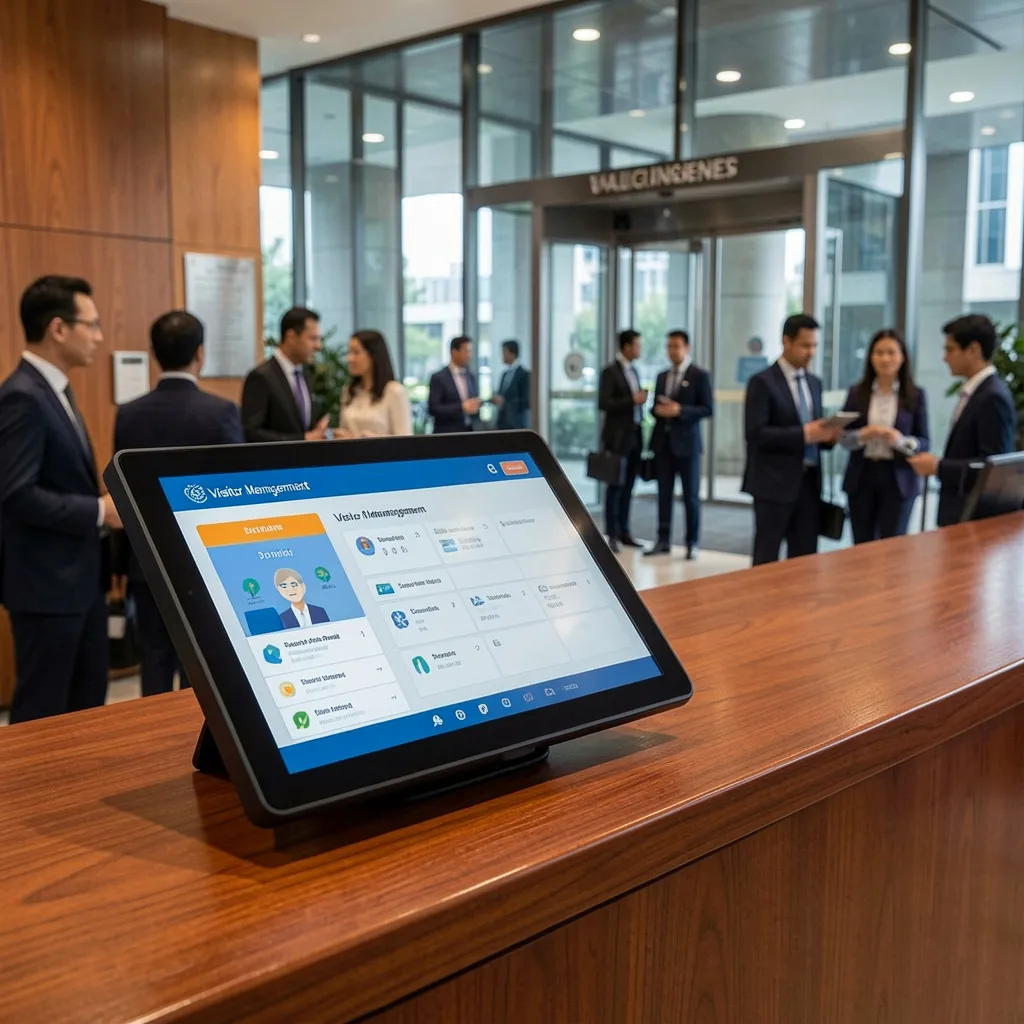
Physical access to servers and storage is as much a security concern as network access, and it requires its own layered control structure. Data Center Access Control in a well-secured facility applies independent verification at each successive zone — building entry, server hall entry, and individual cabinet access — with each layer using credentials that are independent of the ones before it, so compromising a building entry credential does not automatically grant access to the racks. Every entry and exit is logged to the second, creating an audit trail that is often the primary evidence source during an incident investigation.
What a Tiered Physical Access Audit Trail Looks Like in Practice
During a compliance review or incident investigation, a tiered access log allows a security team to reconstruct exactly which individuals were in which zones at which times, cross-referenced against network event logs, to identify whether a physical presence correlates with a suspicious system event, which is a capability no single-point access control system can provide.
Layer Five: Data Center Surveillance Providing Continuous Visual Coverage
Physical access logs record who badged through a door; Data Center Surveillance provides visual confirmation of what actually happened in the physical space during any window of interest. High-resolution cameras at every entry point, server aisle, and loading dock, supported by intelligent analytics that flag loitering, tailgating, open cabinets, and after-hours movement automatically, give security operations a continuous visual record rather than a gap-filled archive that only becomes useful after an incident is already known to have occurred.
Layer Six: Data Center Intrusion Detection and Data Center Threat Detection
The final two layers address detection of events that have bypassed all previous controls. Data Center Intrusion Detection monitors for specific anomalous events — a forced door, a vibration sensor triggered on a cabinet, a network signature matching a known attack pattern — and raises an immediate alert. Data Center Threat Detection operates at a higher level of analysis, correlating signals across physical access logs, network events, and surveillance data over time to identify patterns that indicate a slow-moving attack or insider threat that no single alert would reveal in isolation.
How the GCC Regulatory Environment Is Shaping Data Center Security Requirements
Financial regulators, telecommunications authorities, and national cybersecurity agencies across Qatar and the wider GCC are progressively aligning their data center security expectations with international frameworks such as ISO 27001 and Tier III/IV data center standards. Operators who build their security posture around a documented, layered model are significantly better positioned during regulatory audits, client security assessments, and insurance underwriting reviews than those who rely on informal, undocumented controls that cannot be evidenced during a review.
Why Experience Matters When Securing a Data Center Security GCC Facility
Designing and integrating a layered security model that satisfies GCC regulatory expectations requires direct experience with regional facility types, compliance frameworks, and the specific threat patterns that target data centers in this market. Tektronix LLC has engineered security deployments for data centers and critical infrastructure across Qatar, the UAE, Saudi Arabia, and the broader GCC, working with operators who face the same compliance pressures and threat landscape found throughout the region. That regional experience, from site assessment through integrated system delivery, is detailed on Tektronix LLC's six-layered data center security framework page, where operators across Qatar and the GCC can review the complete model before planning their own security uplift.
Implementation Checklist for GCC Data Center Operators
- Assess current posture against all six layers and document gaps before specifying new controls.
- Prioritize network segmentation between tenants as the highest-impact first step if not already in place.
- Implement encryption at rest and in transit across every system hosting sensitive data.
- Introduce tiered physical access with independent credentials at each successive zone.
- Connect surveillance, access control, and network monitoring into a unified SOC view.
Conclusion
A complete guide to Data Center Security for Qatar and the GCC begins with recognizing that no single control is sufficient on its own. Disciplined Cybersecurity for Data Center operations protect the network, Data Center Encryption secures the data itself, Data Center Firewalls contain lateral movement, Data Center Access Control and Data Center Surveillance protect the physical building, and Data Center Intrusion Detection alongside Data Center Threat Detection catch what every other layer misses. Operators building or auditing their Data Center Security GCC posture can review Tektronix LLC's six-layered security framework to benchmark current controls against a proven regional standard.
Frequently Asked Questions
1. What is the most common gap in Data Center Security Qatar facilities face today?
Network segmentation between internal tenant zones is the most frequently underdeveloped layer, with many facilities focusing heavily on perimeter defence while leaving east-west traffic between internal systems largely unmonitored and unsegmented.
2. Why does Cybersecurity for Data Center go beyond standard IT security practices?
It addresses the specific vulnerabilities of a facility hosting many organizations' systems simultaneously, including shared management interfaces, third-party vendor connections, and the risk that a breach in one tenant's environment can reach another's if internal segmentation is inadequate.
3. How often should Data Center Encryption keys be rotated?
Rotation frequency depends on the sensitivity of the data and the organization's risk appetite, but a defined schedule, typically annual or more frequent for high-value systems, documented and auditable, is consistently expected by GCC regulators and international compliance frameworks.
4. What should a Data Center Surveillance system flag automatically?
At minimum, automatic flagging should cover tailgating at access points, open cabinet doors beyond a defined threshold, after-hours motion in normally unoccupied zones, and unattended items near sensitive rack areas.
5. How does Data Center Threat Detection differ from a standard security information and event management platform?
It correlates signals specifically across physical access, network, and surveillance data rather than network events alone, allowing it to identify threats that cross physical and digital boundaries, such as an access event combined with an unusual data transfer, which a network-only platform would never connect.
For more information contact us on:
Tektronix Technology Systems Dubai-Head Office
+971 55 232 2390



























Sign in to leave a comment.