
Cameras alone were never enough to secure a data center — footage reviewed after an incident doesn't prevent the incident. Modern Data Center Security now relies on surveillance that analyses what it sees in real time, and operators evaluating data center perimeter and surveillance security solutions are discovering that intelligent video has become the connective layer tying every other security control together.
A facility can have hardened access control and a well-configured firewall and still miss an incident if surveillance is treated as a passive recording tool rather than an active detection system. UAE data centers competing for enterprise and government tenancy are increasingly expected to demonstrate exactly that active capability, not just camera coverage on a floor plan.
Why Surveillance Has Become the Backbone of Data Center Security
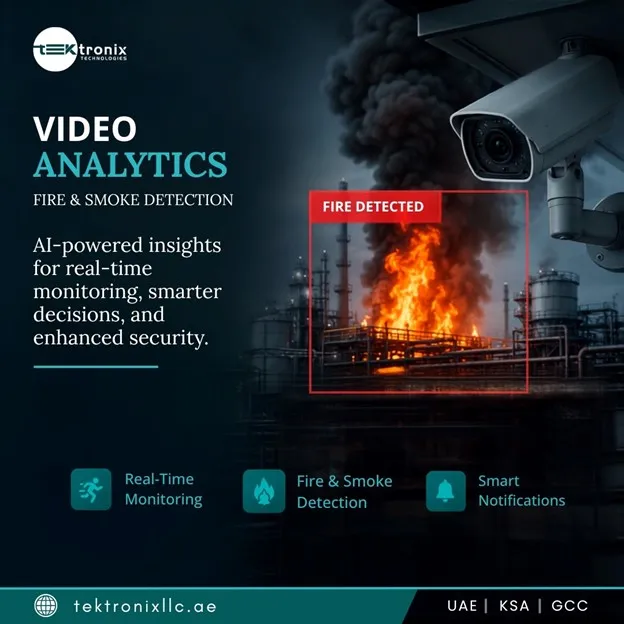
Traditional CCTV answers the question "what happened" hours or days after an event. Intelligent surveillance answers "what's happening right now," flagging a loitering figure near a cage door or an unusual after-hours movement pattern the moment it occurs, giving security operators a chance to intervene rather than simply document.
That shift matters most in shared colocation environments, where dozens of tenants rely on the same physical perimeter. A surveillance system that only records footage offers little comfort to a tenant asking how quickly an intrusion attempt near their cage would actually be caught — a live, analytics-driven system offers a concrete answer.
What Intelligent Surveillance Adds to a Data Center
Data Center Surveillance for Continuous Visual Oversight
Comprehensive Data Center Surveillance covering entry points, server aisles, loading docks, and rooftop access points gives operators complete visual coverage of every zone a facility needs to protect, recorded continuously rather than triggered only by a separate alarm event.
Data Center Intrusion Detection Through Video Analytics
Layered on top of raw footage, video-based Data Center Intrusion Detection identifies forced-entry attempts, fence climbing, or tailgating at controlled doors by analysing movement patterns against the camera feed itself, catching attempts that a motion sensor alone might miss or misclassify.
Data Center Threat Detection via AI-Driven Pattern Recognition
Broader Data Center Threat Detection correlates video analytics with access logs and network alerts, recognising when a physical anomaly and a network anomaly occur together — a pattern far more likely to indicate a coordinated attack than either signal reviewed in isolation.
Connecting Surveillance to Physical Access Control
Data Center Access Control Tied to Camera Verification
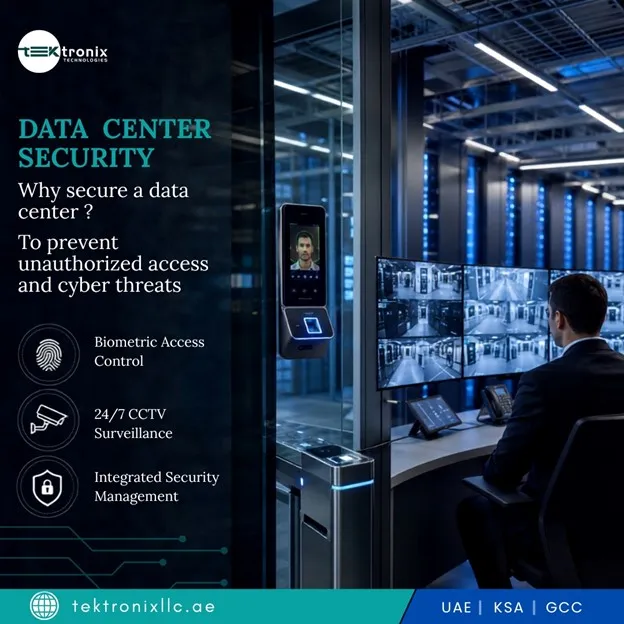
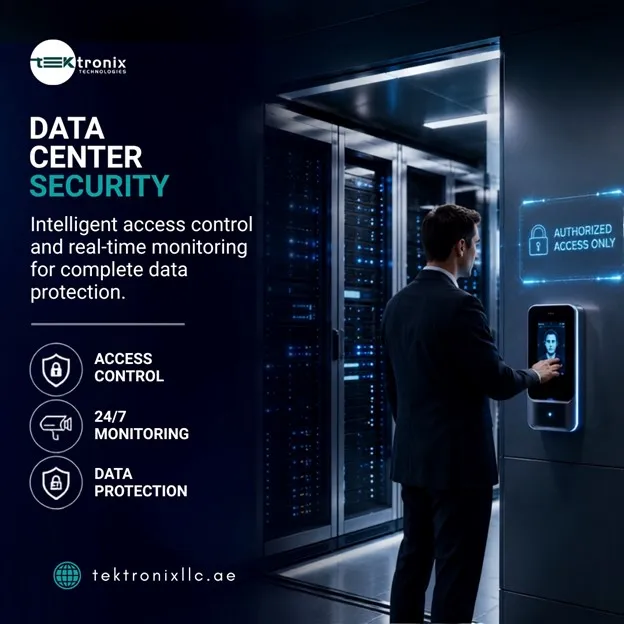
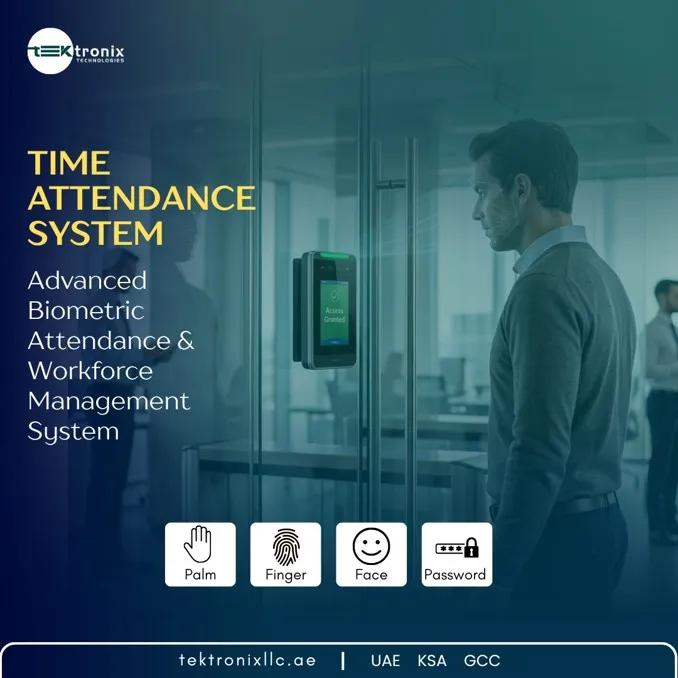
The strongest deployments pair Data Center Access Control credentials with camera-based identity verification at each door, so a valid badge swipe is cross-checked against a live video match before granting entry — closing the gap where a stolen or borrowed credential alone would otherwise succeed.
Protecting the Data Behind the Cameras
An intelligent surveillance network is itself a data asset worth protecting, since video feeds and access logs carry sensitive operational and tenant information that needs the same rigour applied to any other critical system.
Cybersecurity for Data Center Surveillance Networks
Robust Cybersecurity for Data Center surveillance infrastructure covers camera firmware patching, credential hardening on network video recorders, and network segmentation, since an unsecured camera is itself a common entry point attacker exploit precisely because it's often overlooked.
Data Center Encryption for Video and Access Data
Applying Data Center Encryption to stored video footage and access logs ensures that even if storage media were physically removed or network traffic intercepted, the underlying recordings and identity data remain unreadable without properly managed decryption keys.
Data Center Firewalls Segmenting Surveillance Traffic
Dedicated Data Center Firewalls isolate the surveillance network from general IT and tenant traffic, preventing a compromised camera or recorder from becoming a stepping stone into the facility's broader production network.
Data Center Security UAE: Surveillance Deployment Nationwide
Facilities specifying Data Center Security UAE-wide increasingly treat surveillance analytics as a baseline expectation rather than a premium add-on, reflecting the growing density of hyperscale and colocation facilities competing for the same enterprise tenant pool.
Data Center Security Dubai — High-Density Colocation Considerations
A Data Center Security Dubai deployment for a multi-tenant colocation facility typically requires per-cage camera coverage and access-tied verification, since shared floor space means a single tenant's security gap can otherwise expose neighbouring tenants sharing the same physical building.
Data Center Security Abu Dhabi — Critical Infrastructure Considerations
Facilities pursuing Data Center Security Abu Dhabi deployments supporting government or critical infrastructure tenants generally require surveillance retention periods and analytics reporting that align with NESA information assurance expectations, going beyond standard commercial-grade coverage.
Standards and Regulatory Alignment
Surveillance-integrated security programmes across the Emirates are typically benchmarked against the UAE Information Assurance Standard (NESA/SIA), ISO 27001 for information security management, and Uptime Institute Tier certification for infrastructure resilience. DESC oversight applies to Dubai facilities supporting government or regulated tenants, ADHICS governs healthcare-related hosted data, and UAE PDPL shapes how long video and access records can be retained and who may access them.
Why Operators Choose Tektronix for Intelligent Surveillance Deployments
Tektronix LLC designs integrated surveillance and access control programmes for data centers across the UAE, deploying camera and analytics platforms from Genetec, Milestone, Axis Communications, and Honeywell, matched to each facility's tenant density and compliance obligations. Every project includes camera coverage mapping, analytics tuning to reduce false positives, and integration with the client's access control and network security operations so surveillance data strengthens rather than duplicates existing controls.
Operators upgrading legacy CCTV or specifying security for a new build can review Tektronix's data center perimeter security solutions to evaluate surveillance configurations suited to hyperscale, colocation, and enterprise-owned facilities.
Conclusion
Passive recording no longer meets the bar for serious Data Center Security in the UAE. Continuous Data Center Surveillance paired with video-driven Data Center Intrusion Detection and correlated Data Center Threat Detection gives operators the active visibility passive cameras never could.
Tying that visibility to Data Center Access Control, and protecting the surveillance network itself through Cybersecurity for Data Center practices, Data Center Encryption, and Data Center Firewalls, closes the loop between physical and digital protection. As Data Center Security UAE facilities — including Data Center Security Dubai colocation sites and Data Center Security Abu Dhabi critical infrastructure deployments — compete for tenant trust, intelligent surveillance has become the layer that proves security claims rather than simply asserting them.
FAQs
1. How long should data center surveillance footage be retained?
Retention periods vary by facility type and tenant requirements, but many UAE data centers retain footage for 90 days or longer for standard zones, with longer retention often required for facilities serving government or regulated financial tenants.
2. Does adding video analytics increase false alarm rates?
Poorly tuned analytics can initially generate more alerts, which is why proper camera placement and threshold calibration during deployment is essential to reduce false positives without missing genuine incidents.
3. Can surveillance cameras be a cybersecurity vulnerability themselves?
Yes, unsecured cameras and network video recorders are a known attack vector if left on default credentials or unpatched firmware, which is why surveillance network segmentation and regular patching are treated as core security tasks, not optional maintenance.
4. How much network bandwidth does a data center surveillance system require?
Bandwidth needs depend on camera count, resolution, and retention settings, but most deployments use dedicated network segments and on-site storage to avoid competing with production data traffic for capacity.
5. How long does it take to integrate surveillance with existing access control?
Integration timelines vary by facility size, but a typical colocation deployment linking surveillance to access control across all controlled doors generally takes several weeks, including analytics tuning and staff training before full go-live.
For more information contact us on:
Tektronix Technology Systems Dubai-Head Office
+971 50 814 4086
Data Center Encryption
Data Center Firewalls
Data Center Intrusion Detection





























Sign in to leave a comment.