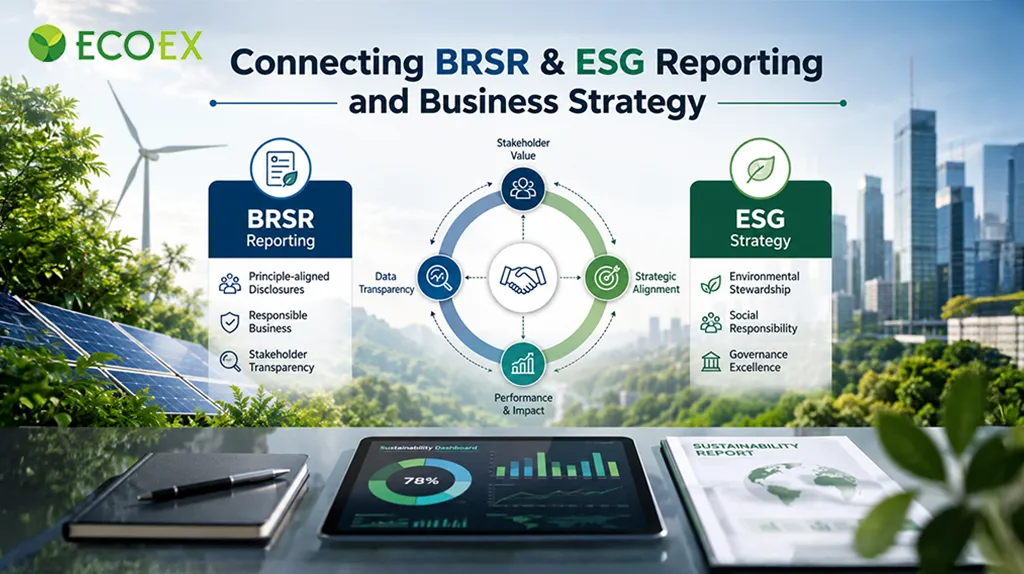

Quick question. When your compliance team submits the BRSR filing every year, does anyone outside that team ever actually look at it again? For a lot of companies, the honest answer is no, and that is precisely the problem this article wants to fix.
BRSR applies to India's top 1,000 listed companies by market capitalization, representing more than 70 percent of the country's total market capitalization, and covers roughly 140 ESG data points spanning emissions, energy, water, workforce diversity, and governance practices. With third-party assurance requirements expanding from the top 150 companies toward the full top 1,000 by FY 2026-27, the credibility bar for this data keeps rising sharply.
Treating BRSR as a once-a-year paperwork exercise means missing out on one of the richest strategic datasets a company generates. Buried inside those disclosures sits information about energy use, emissions, supply chain risk, workforce practices, and governance gaps, all of which directly affect operational costs and long-term resilience. Ignore that connection, and you are essentially collecting valuable business intelligence and then filing it away unused.
EcoEx sits right at this intersection, helping organizations turn BRSR compliance into a genuine strategic asset through digital platforms and comprehensive ESG advisory support. This article explains why ESG reporting, and specifically BRSR, has evolved from a regulatory checkbox into a genuine strategic management tool. You will learn how leading Indian companies are connecting sustainability disclosures to real decision-making, why regulators keep raising the bar on data quality, and how the right consulting partner turns compliance data into a competitive advantage rather than a filing obligation.
Understanding the Strategic Relationship Between BRSR and ESG Reporting
BRSR and broader ESG reporting are not competing frameworks, even though many companies still treat them as separate exercises handled by different teams. BRSR gives Indian listed companies a structured, SEBI-mandated format for disclosing sustainability performance, built around the nine principles of the National Guidelines on Responsible Business Conduct. Broader ESG reporting, meanwhile, provides the language and comparability that global investors, rating agencies, and international partners actually use to evaluate a company's environmental, social, and governance performance.
How does BRSR complement broader ESG reporting frameworks? BRSR was specifically designed to align with international standards, including GRI, TCFD, and UN Sustainable Development Goals, which means the underlying data companies collect for BRSR can largely serve double duty for global disclosure requirements too. This overlap matters enormously for companies with international investors or multinational supply chain relationships, since duplicating data collection efforts across separate frameworks wastes both time and money.
Integration between the two also strengthens corporate governance in ways that go beyond simple reporting efficiency. When BRSR data feeds directly into a company's broader ESG strategy, sustainability stops being something the compliance department handles quietly in the background and becomes part of how the board, the executive team, and operational leaders actually make decisions. This shift creates greater transparency for external stakeholders while giving internal teams a single, coherent source of sustainability truth instead of fragmented, inconsistent datasets scattered across different departments.
Companies that treat these frameworks as connected rather than separate also position themselves better for what is coming next. Value chain disclosure requirements, once voluntary, are moving steadily toward mandatory assurance, and companies with integrated reporting systems will adapt to these tightening requirements far more smoothly than those still managing BRSR and international ESG frameworks as disconnected annual projects.
Why Business Strategy Must Be Built Around ESG Data
ESG data has quietly become one of the most useful sources of operational intelligence a company has, even though most businesses still treat it purely as reporting material rather than strategic input. Emissions data reveals energy inefficiencies. Water usage patterns expose supply chain vulnerabilities in water-stressed regions. Workforce diversity metrics highlight talent retention risks long before they show up in quarterly turnover numbers.
Consider how this plays out in practice. A company reporting Scope 1 and Scope 2 emissions data under BRSR Core is not just fulfilling a disclosure requirement; it is generating a detailed map of where energy costs are highest and where efficiency investments would deliver the fastest payback. Companies that treat this data purely as a compliance output miss the chance to use it for real operational decision-making, essentially collecting valuable information and then filing it away without ever asking what it reveals about their own business.
Why has ESG data become essential for strategic decision-making? Because regulatory and investor expectations are converging around a simple demand, verified evidence over self-reported claims. BRSR Core assurance requirements already apply to the top 150 listed companies and are expanding toward the full top 1,000 by FY 2026-27, meaning the days of loosely estimated sustainability figures are numbered. Companies that build internal processes around collecting accurate, audit-ready ESG data now will face far less disruption when assurance requirements eventually catch up with them.
Supply chain resilience is another area where ESG data proves its strategic worth. Value chain disclosure requirements, even while currently voluntary for many companies, are pushing organizations to understand ESG risks among suppliers and customers representing significant shares of their purchases and sales. This visibility helps companies spot concentration risk, environmental liability exposure, and reputational vulnerabilities within their supply chains long before those risks become costly disruptions.
The Role of ESG Reporting in Driving Long-Term Business Value
Effective ESG reporting does far more than satisfy a regulatory deadline. It functions as an ongoing feedback mechanism that shapes how a company sets goals, allocates resources, and manages risk over multiple years rather than a single reporting cycle. Materiality assessments sit at the heart of this process, helping companies identify which sustainability issues genuinely matter to their specific business and stakeholders rather than chasing every possible metric with equal intensity.
Stakeholder engagement improves considerably when ESG reporting becomes a two-way conversation rather than a one-directional disclosure. Investors, employees, customers, and regulators all bring different priorities to the table, and companies that actively engage these groups while shaping their sustainability targets end up with more credible, better supported ESG strategies than those developed in isolation by a small compliance team.
How does ESG reporting influence long-term business transformation? Through the discipline it forces on target setting and performance measurement. Setting a genuine emissions reduction target, backed by verified baseline data and tracked consistently across reporting periods, creates accountability that a vague sustainability statement never could. Climate risk management benefits enormously from this same discipline, since companies that track physical and transition climate risks through structured ESG reporting are far better equipped to anticipate regulatory shifts, insurance cost changes, and operational disruptions tied to a warming climate.
Governance improvements often follow naturally from this process too. Companies that build proper ESG data collection and reporting systems typically discover governance gaps they were not previously tracking, whether that involves board oversight of sustainability issues, policy documentation, or internal controls over ESG data itself. Addressing these gaps strengthens overall corporate governance quality, not just sustainability performance specifically, creating value that extends well beyond the ESG report itself.
Aligning BRSR with Global ESG Frameworks for Greater Business Impact
Companies that align their BRSR disclosures with internationally recognized frameworks unlock significantly more value from the same underlying data. GRI alignment improves how sustainability performance gets communicated to global stakeholders, since GRI remains one of the most widely recognized reporting standards internationally. SASB alignment sharpens industry-specific materiality, helping companies focus disclosure efforts on the sustainability issues that matter most within their particular sector rather than generic environmental metrics.
TCFD alignment strengthens climate risk disclosure specifically, giving investors and lenders the kind of forward-looking climate risk information that BRSR alone does not fully capture. SDG alignment helps companies connect their sustainability initiatives to globally recognized development goals, which resonates particularly well with international investors and development finance institutions evaluating a company's broader societal contribution.
Why does multi-framework alignment matter for regulatory readiness? Because regulatory expectations rarely move in isolation anymore. BRSR itself was deliberately designed to align with GRI, TCFD, and UN Sustainable Development Goals from the outset, which means companies building genuinely integrated reporting systems reduce duplicate effort considerably. Greenhouse gas accounting standards add another critical layer, since accurate Scope 1, 2, and 3 emissions reporting increasingly underpins virtually every major ESG framework globally, making consistent emissions methodology one of the highest value investments a company can make in its reporting infrastructure.
This kind of multi-framework consistency also protects companies against a growing risk, namely inconsistent disclosures across different reports that damage credibility with sophisticated investors who cross-check data between filings. A unified data foundation supporting BRSR, GRI, SASB, and TCFD simultaneously eliminates this risk while significantly improving global comparability for international stakeholders evaluating the company against peers in other markets.
Using Digital Technologies to Improve ESG Reporting and Strategic Decision-Making
Manual ESG data collection, still common across many Indian companies, simply cannot keep pace with the assurance requirements now expanding across the BRSR Core framework. Digital sustainability management platforms are changing this by consolidating data from utility bills, HR systems, supplier records, and operational reports into unified, auditable repositories that dramatically reduce the manual reconciliation work sustainability teams used to handle.
Automated data collection tools pull information directly from source systems rather than relying on manual entry, cutting down on the kind of human error that has historically undermined confidence in self-reported ESG figures. Analytics dashboards then transform this raw data into usable insight, helping executives spot trends, benchmark performance across business units, and identify emerging risks well before they surface in an annual report.
AI-enabled reporting tools are increasingly supporting this process too, flagging inconsistencies in reported data, predicting future performance trends based on historical patterns, and even assisting with the narrative sections of sustainability disclosures. Integrated sustainability management systems tie all of these pieces together, ensuring that data collected once can support BRSR filings, GRI reports, investor presentations, and internal management dashboards simultaneously rather than requiring separate collection efforts for each output.
This technology infrastructure directly supports audit readiness too, which matters considerably given the phased expansion of BRSR Core assurance requirements. Companies with clean, digitally tracked data sources, documented methodologies, and clear evidence trails will move through third-party assurance processes far more smoothly than those still relying on scattered spreadsheets and manual documentation gathered under deadline pressure.
How EcoEx Connects BRSR Reporting with Business Strategy
EcoEx operates as a technology-enabled environmental services consultancy built around exactly this kind of integration between compliance reporting and strategic business planning. Its services span ESG policy development, materiality mapping, stakeholder engagement, and Scope 1, 2, and 3 emissions assessments, all delivered as part of a coordinated approach rather than fragmented, disconnected offerings.
EcoEx supports BRSR reporting directly while simultaneously helping organizations align that same data with GRI, SASB, and TCFD frameworks, ensuring companies extract maximum value from their sustainability data collection efforts rather than duplicating work across multiple reporting cycles. This digital-first approach means clients gain continuous visibility into their ESG performance rather than a static snapshot produced once a year under filing deadline pressure.
What distinguishes this approach is the deliberate framing of sustainability reporting as a strategic management framework rather than a compliance chore. By connecting BRSR disclosures to operational decision-making, risk management, and long-term business planning, EcoEx helps organizations transform what used to be a purely regulatory exercise into a genuine driver of transparency, compliance readiness, and long-term value creation.
How Does Connecting BRSR and ESG Reporting Strengthen Business Strategy?
Integrating BRSR with broader ESG reporting gives organizations a foundation for establishing measurable sustainability objectives that actually connect to business performance rather than existing as separate, symbolic commitments. When emissions targets, water conservation goals, and diversity benchmarks all trace back to the same underlying data infrastructure, tracking progress becomes far more straightforward and credible.
Governance improves as a natural consequence of this integration, since building the systems needed for accurate, assured ESG reporting typically surfaces governance gaps that would otherwise remain hidden. Business risk identification becomes considerably sharper too, particularly around supply chain exposure, regulatory compliance gaps, and emerging climate-related liabilities that traditional financial reporting rarely captures on its own.
How does integrated reporting strengthen stakeholder engagement specifically? By giving companies, a single, consistent story to tell across every audience, from regulators reviewing BRSR filings to investors evaluating GRI aligned disclosures to customers asking about supply chain sustainability. This consistency builds trust in ways that fragmented, inconsistent reporting never can. Resource management optimization follows naturally from this same data foundation, since accurate ESG data reveals inefficiencies in energy use, water consumption, and waste generation that directly translate into cost savings alongside environmental benefit.
Why Should Companies Integrate ESG Reporting into Their Long-Term Business Strategy?
Companies embedding ESG reporting within corporate strategy position themselves considerably better for the regulatory trajectory already underway across India and globally. BRSR Core assurance requirements are expanding steadily toward the full universe of top 1,000 listed companies, value chain disclosure expectations are tightening, and international frameworks like CSRD in Europe are imposing substantial penalties for non-compliance, with fines reaching up to 5 percent of annual revenue in some jurisdictions.
Why does strategic ESG integration matter for attracting responsible investment specifically? Because institutional investors increasingly screen portfolio companies based on the credibility and completeness of their ESG disclosures, not just their existence. Companies with genuinely integrated, well-governed ESG reporting systems present a far more attractive investor confidence case than those treating sustainability disclosure as an afterthought handled reactively each filing season.
Operational efficiency gains represent another compelling reason for this integration. Companies that use ESG data to inform capital allocation decisions, from energy infrastructure investments to supply chain diversification, consistently identify efficiency opportunities that purely financial analysis alone would miss. Market Competitiveness benefits follow closely behind, since customers and business partners increasingly factor sustainability performance into procurement and partnership decisions, particularly among large enterprise buyers building their own ESG credentials through their supply chains.
Strategic ESG integration also supports genuine innovation rather than merely defensive compliance. Companies that treat sustainability data as a source of business intelligence often discover new market opportunities, whether that involves circular economy initiatives, renewable energy investments, or entirely new product lines built around sustainability performance that their competitors have not yet recognized as valuable.
The Future of Integrated BRSR and ESG Strategy
Corporate sustainability governance is heading unmistakably toward unified frameworks that treat BRSR reporting, broader ESG disclosure, and core business strategy as a single connected system rather than separate obligations managed by different teams. Real-time ESG data is becoming increasingly achievable through digital platforms, replacing the traditional model of periodic, backward-looking annual reports with continuous performance monitoring that supports faster, better-informed decision-making.
AI-enabled reporting tools will keep expanding their role in this transition, helping companies manage the growing complexity of multi-framework alignment while reducing the administrative burden that has historically made comprehensive ESG reporting feel overwhelming for internal teams. Integrated disclosures spanning financial and sustainability performance are also gaining traction globally, reflecting a broader recognition that ESG factors carry genuine financial materiality rather than existing as a separate, secondary consideration.
Climate risk management will continue deepening as a strategic priority too, particularly as physical and transition risks tied to climate change increasingly affect insurance costs, supply chain reliability, and long-term asset value across virtually every industry sector. Stakeholder transparency expectations show no sign of easing either, with regulators, investors, and customers all pushing steadily toward more granular, verified, and comparable sustainability data.
Organizations that embrace this integrated approach today, rather than waiting for regulatory mandates to force their hand, will be significantly better positioned for the sustainability landscape unfolding through the rest of this decade. EcoEx remains firmly positioned at the frontline of this shift, helping businesses transform BRSR and broader ESG compliance into genuine long-term strategic advantage through technology-enabled consulting and integrated environmental expertise.
In a Nutshell
BRSR reporting has moved well past its origins as a regulatory checkbox exercise. Connected properly with broader ESG reporting frameworks and core business strategy, it becomes a genuine source of operational intelligence, risk management insight, and long-term value creation. Companies that continue treating sustainability disclosure as an isolated compliance obligation are leaving significant strategic value untapped, while those integrating BRSR data into decision-making gain sharper risk visibility, stronger investor confidence, and real competitive advantage.
Achieving this integration requires more than good intentions. It demands reliable data infrastructure, multi-framework alignment across GRI, SASB, and TCFD, and digital tools capable of supporting the assurance requirements now expanding across India's regulatory landscape. Organizations that invest in this infrastructure today, with support from experienced consulting partners like EcoEx, will be far better equipped to navigate tightening regulations, meet investor expectations, and build genuinely resilient, sustainability-driven business strategies for the years ahead.
Frequently Asked Questions (FAQs)
1. What is the difference between BRSR and general ESG reporting?
BRSR is India's SEBI-mandated disclosure framework for listed companies, while broader ESG reporting includes global frameworks like GRI, SASB, and TCFD that support international comparability.
2. Which companies are required to file BRSR reports in India?
SEBI requires the top 1,000 listed companies by market capitalization to file BRSR annually, representing more than 70 percent of India's total listed market capitalization.
3. What is BRSR Core and why does it matter?
BRSR Core is a subset of roughly 30 key performance indicators requiring third-party assurance, expanding from the top 150 companies toward the full top 1,000 by FY 2026-27.
4. How does ESG reporting support long-term business strategy?
ESG data reveals operational inefficiencies, supply chain risks, and governance gaps, helping companies make informed decisions on resource allocation, risk management, and investment planning.
5. Why should companies align BRSR with global frameworks like GRI and TCFD?
Alignment reduces duplicate data collection, strengthens investor confidence, improves global comparability, and prepares companies for expanding assurance and value chain disclosure requirements.



























Sign in to leave a comment.