

London's construction pipeline has stayed strong despite the broader economic uncertainty that has affected other sectors. Several large-scale programmes are sustaining consistent demand across trades, professional, and management roles.
The city's construction market is driven by high-rise residential and mixed-use development in East London, Nine Elms, and the City fringe; commercial office refurbishment and net-zero retrofit across the West End and City of London; transport infrastructure including station upgrades, Overground extensions, and Elizabeth Line follow-on works; healthcare capital investment with new hospital builds and NHS estate upgrades; university campus expansion; and data centre construction, which has become one of the fastest-growing subsectors in the South East.
The London Growth Plan confirms that public-sector-led investment will remain a key driver of construction activity across London in the medium term, with funding streams focused on infrastructure, high streets, and regeneration projects expected to generate sustained demand for contractors, consultants, and specialist services. Infrastructure delivery is being reinforced through commitments such as the Docklands Light Railway extension to Thamesmead.
This isn't a short-term spike. According to the latest CITB projections, the UK sector needs to recruit roughly 240,000 additional workers by 2029 to meet national targets. For job seekers, that means genuine leverage — especially if you hold the right qualifications.
The Skills Shortage: What It Means for You as a Job Seeker
The shortage of skilled workers is the defining feature of London's construction labour market in 2026, and it works in job seekers' favour.
EU construction workers in London dropped from 42% to just 8% between 2018 and 2021, with over 200,000 EU workers having left UK construction since 2019. That structural gap has never been fully closed.
Over a third of construction workers are aged 50 or above, and by 2035 many of these experienced tradespeople will retire, taking decades of knowledge with them. Meanwhile, only 5% of students are considering careers in construction.
Because of those shortages, wages for skilled trades have increased steadily — particularly in London, the South East, and major infrastructure zones.
Skills shortages continue to dominate the conversation across every level of the industry, from entry-level positions to senior leadership roles. Employers are competing fiercely for top talent, and this has created an employee-driven market.
The practical takeaway: if you have a relevant CSCS card, NVQ, or professional qualification, you are in a strong bargaining position. This is one of the few UK labour markets where experienced workers can genuinely negotiate.

Construction Salaries in London: What Can You Actually Earn?
London construction salaries are typically 25–30% higher than equivalent regional roles, reflecting higher living costs and project complexity.
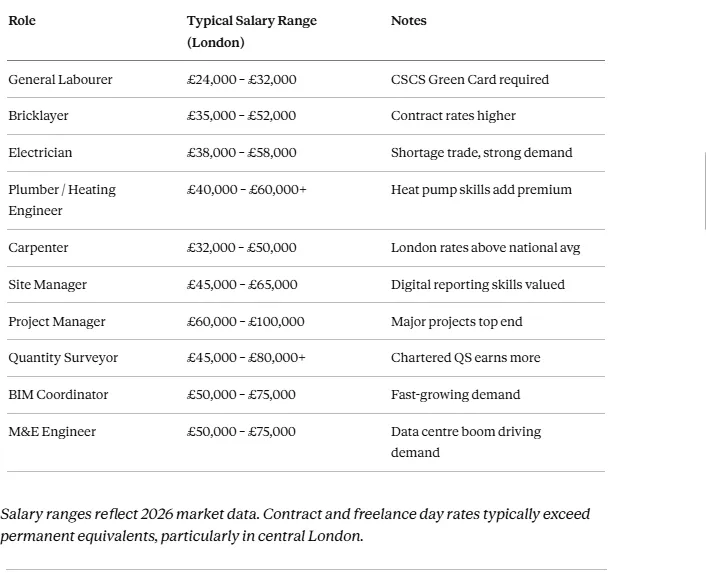
Here's a realistic breakdown by role type:
Trade Roles
Trade and site operative roles are among the most in-demand in London. These hands-on positions typically earn between £28,000 and £45,000 per year on a permanent basis, with experienced tradespeople earning more via contract arrangements.
Contract day rates in London are especially competitive for bricklayers, plasterers, carpenters, groundworkers, and electricians. The plumbing and heating shortage is particularly acute — with the government pushing heat pump installations and decarbonisation targets, demand for these skills is growing faster than the workforce can keep up. That specific skill set commands above-average rates right now.
Site and Project Management Roles
Site management roles now increasingly require digital reporting and safety compliance expertise. Project Managers on major London projects earn between £60,000 and £100,000.
Quantity Surveyors
Quantity Surveyors' salaries typically range from £45,000 to £65,000, with Senior Quantity Surveyors earning between £60,000 and £80,000 or more. Career progression leads to Managing Surveyor, Commercial Manager, and Commercial Director roles.
BIM Coordinators and Digital Construction Specialists
Candidates with digital skills — BIM, Revit, and construction technology fluency — command premium rates, and these roles are among the most actively recruited in London's commercial sector.
General Average
The average pay for a construction worker in London is £51,047 a year and £25 an hour, with the salary range sitting between £37,366 and £60,848. That said, this average covers a wide spread of roles — a first-year labourer and a senior site manager are both counted in figures like this, so your actual earning potential depends heavily on your trade, experience level, and whether you work on a permanent or contract basis.
London Construction Salary Table (2026 Estimates)
The Most In-Demand Construction Jobs in London Right Now
1. Site Manager
Site Managers are among the most actively recruited roles in London's construction market. Responsibilities include overseeing daily operations, managing subcontractors, maintaining health and safety standards, and keeping projects on programme. Digital reporting and compliance knowledge increasingly distinguish strong candidates.
2. Quantity Surveyor (QS)
Commercial and residential developers constantly need QS professionals to manage costs, procurement, and contract administration. London construction consultancies are actively seeking QS professionals with residential project experience, carrying out pre- and post-contract services including feasibilities, cost plans, tendering, and procurement through to completion.
3. Project Manager
The most senior delivery role on most sites. Project managers orchestrate complex builds, manage multimillion-pound budgets, and ensure projects complete on time and within scope. Experience level plays a crucial role, and project managers with proven track records on specific project types can command different rates based on sector demand.
4. M&E Engineer
Mechanical and electrical engineering is a high-demand specialism in London. Data centre construction is one of the fastest-growing subsectors in the South East, and M&E Engineers are essential to delivering these projects. Healthcare builds and commercial fit-outs also drive strong demand.
5. Bricklayer
Bricklayers remain one of the most consistently sought trades across London's residential new-build and refurbishment sectors. The shortage means experienced bricklayers often work on a contract basis, setting their own day rates.
6. Electrician
Skilled trades now offer stronger job security and competitive pay. Electricians with 18th Edition wiring regulations knowledge are particularly valued, especially on commercial fit-outs and new residential schemes.
7. BIM Coordinator
Building Information Modelling (BIM) is now standard on most large London projects. Candidates who develop digital skills in BIM and Revit can command premium rates, and this role bridges technical site knowledge with software proficiency.
Qualifications and Certifications You Need to Work on London Sites
The CSCS Card — Non-Negotiable
The Construction Skills Certification Scheme (CSCS) card is the most widely recognised proof of competence for workers on UK construction sites. Most major principal contractors require all site-based workers — from labourers to managers — to hold a valid CSCS card before they can access sites. Without one, your job options in UK construction are significantly limited.
Card types are identified by colour: the Green Card is for site operatives with a Health and Safety awareness certificate; the Red Card is for workers in training or with a craft/operative NVQ in progress; and the Blue Card is for those with a relevant NVQ Level 2 or equivalent.
To obtain a CSCS card, you need to pass the CITB Health, Safety, and Environment test, which you can book at an approved test centre. The test itself is not particularly difficult if you prepare — most providers offer dedicated revision materials.
NVQs and Apprenticeships
Many skilled trades require NVQs or apprenticeships rather than degrees. However, engineering and surveying roles typically require higher education. An NVQ Level 2 qualifies you for the Blue CSCS card; NVQ Level 3 opens further progression.
Professional Chartership
For those in management, surveying, or engineering roles, chartership significantly boosts earning potential. Professional charterships through RICS (Royal Institution of Chartered Surveyors), ICE (Institution of Civil Engineers), or CIOB (Chartered Institute of Building) maximise earning potential.
How to Find Construction Jobs in London
There's no single best route — the most successful job seekers typically use a combination of approaches.
Specialist job boards such as Construction Job Board, CareerStructure, and CW Jobs carry London-specific vacancies across trades, professional, and management roles. These consistently outperform general platforms like Indeed for construction-specific roles because the listings are more targeted and many smaller contractors only post there.
Recruitment agencies specialising in construction — such as Atkins Search, Linear Recruitment, and Hays Construction — give you access to roles that are never publicly advertised. If you're a QS, project manager, or engineer, registering with a specialist agency is worth the time.
Direct applications to principal contractors (Mace, Skanska, Barratt, Berkeley Group, Kier, Morgan Sindall) often yield results, particularly for management and professional roles. Check their careers pages directly rather than relying on third-party listings.
Networking on LinkedIn is increasingly important in construction's professional tiers. A well-maintained profile with your CSCS status, qualifications, and project history makes you findable by recruiters.
Labour agencies and gang masters remain the most common route for trade and labouring work on a day-rate or short-term contract basis. These are practical for experienced tradespeople who want to maintain flexibility.
How to Stand Out When Applying for Construction Jobs in London
London is a competitive market even with a skills shortage. Here's what separates candidates who get responses from those who don't:
Your CV should be project-focused. List the specific projects you've worked on — their scale, your precise role, and any notable outcomes (delivered on time, resolved a specific technical challenge, managed a subcontractor package). Generic CVs describing "excellent communication skills" are ignored. Concrete project experience isn't.
Get your certifications current before applying. An expired CSCS card or an out-of-date first aid certificate will delay your start date and flag poor preparation to employers.
For trade roles, specify your tools and specialisms. A carpenter who can say they've worked on curtain walling, shopfitting, and timber frame residential is far more attractive than one who lists "joinery skills."
For management and professional roles, demonstrate commercial awareness. Site management roles now increasingly require digital reporting and safety compliance expertise. If you've used digital site management tools (Procore, Fieldview, Autodesk Build), say so.
Consider contract over permanent. Contract-based workers often earn higher daily rates, especially in London and the South East. If you have the financial stability to work contract, you will typically earn more.
Emerging Opportunities: Where London Construction Is Heading
Net-Zero Retrofit
Commercial office refurbishment and net-zero retrofit is one of the fastest-growing work streams in London. Specialising in net-zero retrofit, modular construction, or infrastructure gives workers access to areas of highest unmet demand. Trades with knowledge of insulation systems, heat pumps, and building fabric upgrades are particularly well positioned.
Data Centres
Data centre construction is one of the fastest-growing subsectors in the South East, and London's proximity to major connectivity infrastructure makes it a hub for this work. M&E engineers, project managers, and specialist fit-out trades are in high demand for these projects.
Digital Construction Skills
Construction technology fluency, including BIM and Revit, commands premium rates and is increasingly expected rather than just valued. If you're in a site management or engineering role and haven't yet engaged with digital site tools, now is the time to do so.
Transport Infrastructure
The Docklands Light Railway extension to Thamesmead and the development of a London Infrastructure Framework signal a pipeline of public investment that will directly impact construction activity. Civil engineering and infrastructure trades will see sustained work from these projects over the coming years.
Key Takeaways
- London's construction market is active and well-funded, supported by residential development, infrastructure investment, net-zero retrofit, and a growing data centre sector.
- London salaries are 25–30% above the national average for equivalent roles.
- The sector needs approximately 240,000 additional workers nationally by 2029 — skilled workers are in a strong position.
- A CSCS card is the entry requirement for virtually all commercial site work in London.
- Contract rates outperform permanent salaries in many trade categories, particularly in central London.
- Net-zero retrofit, data centres, and digital construction are the fastest-growing work streams for 2026 and beyond.
- Professional chartership (RICS, ICE, CIOB) significantly increases earning potential in management and surveying roles.
Last Thoughts
London remains one of the UK's most active construction markets, and the combination of a genuine skills shortage, sustained public and private investment, and salaries well above the national average makes it an attractive destination for both new entrants and experienced professionals looking to progress. Whether you're a bricklayer, a project manager, or somewhere in between, the fundamentals are in your favour: get your CSCS card current, keep your qualifications up to date, and target the work streams — retrofit, infrastructure, and data centres — where demand is running ahead of supply.
FAQs: Construction Jobs in London
Q: Do I need a CSCS card to work on London construction sites?
A: Most major principal contractors require all site-based workers to hold a valid CSCS card before they can access sites. There are rare exceptions on private domestic projects, but any commercial or large residential project will require one.
Q: Are construction salaries in London higher than elsewhere in the UK?
A: Yes — London construction salaries are typically 25–30% higher than equivalent regional roles, reflecting higher living costs and project complexity.
Q: Is the London construction market still hiring in 2026?
A: Yes. There are over 2,185 construction vacancies in London, covering permanent, contract, and freelance roles across trades, engineering, and management.
Q: What are the highest-paid construction jobs in London?
A: Project Managers on major projects earn between £60,000 and £100,000. Senior Quantity Surveyors earn between £60,000 and £80,000 or more, with commercial directors and programme managers earning above those figures.
Q: Can overseas workers get construction jobs in London?
A: Yes, but overseas workers must meet UK visa requirements and hold relevant certifications such as a CSCS card. Overseas qualifications may need to be assessed for UK equivalency before a CSCS card can be issued.
Q: Is construction a good long-term career in London?
A: The UK construction skills shortage is not a short-term situation — the National Infrastructure Strategy, housing targets, NHS estate investment, and the net-zero transition will sustain demand for skilled construction workers for at least the next decade.
Q: Do I need a degree to work in London construction?
A: No — many skilled trades require NVQs or apprenticeships rather than degrees. However, engineering and surveying roles typically require higher education.






























Sign in to leave a comment.