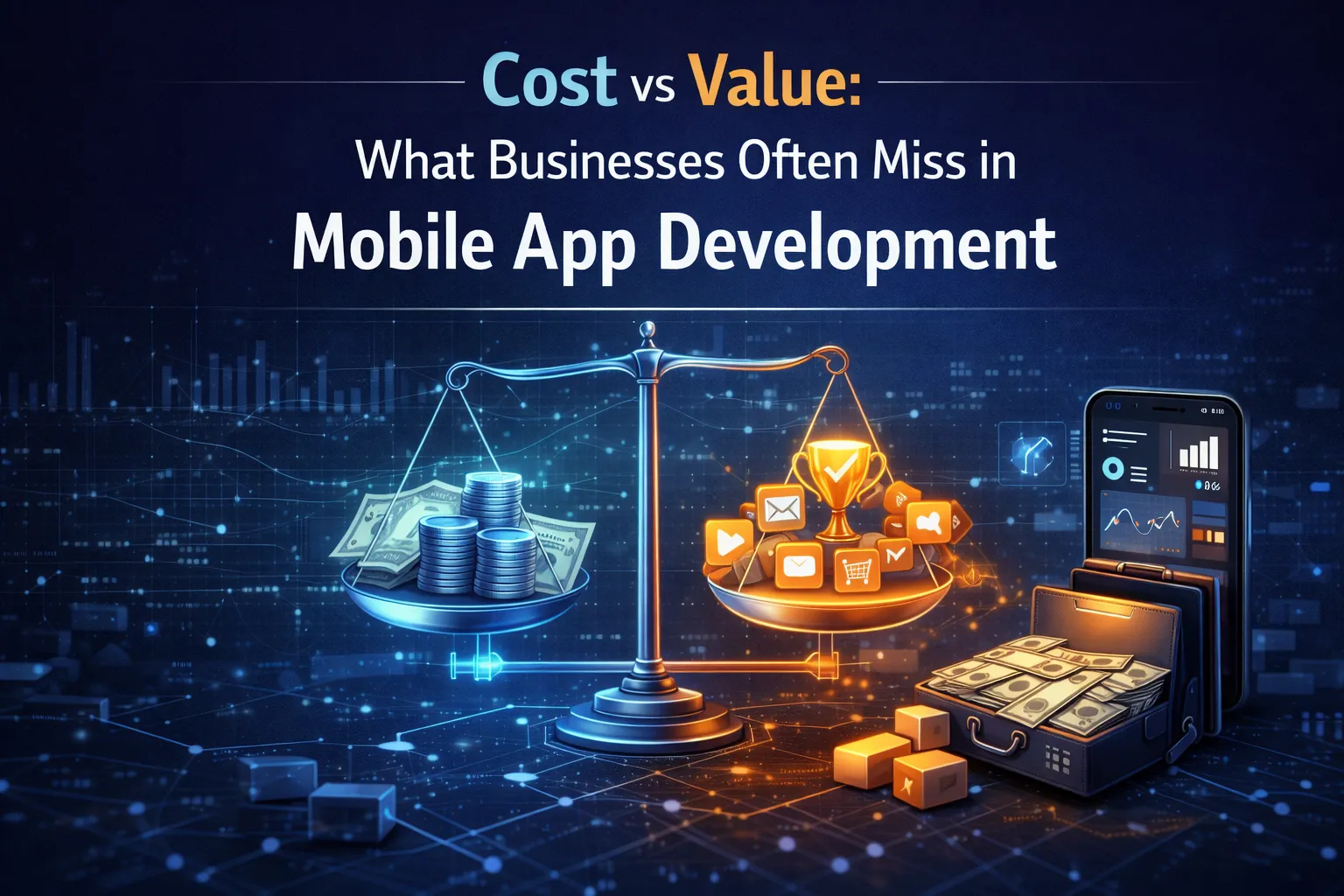

You can spend a lot on an app and still lose. That is the trap. Many teams obsess over mobile app development cost before they ask the bigger question: what value will this app create after launch?
The app economy keeps growing, with global app revenue still climbing in 2025, while poor software quality continues to cost US businesses trillions every year. (Business of Apps)
So, the real risk is not just overspending.
It is paying for the wrong thing, shipping too much, or building an app that looks polished but does not move revenue, retention, or efficiency in a real way.
Mobile App Development Cost is Only Half the Story
Most businesses start with one question: how much will the app cost?
Fair question. But it is incomplete.
Mobile app development cost matters because budget shapes scope, speed, and team structure. Still, cost alone does not tell you whether the app will perform, convert, retain users, reduce service load, or support growth. A cheap app that breaks, confuses users, or needs a rewrite in six months is expensive. A more thoughtful build that solves a real business problem can pay back far more than its price.
That is where a lot of teams slip.
They compare proposals line by line, but they do not compare outcomes line by line.
And that is a huge difference.
What Businesses Usually Measure First
Most buyers focus on things like:
- design screens
- feature count
- hourly rate
- delivery timeline
- iOS vs Android pricing
- in house team vs agency cost
Those are valid. But they are inputs, not outcomes.
A smarter buying lens looks at what the app should actually do for the business, such as:
- increase repeat purchases
- cut manual work
- shorten sales cycles
- improve customer retention
- reduce churn
- create new revenue streams
- speed up field operations
That is the shift from price to value.
In the upper part of the market, even an AI app development company USA may price higher than a low-cost vendor, but if the app reduces support volume, improves decision-making, and increases conversion, the return can be stronger over time.
Why Cheap Apps Often Become Expensive
Here is the part many teams learn late.
A low upfront mobile app development cost can look attractive in a proposal, but hidden costs usually show up after launch. Bugs, poor code structure, weak testing, and missing analytics create extra rounds of fixes, lost users, and rework. That pain is not minor either. The Consortium for Information and Software Quality estimated the cost of poor software quality in the US at at least $2.41 trillion in its 2022 report.
That number is massive. But the lesson is simple.
Poor quality costs more than quality.
The Hidden Costs That Hurt ROI
Watch for these common budget leaks:
- unclear product scope that keeps changing mid build
- poor backend planning that slows every future update
- no event tracking, so you cannot measure app ROI cleanly
- rushed QA that lets retention killing bugs go live
- overbuilding features users do not even need
- weak onboarding that drives uninstall rates up
- cheap architecture that blocks future scaling
This is why mobile app development cost should never be reviewed by itself. It has to sit next to lifetime value, retention targets, support savings, and monetization goals.
A business app is not a brochure. It is an operating asset.
What Value Actually Looks Like in A Mobile App
Now let us get practical.
Value does not always mean direct app sales. Sometimes the app makes money. Sometimes it saves money. Sometimes it protects customer relationships that would otherwise leak away.
All three count.
Direct Value
This is the obvious one. The app drives revenue by:
- increasing purchases
- improving subscription signups
- enabling upsells
- supporting paid features
- lifting conversion through a smoother checkout or booking flow
Indirect Value
This is the part people miss. An app can create strong business value by:
- reducing admin time
- replacing manual reports
- improving team response times
- lowering support tickets
- shortening field task completion
- improving staff productivity
Strategic Value
This is long game value. The app helps you:
- own customer relationships directly
- collect first party behavioral data
- test offers faster
- launch new services
- strengthen retention over competitors
So yes, mobile app development cost is important. But value is multi-layered. If you only calculate build spend and ignore operational gain, you are undercounting the return.
That is why many teams working with a mobile app development company Atlanta or any regional partner should ask outcome questions before asking for a discount.
How To Judge Mobile App Development Cost the Right Way
Here is a cleaner way to evaluate an app investment.
Do not ask, “What is the cheapest way to build this?”
Ask, “What is the smartest way to reach the result we want?”
That small change improves everything.
Use This Cost vs Value Table
| Area | Low-Cost Thinking | Value-Based Thinking |
| Scope | Add as many features as possible | Build only what drives outcomes |
| Design | Make it look modern | Make it easy to use and convert |
| Tech Stack | Pick whatever is cheapest now | Pick what is maintainable later |
| QA | Test at the end | Test throughout development |
| Analytics | Add later | Add from day one |
| Launch | Ship and hope | Launch, measure, improve |
| Success Metric | Build completed | Business goal achieved |
This is where mobile app development cost becomes more meaningful. You are not just buying code. You are buying user flow, retention logic, system reliability, and future flexibility.
And honestly, that is a better deal.
The Questions Smart Buyers Ask Before They Build
Before approving any budget, ask these questions.
1. What Business Problem is the App Solving?
Be precise.
Not “we need an app because competitors have one.”
Try this instead:
- we need to reduce missed bookings
- we need faster order repeat rates
- we need field teams to work offline
- we need customers to self serve more often
Clear problem, clearer value.
2. What Does Success Look Like in Numbers?
Tie the app to measurable outcomes:
- 15 percent increase in repeat orders
- 20 percent drop in support tickets
- 30 percent faster sales rep task completion
- 10 percent lift in renewal rate
Without this, app ROI becomes fuzzy, and fuzzy kills confidence.
3. What Can Wait Until Version Two?
This one saves money fast.
Most first releases do not fail because they are too small. They fail because they are too bloated. A focused MVP usually creates better learning and stronger app ROI than a stuffed launch with unclear priorities.
4. What Will Maintenance Cost?
Businesses ask about build cost, then forget updates, hosting, security patches, store compliance, analytics refinement, and feature tuning. Real mobile app development cost includes post launch work too.
5. Do We Need Native or Cross Platform?
There is no universal winner.
The right answer depends on speed, performance, budget, and feature needs. A good Android app development company should not just sell code. They should explain why the platform choice fits your business case.
Where ROI Usually Comes from After Launch
Here is the good part. Value often starts appearing in places businesses did not model well enough at the start.
Common ROI Drivers
- higher order frequency from saved payment details
- better retention from push notifications used with restraint
- stronger conversion from simpler user journeys
- lower churn from faster support access
- lower operating cost from workflow automation
- better decisions from in app analytics
- more repeat engagement through personalization
Transition line here, because this matters.
Your app does not need to “go viral” to work. It needs to improve a business metric that matters.
That is a much more stable path.
A Simple ROI Formula
You can estimate app ROI with a basic model:
ROI = (Gain from app - total app cost) / total app cost
Your gain can include:
- revenue generated
- support costs reduced
- labor hours saved
- churn prevented
- repeat purchase increase
When businesses skip these inputs, they end up treating the app like a design project, not a business system.
The Biggest Mistake: Confusing Features with Value
This happens all the time.
A team asks for chat, loyalty, AI recommendations, dashboards, admin roles, custom filters, geolocation, wallets, and multi language support right out of the gate.
Sounds impressive. But does the user need all that now?
Maybe not.
Features are only valuable when they improve a result. Otherwise, they raise mobile app development cost, slow testing, and make the app harder to use.
That is why fewer features can sometimes produce better app ROI.
Yes, really.
Build This First
Prioritize features that do one of these things:
- remove friction from the main user task
- help users complete actions faster
- create repeat usage
- reduce operational work for the business
- make measurement easier
Everything else can wait.
How To Spend Better Without Spending Blind
This is not a pitch for spending more. It is a pitch for spending smarter.
You can control mobile app development cost without killing value when you:
- define one clear user journey first
- keep version one focused
- choose scalable architecture early
- add analytics before launch
- test with real users, not assumptions
- budget for iteration, not just delivery
- judge vendors on thinking, not only price
That last one is key.
A team that challenges bad ideas can save you more than a team that agrees to every feature request.
And that is where this becomes more than a cost vs ROI. It becomes a decision framework for the whole business.
Final Take: Cost Matters, But Value Decides the Win
Let us land this simply.
Mobile app development cost is the price of building.
Value is the reason building is worth it.
When businesses focus only on cost, they often buy the wrong scope, the wrong team, or the wrong timeline. When they focus on value, they build apps that support revenue, reduce waste, and stay useful longer.
So before you ask what the app will cost, ask what the app must change.
That answer will shape better features, better spending, and better app ROI.
And in the end, that is what separates an app expense from an app asset.

























Sign in to leave a comment.