
Know-your-customer onboarding is one of the least forgiving places for bad country data to hide, because the consequences of getting it wrong aren't just a cosmetic bug, they're compliance failures, rejected legitimate applicants, or worse, accepted applicants who should have been flagged. A country api for kyc workflow needs a different standard of reliability than a casual signup dropdown, and a proper country data api for forms approach is what closes the gap between "looks fine in testing" and "holds up under actual regulatory scrutiny."
Why KYC Has Zero Tolerance for Stale Country Data
Most country dropdown bugs are minor annoyances, a wrong currency symbol, a missing flag icon. In a KYC context, the same category of bug becomes a genuine compliance problem. Sanctioned country lists change. Jurisdictional naming conventions matter for regulatory reporting. A country's official designation or classification under a specific compliance framework can shift without much public notice, and a static, unmaintained country list has no mechanism to catch that change before it results in either wrongly rejecting a legitimate applicant from a country that's no longer restricted, or wrongly accepting one from a jurisdiction that's since become restricted.
This is the core argument for treating country reference data in a KYC flow as something that needs to stay current by design, not something that gets set once during initial development and revisited only when someone notices a problem.
The Difference Between Displaying a Country and Validating One
A casual signup form treats country selection as a display and personalization input, get the currency roughly right, show a reasonable flag. A KYC form needs country data to actually validate against, confirming the selected country matches an ISO-standard code that downstream compliance systems, sanctions screening tools, and reporting requirements all expect consistently. A dropdown populated from a hardcoded list that uses slightly different naming or code conventions than what your compliance backend expects creates a silent mismatch, the form looks like it's working, but the data flowing into compliance systems doesn't cleanly map to what those systems are checking against.
Standardizing on ISO country codes as the actual stored and transmitted value, with display names as a separate, purely cosmetic layer, avoids this entire category of mismatch. The code is what compliance systems check, the display name is what a human sees, and conflating the two is where a lot of subtle KYC data integrity problems originate.
Multiple Nationality and Residency Fields Need Independent Accuracy
A thorough KYC form often asks for more than one country-related field, nationality, country of residence, sometimes country of birth, each potentially subject to different rules. A user's nationality might not be subject to any restriction while their current country of residence is, or vice versa. This means the underlying country dataset powering each of these fields needs to be equally reliable and equally current across all of them, a system that keeps one field accurate while letting another drift out of date creates exactly the kind of inconsistency that undermines the whole point of collecting multiple country fields separately in the first place.
Handling Disputed Territories and Naming Sensitivities
Country data in a compliance context occasionally intersects with genuinely sensitive naming and territorial questions, regions with contested status, or countries known by more than one name depending on political context. A KYC system needs a clear, documented, consistently applied policy for how these are handled and labeled, rather than an ad hoc decision made once during development and never revisited. This isn't primarily a technical problem, it's a policy decision that then needs to be technically enforced consistently across every part of the system that touches country data.
How countrylayer Supports This
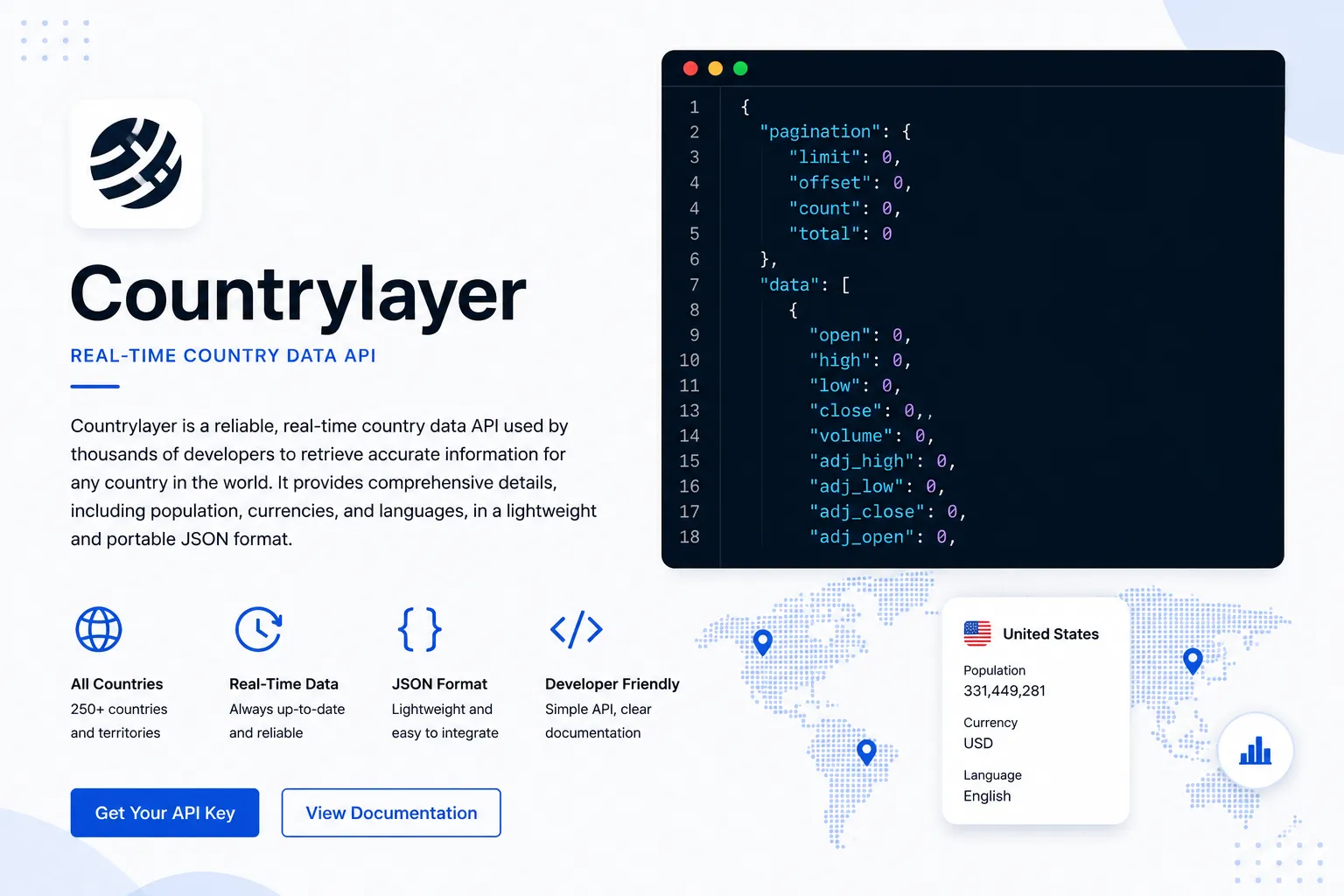
countrylayer returns ISO-standard country codes alongside names, regions, and related metadata from a centrally maintained, continuously updated source, which gives a KYC workflow the consistency needed between what a form displays and what compliance systems downstream actually validate against. Because the underlying data updates centrally rather than requiring manual maintenance of a static list, a form built on it stays aligned with current country classifications without someone needing to notice and manually patch a stale entry.
Frequently Asked Questions
Why does country data matter more for KYC than for a typical signup form? KYC data feeds directly into compliance and sanctions screening decisions, where stale or inconsistent country data can result in either wrongly rejecting legitimate applicants or missing genuinely restricted ones, consequences a typical signup form doesn't carry.
Should nationality and country of residence use the same underlying data source? Yes, using a single consistent, current source for every country-related field avoids the inconsistency that arises when different fields are populated from different, potentially out-of-sync data sources.
Is displaying a country's common name enough, or does the system need the ISO code too? Both matter, but for different purposes, the ISO code should be what's actually validated and stored for compliance purposes, while the display name is a separate, purely cosmetic layer for the user-facing form.
Build KYC Forms on Data That Holds Up to Scrutiny
Get ISO-standard, continuously current country data instead of a static list that quietly drifts out of date.
Get started here: https://apilayer.com/products/countrylayer/























Sign in to leave a comment.