


Manufacturers often need to decide whether a dedicated custom fixture or a modular fixturing system is more suitable for their welding process. The right choice depends on production volume, component geometry, accuracy requirements, product variation, and how often the fabrication setup is expected to change.
Custom fixtures are developed around a particular component or assembly. They can incorporate dedicated locating, clamping, and support elements based on the geometry of the workpiece. This can make them useful for specialised components or repetitive high-volume production.
For a component that is manufactured repeatedly with the same dimensions, a dedicated fixture can provide a consistent setup. Once the fixture has been developed and adjusted, operators can use the established locating and clamping arrangement for subsequent assemblies.
However, dedicated fixtures may become less flexible when product designs change. If dimensions or component geometry are modified, the existing fixture may require changes or may no longer be suitable.
This is where modular fixturing can provide an alternative. Modular systems use reusable components that can be arranged and rearranged according to the workpiece. Pins, stops, supports, clamps, angles, and other elements can be configured for different assemblies.
Modular systems can be useful for prototypes, small batches, multiple product variations, and manufacturing environments where designs change frequently. Instead of creating a completely new fixture for every component, manufacturers can adjust an existing setup.
Regardless of which approach is selected, the fundamentals of welding fixture design remain the same. The fixture needs to establish accurate reference points, secure the workpiece, provide adequate support, and maintain access to the welding area.
Locating and clamping should not be treated as the same function. Locators establish position, while clamps secure the component against those reference points. This distinction helps create a more controlled fixture arrangement.
Complex assemblies may also require adjustable supports. Tubes, frames, curved components, and irregular fabrications can need additional support to maintain stability during welding.
The 3-2-1 principle may provide a useful framework for locating a workpiece. However, it should be applied according to the actual geometry and critical dimensions rather than used as a rigid formula.
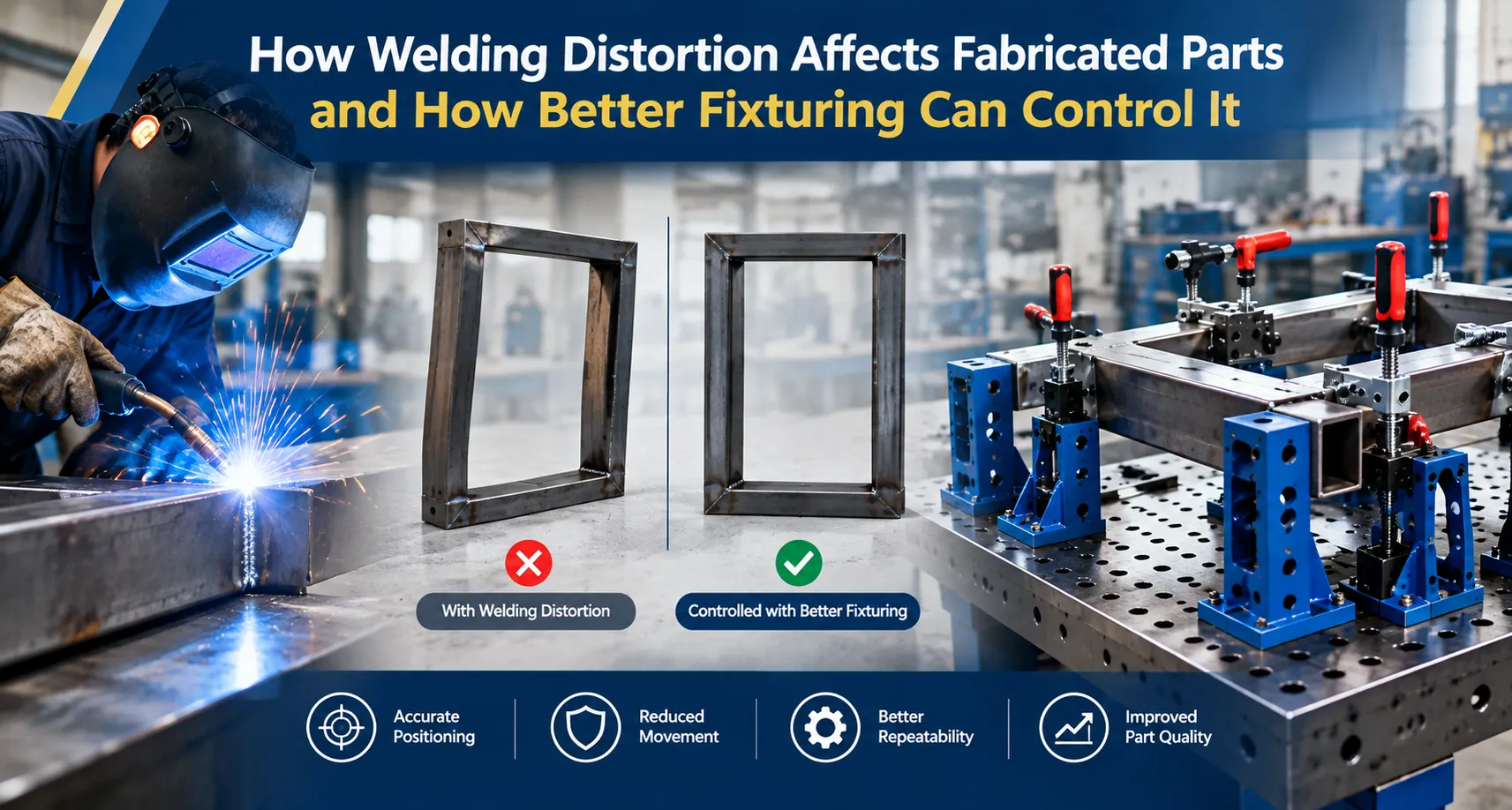
Welding distortion should also be considered. Clamps and supports can help control unwanted movement, but excessive restriction can create stress. Welding sequence, heat input, joint design, and material behavior all need to be considered.
FIXTO Welding Solution provides modular welding and fixturing solutions for manufacturers working with different fabrication requirements.
The decision between custom and modular fixturing should therefore be based on the manufacturing environment. High-volume production of one specialised component may justify a dedicated fixture, while varied production may benefit from modular equipment.
Manufacturers should also consider future requirements. If new product designs or dimensional changes are expected, a flexible fixture system may reduce the need for complete fixture redesigns.
Ultimately, both custom and modular approaches have a place in welding fabrication. The important factor is selecting the system that matches the component, production volume, accuracy requirements, and expected changes.
A well-planned fixture can support consistent positioning, controlled clamping, practical accessibility, and repeatable fabrication.
Read More: Welding Fixture Design: How to Position, Clamp, and Support Complex Fabrications



















Sign in to leave a comment.