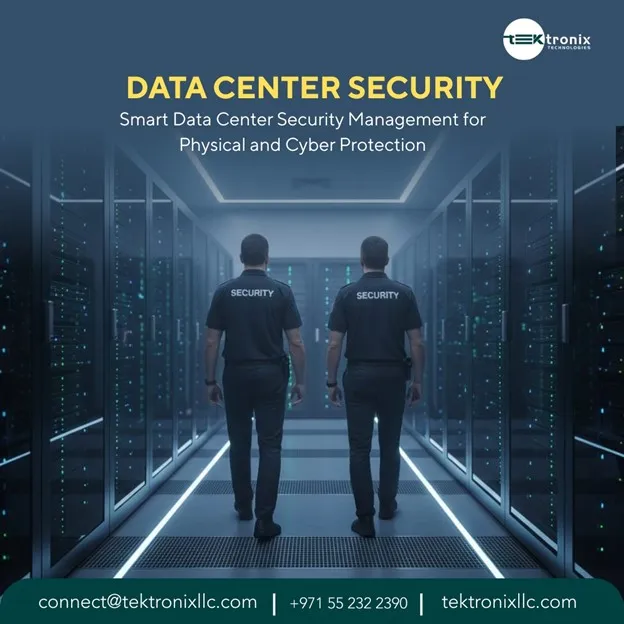

Data Center Security is no longer a back-office afterthought — it is a board-level strategic priority for every organisation that processes, stores, or transmits critical digital assets across the Middle East. From hyperscale cloud providers to enterprise colocation tenants in Muscat and Salalah, the threat landscape has evolved dramatically, demanding a layered, intelligence-driven approach that goes far beyond perimeter fencing and lock-and-key cabinets.
At Tektronix LLC, we have engineered a comprehensive six-layer data center security framework that integrates physical, electronic, and biometric controls into a single, unified system — purpose-built for the operational realities of Oman and the broader GCC. This article walks through every layer, the technologies behind it, and why this multi-dimensional approach is the only credible answer to today’s physical and cyber-physical threats.
Why a Layered Approach to Data Center Security Is Non-Negotiable?
The phrase “defence in depth” originates in military strategy, but no concept translates more directly to the world of physical infrastructure protection. A data centre that relies on a single barrier — however formidable — creates a single point of failure. The moment that barrier is compromised, every asset inside is exposed.
Modern threat actors are patient, resourceful, and well-informed. Insider threats, social engineering, targeted theft of hardware, and corporate espionage are as real a concern in Oman’s growing digital economy as they are in Frankfurt or Singapore. Regulatory frameworks including Oman’s National Information Technology Governance Framework and the GCC’s Critical Information Infrastructure Protection directives are codifying this reality into compliance obligations — meaning organisations cannot afford a reactive posture.
The answer is a structured security architecture where each layer independently validates identity, monitors behaviour, detects anomalies, and reports to a central command layer. Defeat one layer and you still face five more. This is the philosophy behind Tektronix LLC’s proven framework, and it is the foundation upon which robust Data Center Security Oman projects are designed and delivered.
Layer 1: Facial Recognition in Data Center Security
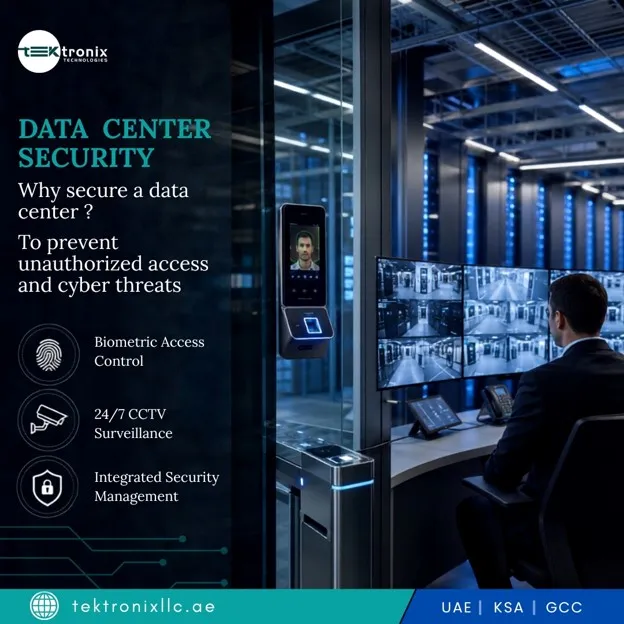
Facial Recognition in Data Center Security represents the gold standard for identity assurance at the highest-consequence access points — server halls, meet-me rooms, and operations centres. Unlike access cards, PINs, or even fingerprints, a face cannot be shared, borrowed, duplicated from a photograph at distance, or left on a desk.
How it works in a data centre context
Deployed at mantrap corridors and critical inner-zone doorways, facial recognition terminals capture a live biometric frame, perform real-time liveness detection to reject spoofing attempts, and match the result against a centralised or on-device enrolment database — all in under a second. The technology integrates directly with the site’s access control platform to trigger door release, log a timestamped audit record, and optionally alert security operations if an unrecognised individual attempts entry.
In the context of Omani data centre operations, the technology offers particular value in high-rotation colocation environments where dozens of different client technicians request access on irregular schedules. Facial recognition removes the administrative overhead of physical credential issuance while simultaneously hardening the verification standard beyond what card-based systems can achieve.
Key operational benefits:
• Zero-touch entry — no contact surface, no credential to forget or lose
• Mask and eyewear tolerance — algorithm adapts to cultural dress requirements across the GCC
• Sub-second throughput — no queuing at high-volume shift-change gates
• Audit-grade evidence — every entry logged with a biometric-verified identity record
Layer 2: Visitor Management System in Data Center Security
Every data centre faces a paradox: it must remain accessible to authorised engineers, clients, and auditors while remaining impenetrable to everyone else. A robust Visitor Management System in Data Center Security resolves this paradox by digitising, automating, and auditing the entire visitor lifecycle — from pre-registration to departure — without creating bottlenecks at the reception desk.
Beyond the paper sign-in sheet
Legacy visitor books are a liability. They expose the names of previous visitors to subsequent arrivals, provide no real-time verification capability, and create no actionable audit trail. A modern visitor management platform replaces this with a digital workflow: visitors are pre-registered by their host, receive a QR code or access token, are photographed and ID-verified on arrival, and are issued a time-limited, zone-restricted access credential that expires automatically when their appointment ends.
For Data Center Security Muscat deployments in particular, where international and regional clients frequently send visiting engineers from different organisations, the visitor management system becomes the primary mechanism for enforcing the principle of least-privilege access — ensuring that a storage system engineer from one client never accidentally or deliberately accesses another client’s cage.
Platform capabilities that matter most for data centres:
• Pre-authorisation workflow — host-initiated approval before the visitor reaches site
• National ID / passport scanning — automated OCR verification against government databases
• Watchlist screening — real-time check against internal and external security lists
• Escort management — mandatory host accompaniment enforced at every access point
• Departure tracking — system alerts if a visitor has not checked out within their scheduled window
Layer 3: Smart Turnstile System in Data Center Security
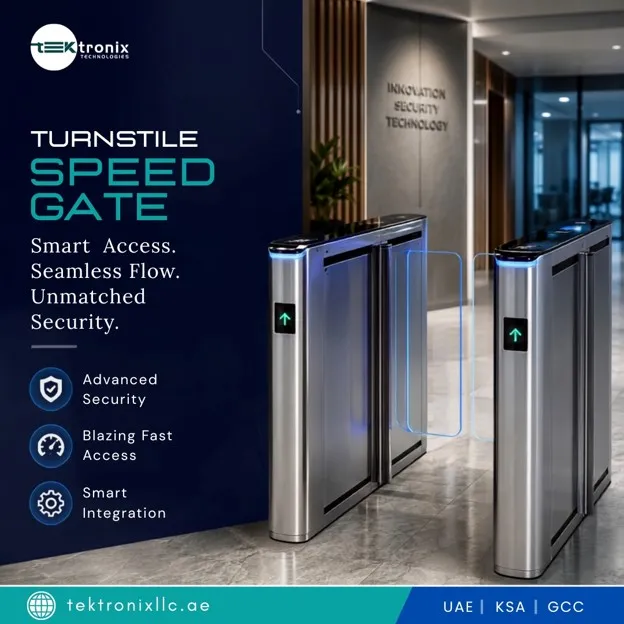
Physical access control is only as strong as its enforcement mechanism. A Smart Turnstile System in Data Center Security provides the critical bridge between electronic identity verification and the physical prevention of unauthorised entry — eliminating the most common vulnerability in card-based systems: tailgating.
Optical turnstiles with tailgate detection sensors monitor the exact number of individuals passing through each passage event. When a single credential is used to admit two or more people simultaneously, the system triggers an immediate alarm and, optionally, locks the barrier. Combined with overhead video analytics, the system can generate a tailgate probability score for every passage event and flag high-risk incidents for security review.
Turnstile configurations for data centre zones
Not all data centre zones require the same physical deterrent. Tektronix LLC designs turnstile deployments in tiered configurations:
• Lobby speed lanes — sleek optical barriers for staff and authorised visitor throughput in public-facing areas
• Mantrap airlocks — interlocked double-door systems for highest-security inner zones where only one individual may be present at a time
• Full-height turnstiles — anti-climb barriers for critical infrastructure perimeter entry points in outdoor or semi-outdoor settings
All configurations integrate natively with the site’s access control management system, feeding real-time passage event data into the central security operations dashboard. For Data Center Security Salalah projects — particularly at logistics and port-adjacent facilities — full-height configurations are frequently specified to address the elevated physical intrusion risk profile of industrial perimeters.
Layer 4: CCTV Surveillance in Data Center Security
If access control is the immune system of a data centre, then CCTV Surveillance in Data Center Security is its nervous system — constantly sensing, recording, and analysing everything happening across every physical zone, 24 hours a day, 365 days a year. But modern data centre CCTV has evolved far beyond passive recording.
Video analytics: from recording to intelligence
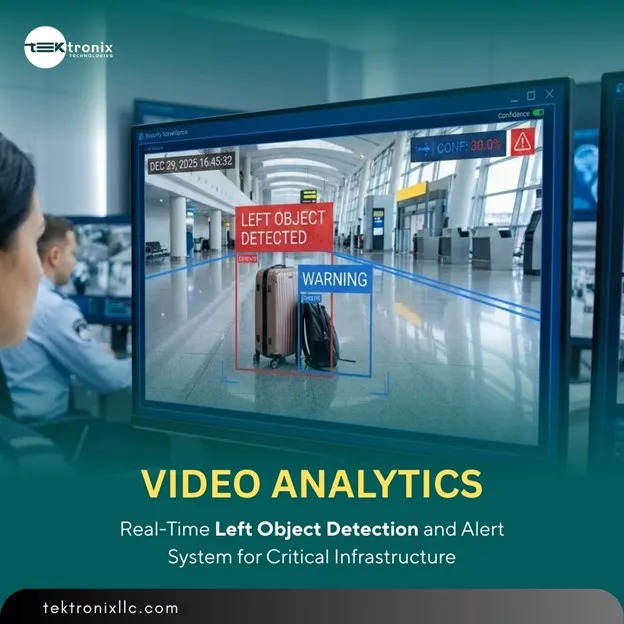
AI-driven video analytics transform the CCTV layer from a forensic tool into a real-time detection engine. Behaviours that previously required a vigilant human operator to catch — loitering at a secure door, an individual in a zone they have not been authorised for, a vehicle moving in a direction inconsistent with normal traffic flow — are now detected automatically and generate instant alerts to the security operations centre.
Camera placement for data centre environments follows a structured topology: perimeter coverage at the external boundary, lobby and reception monitoring at the first layer of entry, aisle-level cameras within the data hall providing cabinet-by-cabinet visibility, and dedicated coverage of power, cooling, and network infrastructure areas where sabotage risk is highest.
For compliance purposes, video retention policies must align with the data centre’s client SLAs and applicable regulations. Tektronix LLC architect’s CCTV systems with compressed, encrypted storage capable of retaining high-definition footage for 90 days or beyond, with secure chain-of-custody export capability for use as evidence in the event of a security incident. This is a recurring requirement in Data Center Security Muscat projects serving financial services and telecommunications clients.
Layer 5: Perimeter Intrusion Detection in Data Center Security
The most dangerous threat is the one that never reaches the front door. Perimeter Intrusion Detection in Data Center Security extends the protection boundary outward — detecting, classifying, and alerting on intrusion attempts at the outer fence line, building envelope, or roof before any adversary gets close enough to attempt a physical breach of the facility.
Technologies in the perimeter detection stack
A robust perimeter detection solution draws on multiple complementary sensing technologies, each covering a different attack vector:
• Fibre optic fence sensors — detect vibration, cutting, or climbing activity on the perimeter fence with metre-level location accuracy
• Microwave and radar barriers — invisible detection beams that alert on any mass crossing the protected zone, unaffected by weather or lighting conditions
• Thermal imaging cameras — detect human body heat at long range in complete darkness, sandstorms, or heavy fog — conditions regularly encountered across Oman
• Ground-based radar — provides wide-area coverage for large campuses, classifying targets as human, vehicle, or animal to minimise false alarms
All sensor inputs are fed through a central fusion engine that correlates alarms from multiple layers before escalating to the security operations centre — dramatically reducing false-positive rates that have historically undermined confidence in perimeter detection systems. For Data Center Security Oman projects where sites may be located on the outskirts of industrial zones with long unguarded fence perimeters, this convergence capability is essential to maintaining operator attention and response readiness.
Layer 6: Unified Security Management — Where Every Layer Converges
Five independent security layers operating in isolation still leave dangerous gaps. The sixth and most critical layer is the unified security management platform — a Physical Security Information Management (PSIM) or integrated security management system that aggregates alarms, events, video feeds, access logs, and environmental sensor data from every other layer into a single operational interface.
When an unknown individual attempts entry at a biometric reader, the PSIM instantly correlates that access denial with the nearest camera feed, checks whether a visitor management pre-registration exists, evaluates whether any perimeter or turnstile anomaly has been detected in the preceding minutes, and presents the security operator with a composite incident picture — rather than a stream of disconnected alarms.
This convergence is what transforms a collection of security products into an intelligent, responsive security system. Tektronix LLC’s integration team specialises in configuring multi-vendor environments — ensuring that hardware from different manufacturers communicates seamlessly through open standards including ONVIF, OSDP, and standard access control APIs.
Data Center Security Across Oman: Muscat, Salalah & Beyond
Oman’s digital infrastructure ambitions — anchored by the National Broadband Plan, Vision 2040, and the designation of Muscat as a regional data centre hub — are creating rapid demand for enterprise-grade physical security across the country. Tektronix LLC has designed and delivered data center security solutions for facilities ranging from enterprise on-premise server rooms to multi-megawatt colocation campuses.
Data Center Security Muscat
Data Center Security Muscat projects span the capital’s growing concentration of financial institutions, government ministries, telecom operators, and commercial enterprises in districts including Qurum, Al Khuwair, the Knowledge Oasis Muscat (KOM), and the Muscat Technology Park. Projects in the capital frequently require integration with existing building management systems and compliance with Central Bank of Oman and Capital Market Authority cybersecurity and physical security mandates.
Data Center Security Salalah
Data Center Security Salalah projects benefit from the city’s strategic position as a submarine cable landing station and free-trade zone hub. Data centre operators in Salalah face specific environmental challenges — coastal humidity, seasonal Khareef mist, and the proximity of industrial port infrastructure — that inform the selection of weatherproof hardware ratings, thermal imaging specifications, and perimeter sensor technologies. Tektronix LLC’s project experience in Salalah ensures that every system we commission is calibrated for these local conditions, not simply imported from a temperate-climate specification sheet.
Tektronix LLC — Proven Expertise in GCC Data Centre Physical Security
Tektronix LLC is a specialist physical security integrator with a verified track record across Oman, the UAE, Saudi Arabia, and the wider GCC. Our engineering team holds vendor-certified qualifications across the leading access control, video surveillance, intrusion detection, and visitor management platforms — and our project portfolio spans telecom data centres, financial institution infrastructure, government facilities, and large-scale industrial campuses.
We do not sell products — we design, supply, commission, and maintain security systems. Every Data Center Security project begins with a structured risk assessment aligned to internationally recognised frameworks including ISO 27001 Annex A, ANSI/TIA-942 (data centre infrastructure standard), and the CPNI (Centre for Protection of National Infrastructure) physical security guidance. This framework-first approach ensures that every technical decision is traceable to a validated risk, and that the delivered system can be audited against a defined compliance baseline.
Our authoritative capabilities cover:
• Security consulting & risk assessment — threat modelling, vulnerability analysis, and zone classification
• System design & architecture — layered schematics, technology selection, and integration planning
• Supply, installation & commissioning — certified engineers, structured cabling, and factory acceptance testing
• Integration & software configuration — PSIM/SIEM connectivity, API development, and custom reporting
• Managed services & maintenance — SLA-backed support, remote monitoring, and on-site response across Oman
Key Concepts in Modern Data Centre Physical Security
For security directors and facilities managers evaluating solutions, the following related concepts and standards are central to any credible data centre security specification:
• Defence in depth — the security architecture principle that multiple independent layers must be defeated for an intrusion to succeed
• Zero-trust physical access — every individual is verified at every access point, regardless of prior authentication
• Anti-passback & anti-tailgate — access control rules preventing credential sharing and unauthorised piggyback entry
• Two-person integrity (TPI) — operational policy requiring two authorised individuals to be present for access to the highest-security zones
• Physical penetration testing — adversarial simulation exercises that validate real-world security posture against the six-layer framework
• ANSI/TIA-942 compliance — the internationally recognised data centre infrastructure standard covering physical security classification tiers
Conclusion
The stakes inside a modern data centre could not be higher — petabytes of customer data, mission-critical application infrastructure, and the digital continuity of entire organisations depend on the physical security measures surrounding every server rack. A single-layer defence is not adequate. A patchwork of unintegrated products is not adequate. What is required is a coherent, layered, and intelligently managed security architecture.
Tektronix LLC’s six-layer Data Center Security framework — spanning Facial Recognition in Data Center Security, Visitor Management System in Data Center Security, Smart Turnstile System in Data Center Security, CCTV Surveillance in Data Center Security, and Perimeter Intrusion Detection in Data Center Security, converged through unified management — delivers exactly that. It is proven across Data Center Security Oman projects from Muscat to Salalah, calibrated for the region’s unique environmental and regulatory context, and backed by the expertise of a team that has been protecting critical infrastructure across the GCC for over a decade.
Whether your facility is in the planning stage, undergoing a security upgrade, or preparing for a compliance audit, the question is not whether you need this level of protection — it is how quickly you can put it in place.
FAQs
1. What are the six layers of data center security and why does each matter?
A comprehensive Data Center Security framework typically covers: (1) biometric identity verification (Facial Recognition in Data Center Security), (2) structured visitor governance via a Visitor Management System in Data Center Security, (3) physical access enforcement through a Smart Turnstile System in Data Center Security, (4) continuous visual monitoring via CCTV Surveillance in Data Center Security, (5) early-warning detection through Perimeter Intrusion Detection in Data Center Security, and (6) unified management that integrates all five into a single operational system. Each layer addresses a distinct attack vector; removing any one creates an exploitable gap.
2. How accurate is facial recognition in a busy data centre environment?
Enterprise-grade Facial Recognition in Data Center Security systems achieve False Acceptance Rates (FAR) below 0.0001% and are tested against ISO/IEC 30107–3 anti-spoofing standards. They operate accurately under varying lighting conditions, accommodate face masks and cultural head coverings, and complete verification in under a second — making them practical for high-throughput shift-change scenarios without creating entry queues.
3. How does a visitor management system improve compliance in a data centre?
A Visitor Management System in Data Center Security creates a complete digital audit trail of every individual who enters the facility — including their identity verification record, the host who authorised their visit, the zones they accessed, and the time of departure. This audit trail is essential for compliance with standards including ISO 27001, SOC 2, and PCI DSS, all of which require demonstrable evidence that access to critical infrastructure is controlled and logged.
4. What makes perimeter intrusion detection especially important for data centres in Oman?
Many Data Center Security Oman sites — particularly in industrial and peri-urban zones around Muscat and Salalah — have large outdoor perimeters exposed to low ambient lighting, sand, dust, and coastal humidity. Standard detection technologies can generate excessive false alarms under these conditions. Tektronix LLC specifies thermal imaging cameras, fibre optic fence sensors, and multi-sensor fusion platforms specifically validated for GCC environmental conditions, maintaining high detection probability while keeping false-alarm rates operationally manageable.
5. How do I get started with a data center security assessment for my facility in Oman?
The fastest path is to contact Tektronix LLC through the Six-Layered Data Center Security service page. Our security consulting team will conduct a complimentary on-site risk assessment, produce a zone-by-zone vulnerability report, and recommend a phased implementation roadmap covering all relevant layers — whether your facility is in Data Center Security Muscat, Data Center Security Salalah, or any other location across Oman and the GCC.
For more information contact us on:
Tektronix Technology Systems Dubai-Head Office
+971 55 232 2390





























Sign in to leave a comment.