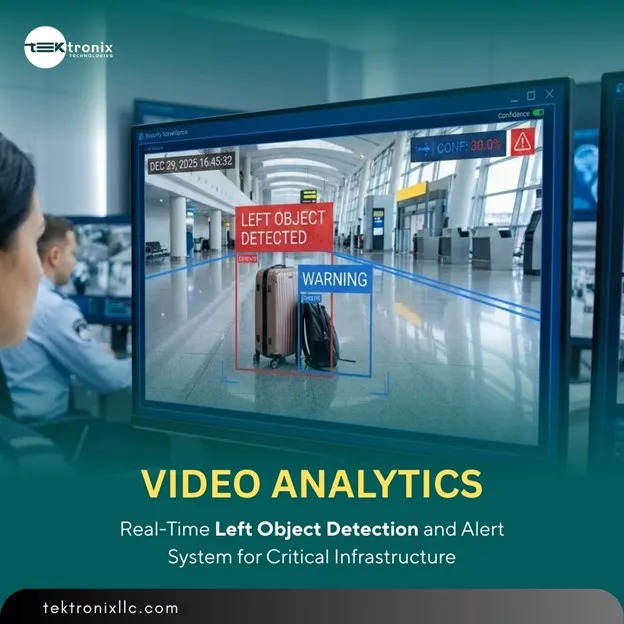

Video Analytics is rewriting the rules of workplace safety enforcement across the Middle East. In high-risk industries — oil and gas, construction, manufacturing, utilities, and logistics — the human and financial cost of a single Personal Protective Equipment (PPE) violation can be catastrophic. A hard hat not worn, a high-visibility vest absents from a live-work zone, or safety goggles missing from a chemical handling area: each represents a preventable tragedy that traditional supervision simply cannot catch at scale.
Tektronix LLC’s AI-Powered PPE Detection Video Analytics platform changes that equation entirely. By embedding deep-learning object recognition directly into the camera network, the system monitors every worker in every zone, every second of every shift — and triggers real-time alerts the moment a violation occurs. This article explains how the technology works, why it matters for Oman and the GCC, and what sets enterprise-grade Video Analytics Solutions apart from basic CCTV recording.
The PPE Compliance Crisis in Oman & GCC Workplaces
The Gulf Cooperation Council is home to some of the world’s most demanding industrial environments. Oman alone has tens of thousands of workers employed across oil and gas fields, port logistics, petrochemical plants, and major infrastructure projects linked to Vision 2040. Each of these environments carries significant physical hazard — and each is governed by increasingly stringent occupational health and safety (OHS) regulations from bodies including the Oman Ministry of Manpower, OSHA-aligned standards applied by international operators, and client-mandated safety protocols.
The compliance gap is not a matter of intent — most workers and supervisors understand the importance of PPE. The gap is a matter of scale and continuity. A supervisor responsible for 50 workers across a multi-acre site cannot maintain visual oversight of every individual at every moment. Fatigue, distraction, and the sheer physical impossibility of being everywhere simultaneously mean that PPE violations go undetected with alarming frequency.
The consequences are severe: workplace injuries, regulatory fines, project shutdowns, insurance premium increases, and — most critically — preventable deaths. Video Analytics Oman deployments are directly addressing this gap by making continuous, automated, AI-driven monitoring a practical operational reality rather than an aspirational safety target.
What Is AI-Powered Video Analytics for PPE Detection?
AI-Powered Video Analytics is the application of machine learning and computer vision algorithms to live or recorded video streams — enabling systems to identify, classify, and respond to specific objects, behaviours, and events within the frame without human review of every image.
In the context of PPE compliance, AI-Powered Video Analytics systems are trained on millions of labelled images of workers in diverse industrial environments — across different lighting conditions, camera angles, body positions, and PPE equipment types. The trained neural network is then deployed at the edge (on-camera or on a local inference server) or in the cloud, where it processes video in real time and classifies each detected person as compliant or non-compliant against a configurable set of PPE rules.
What the system detects
A fully configured PPE detection deployment monitors for the presence or absence of:
• Hard hats / safety helmets — colour-coded by role where required
• High-visibility (hi-vis) vests and jackets — including reflective strip verification
• Safety goggles and face shields — for chemical, grinding, and splash-hazard zones
• Gloves — including cut-resistant, chemical-resistant, and general-purpose variants
• Safety footwear — steel-toe boots detected at entry points and within controlled zones
• Respiratory protective equipment (RPE) — masks and respirators in dust or fume environments
Rules are zone-specific and time-specific. A site office area may require only a hi-vis vest, while a confined-space entry point may enforce a full six-item PPE checklist. The Video Analytics Software platform allows each camera zone to carry its own independently configured compliance rules — giving safety managers granular, site-accurate enforcement without false positives from zones where certain PPE is not required.
High Accuracy Detection: The Technical Foundation
High Accuracy Detection is the defining capability that separates enterprise-grade PPE analytics from consumer-level computer vision. In a real industrial environment, the system must contend with poor lighting, camera shake, worker occlusion, crowds, and rapidly changing scene content — and still deliver detection results that safety managers can operationally rely upon.
How accuracy is achieved and measured
Tektronix LLC’s platform is built on a multi-stage detection pipeline. A person detection model first identifies and isolates each individual in the frame. A secondary classification model then examines each detected person against the PPE rule set for that zone. This two-stage approach significantly reduces false positives compared to single-model systems that attempt to perform both tasks simultaneously.
Key accuracy benchmarks in certified deployments:
• Hard hat detection accuracy exceeding 96% under standard industrial lighting conditions
• Hi-vis vest detection accuracy exceeding 97% at distances up to 15 metres from the camera
• Multi-person scene processing — up to 30 simultaneous individuals per camera frame without accuracy degradation
• False positive rate below 3% in calibrated deployments, minimising alert fatigue among safety personnel
These benchmarks are not marketing claims — they reflect the measured performance of High Accuracy Detection systems in active GCC deployments where operational credibility is a non-negotiable requirement. A system that generates constant false alarms is ignored; a system that misses genuine violations is dangerous. Precision and recall must both be optimised, and Tektronix LLC’s tuning methodology achieves this balance through site-specific calibration at commissioning.
AI-Powered Object Recognition: Beyond PPE Detection
The same neural network architecture that enables PPE compliance monitoring also powers AI-Powered Object Recognition for a broader set of workplace safety and operational use cases. Once the camera infrastructure and inference engine are in place, additional detection capabilities can be activated through software configuration — without new hardware investment.
Extended workplace safety use cases
• Restricted zone intrusion — alerts when an unauthorised individual enters a hazardous or controlled area
• Slip and fall detection — identifies worker falls in real time for immediate emergency response
• Crowd density monitoring — flags unsafe gatherings near active machinery or elevated-risk structures
• Forklift and pedestrian conflict — detects proximity violations between moving vehicles and foot traffic in warehouse and logistics environments
• Smoking in prohibited areas — detects smoking behaviour in no-smoking zones near flammable materials
This extensibility is a critical procurement consideration for Video Analytics GCC projects. Rather than deploying single-purpose safety tools, organisations that invest in a full-spectrum Video Analytics Solutions platform gain a continuously expandable safety and operational intelligence capability — with each new use case adding value without adding infrastructure cost.
Video Analytics Software: Platform Architecture & Integration
The Video Analytics Software layer is where the intelligence of the system becomes operationally useful. Raw detection events from the AI engine are processed, contextualised, and delivered through a management platform that gives safety managers, site supervisors, and compliance officers actionable visibility across every monitored zone.
Core platform capabilities
• Real-time alert dashboard — live violation events displayed by zone, camera, and worker ID with annotated video thumbnails
• Automated notifications — instant SMS, email, or two-way radio alerts to the relevant supervisor when a violation is detected
• Violation heatmaps — spatial analysis of where violations cluster across a site, enabling targeted safety interventions
• Shift and trend reporting — daily, weekly, and monthly PPE compliance rate reports by zone, shift, contractor, and equipment type
• Video evidence export — timestamped, annotated video clips automatically saved for each violation, providing chain-of-custody evidence for regulatory reporting
• Access control integration — block entry to controlled zones for workers who have not completed mandatory PPE checks at designated inspection points
Deployment models
Tektronix LLC’s PPE Detection Video Analytics platform is available in three deployment architectures to match the connectivity and data-sovereignty requirements of different sites:
• Edge deployment — inference runs on-camera or on a local server, with no video leaving the site — suitable for oil and gas facilities with strict data residency requirements
• Hybrid deployment — event metadata and thumbnails are sent to a cloud dashboard while full video stays on-premise
• Cloud deployment — suitable for multi-site enterprises requiring a single unified safety dashboard across all facilities in Oman and the GCC
Video Analytics Oman: Deployments Across Key Industrial Sectors
Video Analytics Oman projects are active across the country’s most safety-critical sectors. Tektronix LLC has designed and commissioned PPE detection systems for clients operating in the following environments:
Oil, gas & petrochemical
Production facilities, refinery units, and LNG processing plants require the highest level of PPE enforcement — full body coverage, specialised respiratory equipment, and chemical-resistant gloves are mandatory in many zones. AI-powered PPE analytics provide the continuous coverage that rotating shift supervisors cannot, and generate the compliance reports required by international operator audits and ISO 45001 certification programmes.
Construction & infrastructure
Major infrastructure projects across Muscat and other governorates — roads, bridges, utilities, and commercial developments — involve hundreds of workers from multiple contractors operating simultaneously. Video Analytics GCC deployments on construction sites have demonstrated compliance rate improvements of 30–50% within the first 90 days of go-live, driven purely by the deterrent effect of real-time automated monitoring.
Ports, logistics & warehousing
Port facilities and distribution centres combine forklift traffic, pedestrian workers, and high-throughput loading operations — a combination that creates multiple simultaneous PPE and zone compliance requirements. Tektronix LLC’s AI-Powered Object Recognition layer handles multi-hazard environments natively, applying different rule sets to different zones within the same camera network without additional hardware or software licences.
Tektronix LLC — Certified AI Safety Analytics Integrator for the GCC
Tektronix LLC is a specialist technology integrator with a decade of proven project delivery across Oman, the UAE, Saudi Arabia, Qatar, and the wider GCC. Our AI and video analytics practice is built on vendor-certified expertise across leading analytics platforms — combined with deep domain knowledge of the industrial safety, regulatory compliance, and infrastructure requirements that define high-stakes deployments in the region.
We do not deploy generic surveillance products and call them analytics. Every Video Analytics Solutions engagement begins with a structured site safety assessment: identifying the highest-risk zones, the PPE categories that matter most per zone, the existing camera infrastructure, and the notification workflows that match the client’s operational structure. The result is a purpose-configured system that delivers accuracy from day one — not a default installation requiring months of post-commissioning tuning.
Our certified capabilities cover:
• AI safety analytics consulting — risk zone mapping, PPE rule definition, and compliance benchmark setting
• Camera network assessment — FOV analysis, coverage gap identification, and upgrade specification
• Platform configuration & training — site-specific model calibration, zone rule setup, and dashboard configuration
• Systems integration — connection to HR, access control, incident management, and EHS reporting platforms
• Ongoing managed services — model retraining, performance monitoring, and SLA-backed support across Oman and GCC sites
To discuss your site’s requirements, visit our dedicated AI-Powered PPE Detection service page or contact the Tektronix LLC team for a complimentary safety analytics assessment.
Key Concepts in AI-Powered Workplace Safety Monitoring
For health and safety managers, operations directors, and compliance officers evaluating PPE detection technology, the following related concepts are central to understanding what a mature Video Analytics deployment actually delivers:
• Computer vision — the field of AI that enables machines to interpret and understand visual data from cameras and sensors
• Convolutional neural network (CNN) — the deep-learning architecture most commonly used for image classification and object detection tasks
• Edge AI inference — running AI models directly on-camera or at a local server to minimise latency and protect data sovereignty
• ISO 45001 — the international standard for occupational health and safety management systems, increasingly cited by GCC regulators and international operators
• EHS software integration — connecting analytics violation data directly into Environmental, Health and Safety management platforms for unified reporting
• Behaviour-based safety (BBS) — a safety management methodology that uses observation data (increasingly from AI analytics) to identify systemic risk patterns and drive targeted interventions
Conclusion
The ambition of zero PPE violations is not a safety slogan — it is an achievable operational target when the right technology is correctly deployed. Video Analytics has crossed the threshold from emerging technology to proven industrial tool: the accuracy benchmarks are validated, the deployment models are mature, and the ROI — measured in prevented injuries, avoided regulatory fines, and reduced insurance exposure — is well-documented across the GCC.
Tektronix LLC’s AI-Powered Video Analytics platform for PPE detection brings together High Accuracy Detection, AI-Powered Object Recognition, and enterprise Video Analytics Software management into a unified solution that is calibrated for the industrial realities of Video Analytics Oman and Video Analytics GCC deployments. From oil fields and refineries to construction sites and logistics hubs, the platform delivers the continuous, scalable, evidence-grade monitoring that manual supervision alone can never achieve.
Every workplace incident that is prevented represents a worker who goes home safely at the end of their shift. That outcome is the measure against which every Video Analytics Solutions investment should be evaluated.
FAQs
1. How does video analytics detect PPE violations in real time?
AI-Powered Video Analytics systems process each camera frame through a two-stage deep-learning pipeline: a person detection model identifies and isolates each worker in the scene, then a classification model evaluates each individual against the zone-specific PPE rule set — checking for the presence of hard hats, hi-vis vests, gloves, goggles, and other required equipment. When a violation is detected, the system generates an alert within seconds, simultaneously logging a timestamped video thumbnail as evidence. The entire process runs continuously without human review of every frame.
2. What level of accuracy can we expect from a PPE detection system?
Enterprise-grade High Accuracy Detection systems achieve hard hat and hi-vis vest detection accuracies above 96–97% in standard industrial lighting conditions, with false positive rates below 3% in calibrated deployments. These benchmarks depend significantly on camera placement, resolution, and site-specific model calibration — all of which are part of Tektronix LLC’s commissioning process. A poorly positioned camera or an uncalibrated model will underperform; a properly engineered installation delivers results that safety managers can operationally rely upon.
3. Can the same platform detect other safety violations beyond PPE?
Yes. The AI-Powered Object Recognition architecture that powers PPE detection can be extended — through software configuration alone — to detect restricted zone intrusions, worker falls, crowd density violations, vehicle-pedestrian proximity conflicts, and smoking in prohibited areas. For Video Analytics GCC deployments at large industrial sites, this extensibility means the initial PPE detection investment creates a reusable platform for a growing range of safety and operational use cases without additional hardware cost.
4. How is video analytics data managed for privacy and data sovereignty in Oman?
Tektronix LLC’s Video Analytics Software platform supports full edge deployment — where all AI inference runs on-site and no video data leaves the facility. Only violation metadata and thumbnail images are transmitted to the management dashboard, and these can be hosted on-premise or in a Oman-based cloud instance to satisfy data residency requirements. For regulated sectors including oil and gas and government-linked infrastructure, this architecture ensures full compliance with Oman’s data protection and information security frameworks.
5. How do we get started with a video analytics deployment in Oman or the GCC?
The recommended first step is a complimentary safety analytics site assessment with the Tektronix LLC team. Our consultants will review your existing camera infrastructure, map your highest-risk PPE compliance zones, define the detection rule set, and produce a phased deployment proposal. Whether your facility is part of a Video Analytics Oman project or a multi-site Video Analytics Solutions rollout across the GCC, our team has the regional expertise and certified technical capability to deliver measurable results from day one.
For more information contact us on:
Tektronix Technology Systems Dubai-Head Office
+971 55 232 2390




























Sign in to leave a comment.