
Your Buyers Are More Informed Than Ever. Is Your Sales Experience Keeping Up?
The Indian real estate buyer of 2025 has done their homework before walking into your sales office. They have checked PropTiger, looked up reviews on Housing.com, cross-referenced your past projects, and probably watched a few virtual tour videos on YouTube. They arrive with specific questions, calibrated expectations, and a low tolerance for vague answers.
And yet many developers are still running the same sales experience they were running five years ago. The brochure is better. The renders are more polished. But the fundamental format — static visuals, verbal explanation, flat floor plans — has not changed.
In a market where buyers arrive well-informed, the sales experience needs to do something that information alone cannot: it needs to create genuine conviction. Digital twin real estate technology is how the most serious developers are meeting this moment. This guide explains what it involves, how it works in practice, and what developers and sales teams need to understand before building their next experience centre around it.
What a Real Estate Digital Twin Actually Comprises
Before discussing how it is used, it is worth being precise about what a full-capability digital twin in a real estate context includes:
- A geometrically accurate 3D model — interior and exterior, built to design specifications
- Interactive navigation — the user can move freely, zoom in, and switch between units or locations
- Dynamic environments — day-to-night lighting cycles and seasonal light changes that show how the space feels at different times
- Unit configurability — the ability to move between configurations, floors, and orientations in a single session
- Amenity and vicinity mapping — interactive exploration of shared spaces, nearby landmarks, and the surrounding neighbourhood
- Offline functionality — the full experience runs without internet connectivity, which is critical for reliable sales office use
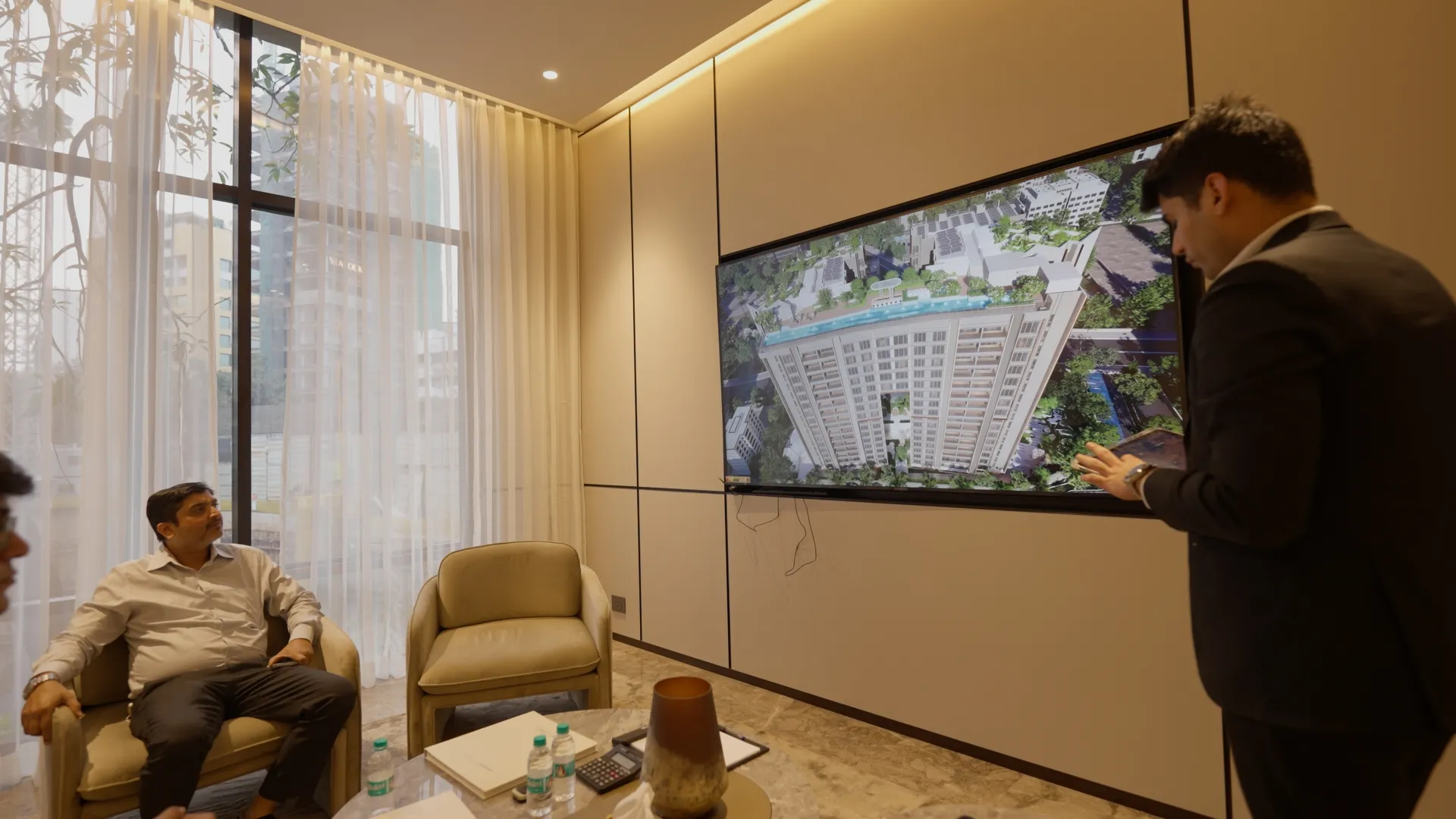
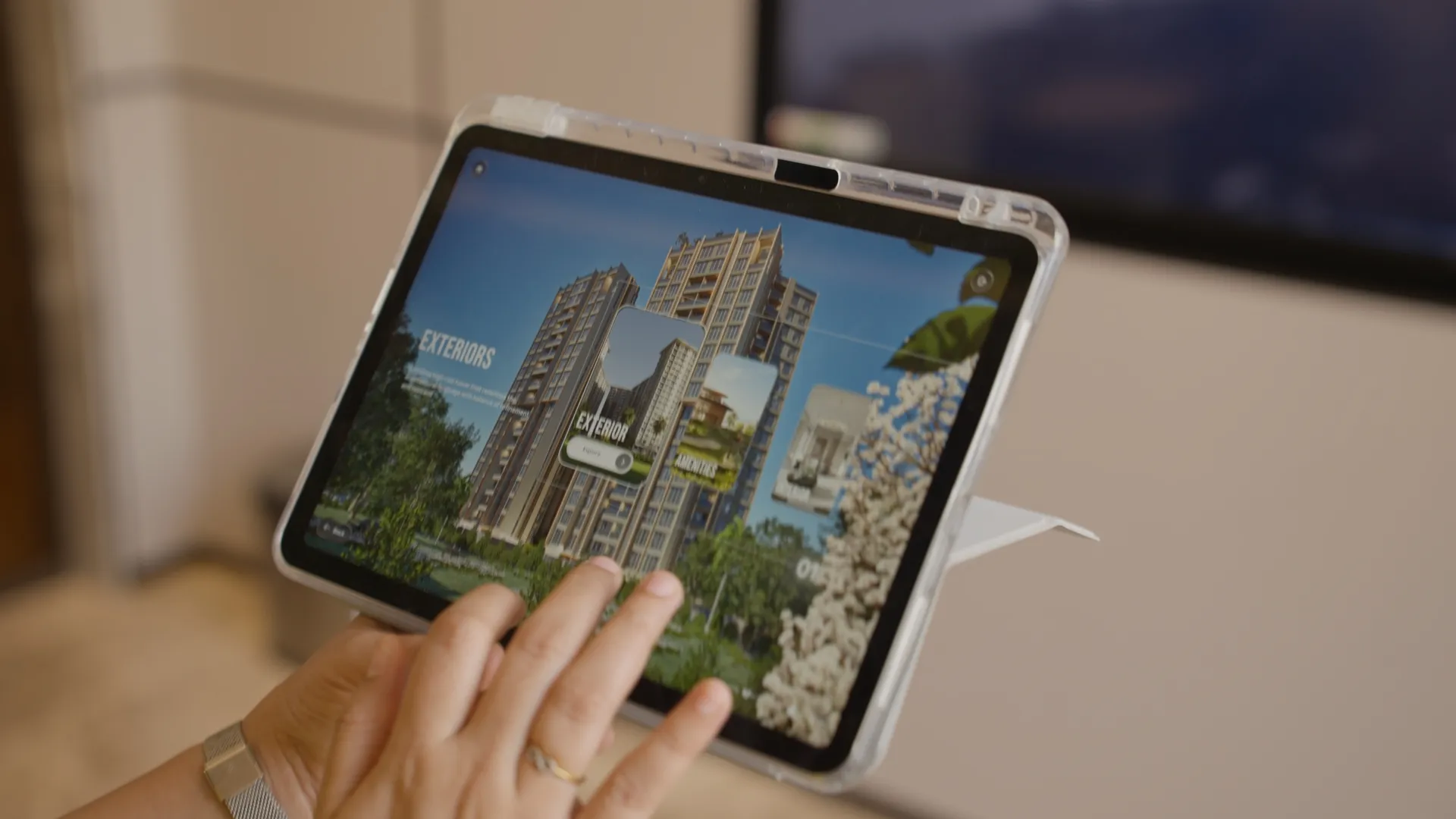
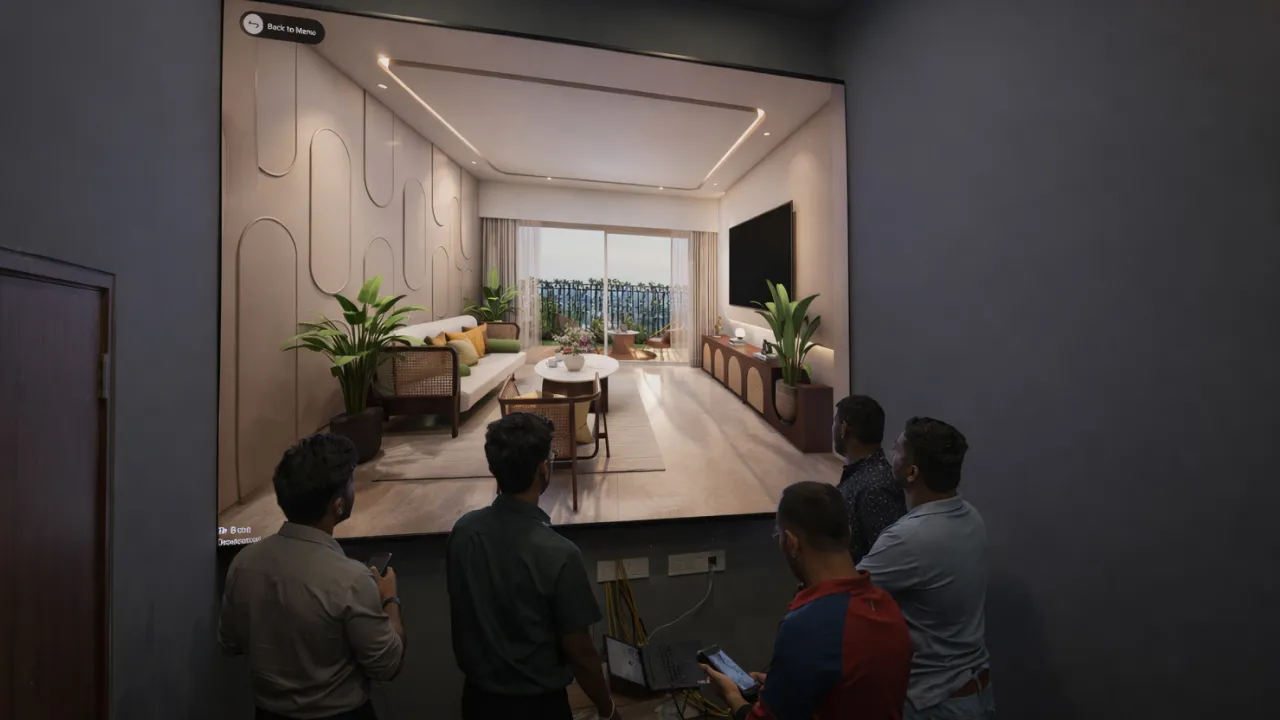
V-Estate's platform delivers all of this in an integrated experience that runs on touchscreen systems inside physical experience centres. It is not a web-based viewer. It is a presentation-grade sales tool designed for the conditions of a real-world site visit.
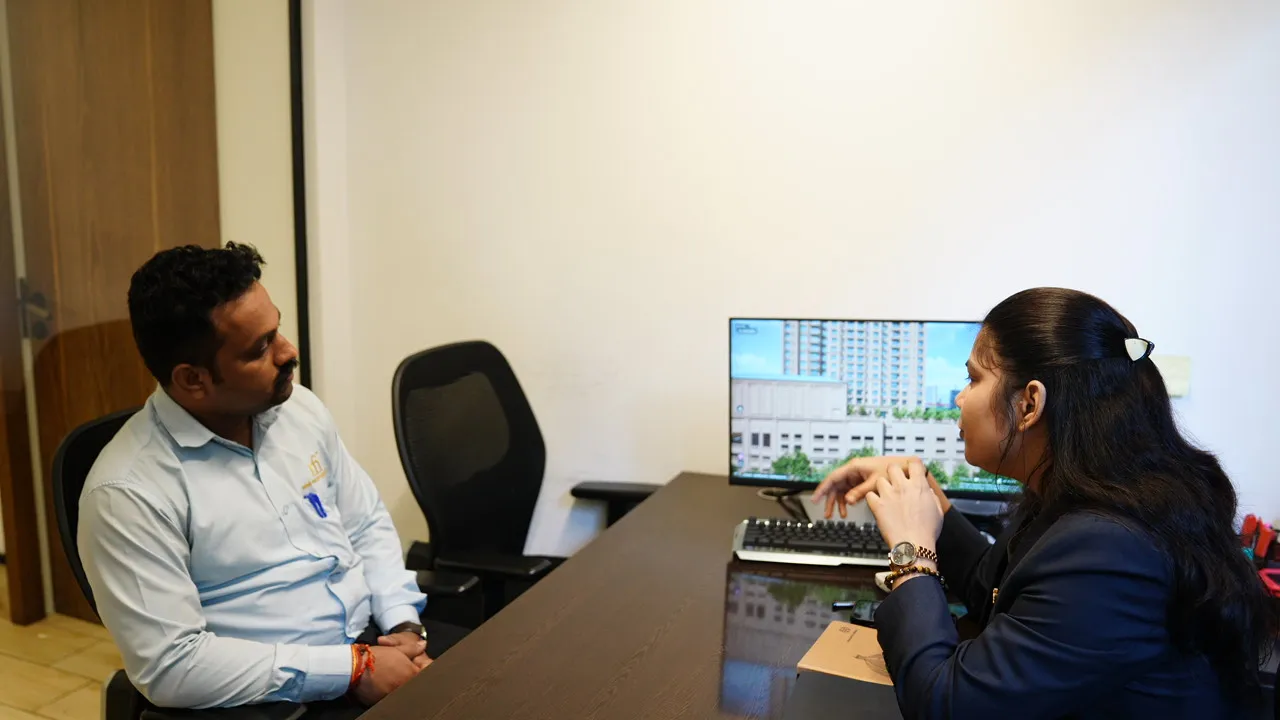
How Sales Teams Actually Use Digital Twins During a Buyer Visit
The practical workflow matters more than the technology itself. Here is what a well-designed digital twin presentation looks like inside a sales office.
The opening: project orientation The salesperson brings up the development's master view — an aerial perspective showing the entire project, the surrounding vicinity, and key landmarks nearby. Schools, hospitals, transit hubs, and commercial centres are mapped within a 5km radius. The buyer gets an immediate sense of location and scale without a single word about square footage.
The deep dive: unit exploration Based on the buyer's interest — say, a 2BHK on a higher floor with a west-facing view — the salesperson navigates directly to that configuration. The buyer is now inside the apartment in three dimensions. They walk through it. They examine the bedroom proportions. They step out onto the balcony. They see the view.
The comparison: when a buyer is deciding between units A buyer considering both a 2BHK and a 3BHK can switch between them in the same session. The spatial difference becomes visceral rather than intellectual. This is the moment when many buyers who were sitting on the fence decide — not because the salesperson persuaded them, but because the buyer persuaded themselves.
The lifestyle layer: amenities and common areas The pool deck. The clubhouse. The landscaped entrance. These features appear on every developer's brochure — but the digital twin makes them feel real and specific in a way that a photograph or description simply cannot.
What Rustomjee's Experience Centres Teach Us About This Workflow
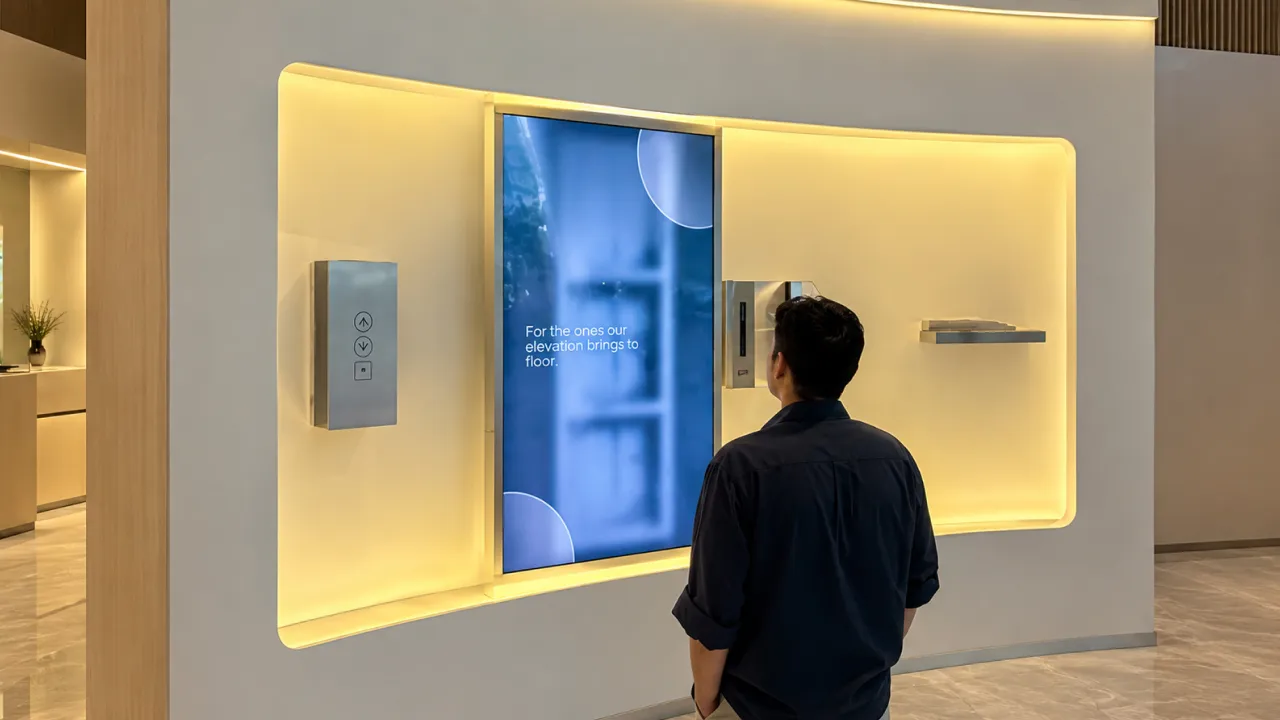
Rustomjee implemented V-Estate's platform across two Mumbai projects — Matunga and Crescent — and both experience centres reflected a similar strategic intent: to build buyer confidence through immersive, accurate, self-directed exploration.
At the Matunga project, the focus was on communicating the quality and spatial feel of apartments within a dense urban location. Buyers in Matunga are typically decision-ready but conservative — they need to see and believe before they commit. The digital twin removed the imagination gap entirely.
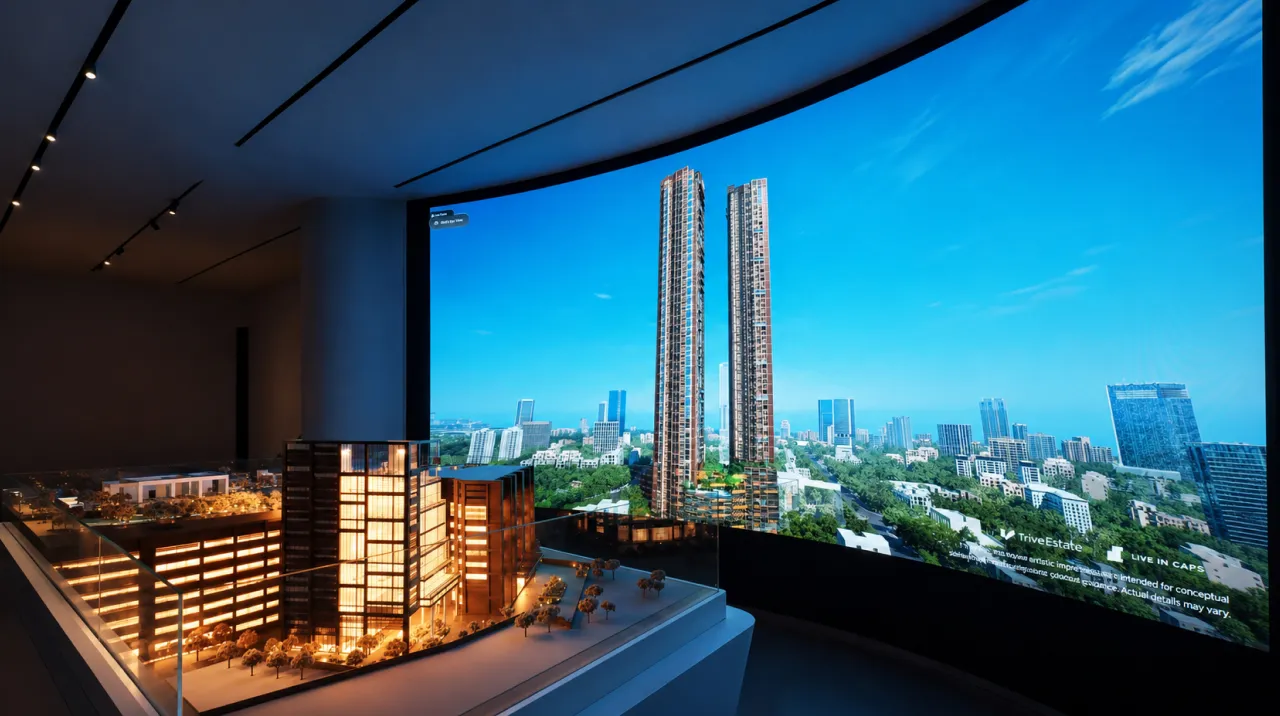
At the Crescent project in Bandra West, the digital twin's most important job was communicating the waterfront lifestyle promise. Views, light, and the sense of premium living at that address had to be felt. The platform delivered this in a way that physical samples and renders alone could not.
Across both projects, the common outcome was shorter deliberation cycles and higher conversion rates from first visit to booking. The experience centres worked not because they showed more information — but because they created more certainty.
The Offline Factor: Why It Matters More Than Most Developers Think
V-Estate runs as offline activation software. In a market where sales offices are sometimes in areas with unreliable connectivity, this is not a minor technical feature — it is a prerequisite for reliability.
An experience centre that crashes during a presentation undermines everything the developer has invested in that moment. The technology is supposed to communicate professionalism and quality. A technical failure does the opposite. Offline functionality ensures the experience is consistent, complete, and under control — every single time.
Questions Sales Heads Should Be Asking Before the Next Launch
If you are evaluating whether a digital twin experience centre belongs in your sales strategy:
- What is the average number of visits a buyer makes before booking, and what is driving the extra visits?
- How consistently is your sales team communicating the project's key differentiators across all team members?
- What percentage of your serious leads are out-of-city or NRI buyers who cannot visit in person?
- What would improving your first-visit conversion rate by 10–15% mean for your launch numbers?
- How does your current presentation compare to what buyers experience at your competitors' projects?
Digital twin technology in real estate is not a solution looking for a problem. If any of these questions resonate, there is a specific problem it is designed to solve.
Related reading: Digital Twins in Real Estate: A Living Blueprint V-Estate Interactive Sales Platform
Want a real working demonstration? V-Estate works directly with your project specifics — not a generic demo. If you want to see what their platform can do for your next launch, this is the conversation to have. Book a demo
























Sign in to leave a comment.