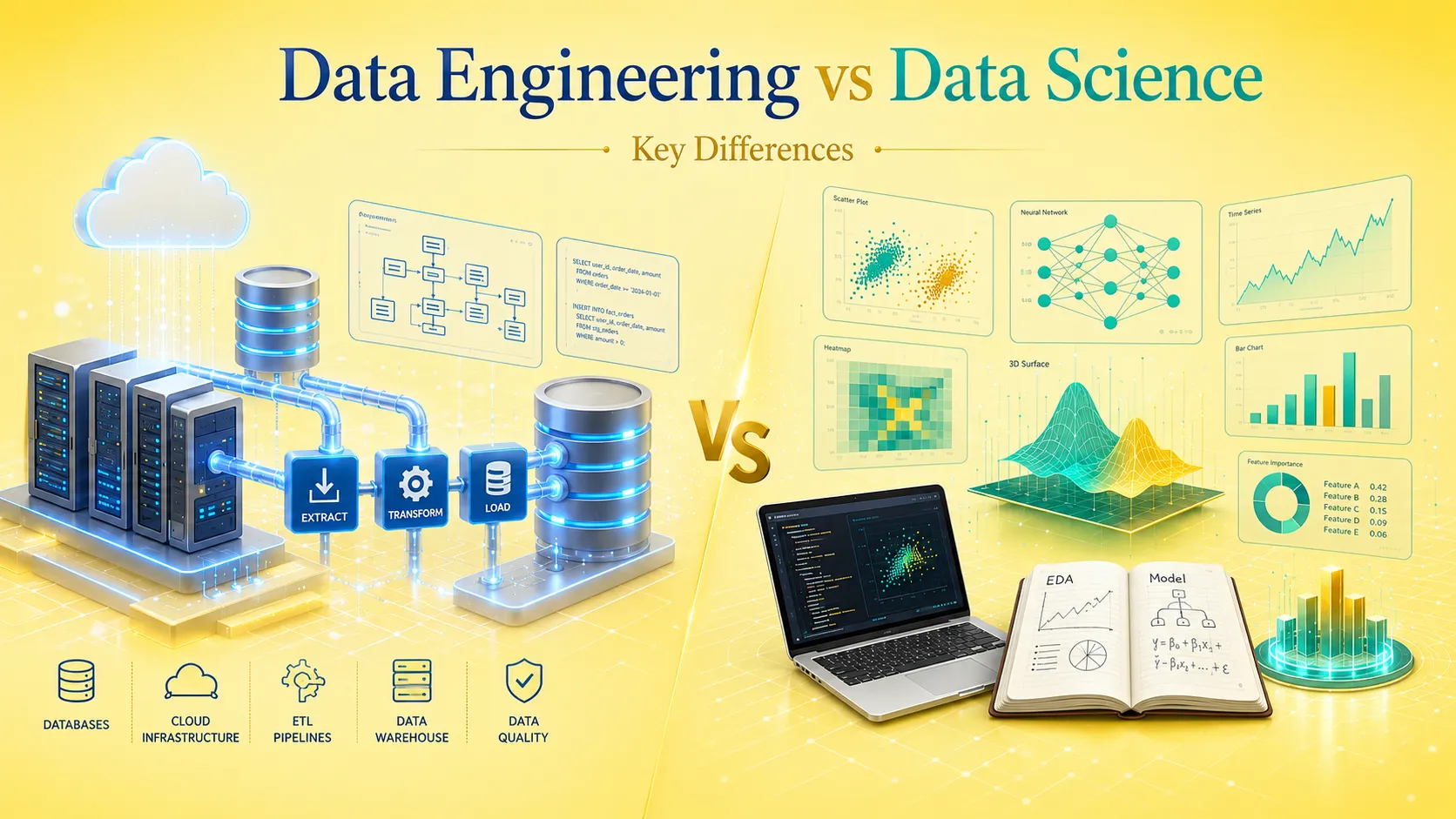

Data engineering builds the systems that collect, organize, and deliver reliable data, while data science uses that data to identify patterns, build predictive models, and answer business questions.
Although data engineering and data science are closely connected, they solve different problems. A data engineer focuses primarily on data infrastructure and pipelines. A data scientist focuses on analysis, experimentation, statistics, and machine learning.
Understanding these differences can help students choose the right learning path, organizations build balanced data teams, and professionals identify the skills required for each career.
What Is Data Engineering?
Data engineering is the process of designing, building, testing, and maintaining systems that collect, transform, store, and distribute data.
Data engineers create the infrastructure that allows information to move reliably between applications, databases, data lakes, data warehouses, dashboards, and machine learning platforms. IBM describes data engineers as professionals who develop and maintain data architectures and pipelines so that data remains meaningful and usable for operations and analysis.
Common data engineering responsibilities include:
- Building batch and streaming data pipelines
- Integrating data from multiple sources
- Cleaning and transforming raw information
- Managing databases, data lakes, and warehouses
- Automating data processing workflows
- Monitoring pipeline performance and failures
- Applying security and data quality controls
- Optimizing systems for cost and performance
For example, an online retailer may collect information from websites, payment systems, inventory applications, and customer support platforms. A data engineer builds the workflow that combines this information and delivers accurate datasets to analysts and data scientists.
What Is Data Science?
Data science is an interdisciplinary field that uses programming, mathematics, statistics, machine learning, and domain knowledge to extract insights from data.
Data scientists explore information to understand patterns, test assumptions, predict future outcomes, and support business decisions. Data science commonly involves machine learning, data exploration, statistical modelling, and predictive algorithms.
Typical data science responsibilities include:
- Exploring and visualizing datasets
- Identifying trends and relationships
- Creating statistical models
- Training machine learning algorithms
- Evaluating model accuracy
- Designing experiments
- Communicating findings to stakeholders
- Supporting data-driven decision-making
For instance, after a data engineer prepares reliable customer data, a data scientist might use it to predict which customers are likely to cancel a subscription or respond to a marketing campaign.
Data Engineering vs Data Science at a Glance
| Area | Data Engineering | Data Science |
|---|---|---|
| Primary goal | Builds reliable data systems | Produces insights and predictions |
| Main focus | Data pipelines and infrastructure | Analysis and machine learning |
| Typical output | Clean, accessible datasets | Models, forecasts, and recommendations |
| Common users | Analysts, scientists, applications | Business leaders and product teams |
| Core strengths | Software, cloud, and database engineering | Statistics, experimentation, and modelling |
| Key concern | Data reliability and scalability | Analytical and predictive accuracy |
The simplest way to understand the relationship is that data engineers prepare and deliver the data, while data scientists use it to solve analytical problems. Coursera similarly distinguishes the roles by explaining that data engineers build and maintain data collection tools before data scientists use the resulting information for analysis.
Differences in Daily Responsibilities
A data engineer may spend the day troubleshooting a failed pipeline, changing a database schema, improving processing speed, or configuring a cloud data warehouse.
A data scientist may spend the same day exploring customer behaviour, selecting model features, training an algorithm, comparing model performance, or presenting findings to business stakeholders.
Data engineers commonly ask questions such as:
- Is the incoming data complete?
- Can the pipeline process increasing volumes?
- How quickly can data reach its destination?
- What happens if a processing job fails?
- Are access permissions correctly configured?
Data scientists are more likely to ask:
- What patterns exist in this dataset?
- Which factors influence the outcome?
- Can future behaviour be predicted?
- Is the model sufficiently accurate?
- How should the results be explained?
Both roles work with data, but their objectives and measures of success are different.
Skills Required for Data Engineering
Strong data engineering fundamentals usually include:
- SQL and database design
- Python, Java, or Scala
- ETL and ELT processes
- Data modelling
- Data warehouses and data lakes
- Batch and stream processing
- Workflow orchestration
- Cloud computing
- Data governance and security
- Pipeline testing and monitoring
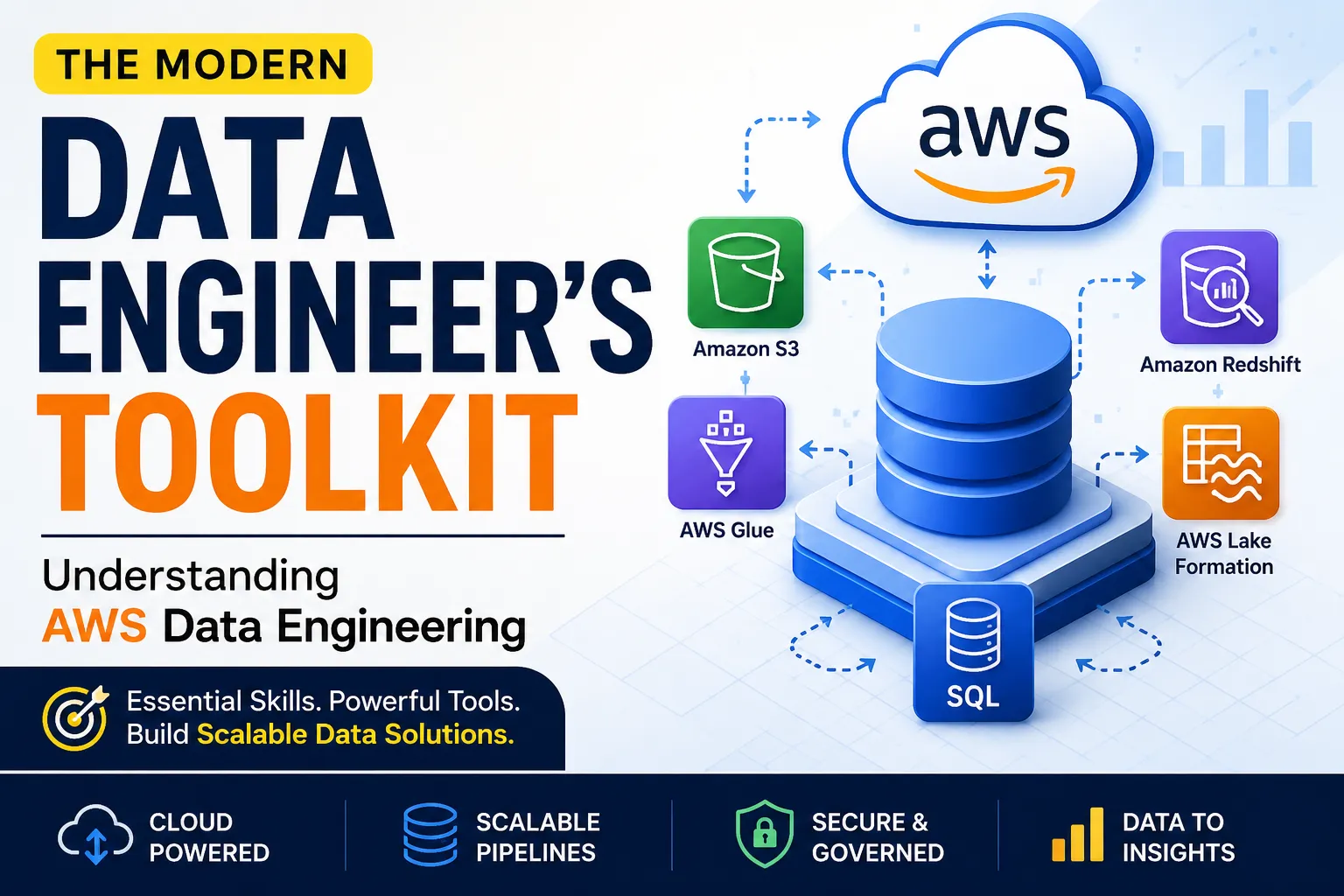
An AWS data engineer also needs familiarity with cloud services for data ingestion, transformation, storage, orchestration, and monitoring. The AWS Certified Data Engineer – Associate certification, for example, validates capabilities involving data ingestion, transformation, pipeline orchestration, data modelling, lifecycle management, and data quality.
AWS guidance also recommends automating and orchestrating organizational data flows and using reusable patterns to simplify pipeline deployment.
Skills Required for Data Science
Important data science skills include:
- Python or R
- Statistics and probability
- Data exploration
- Data visualization
- Machine learning
- Feature engineering
- Model evaluation
- Experimental design
- Business communication
- Domain knowledge
Data scientists may use tools such as Jupyter notebooks, pandas, NumPy, scikit-learn, TensorFlow, PyTorch, RStudio, and visualization platforms.
While both careers require programming, data engineering usually places greater emphasis on system reliability and architecture. Data science usually places greater emphasis on mathematical reasoning and model performance.
How the Two Roles Work Together?
Data engineering and data science are not competing fields. They are complementary parts of the same data lifecycle.
Consider a company developing a product recommendation system. Data engineers first collect browsing activity, purchase history, product details, and customer information. They create pipelines that validate, transform, and store the data.
Data scientists then explore these datasets, select relevant variables, train recommendation models, and measure their accuracy. Once a suitable model is developed, engineers may help integrate it into a reliable production environment.
Without strong engineering, data scientists may spend too much time finding, cleaning, and reorganizing information. Without data science, well-built data platforms may fail to produce valuable predictions or insights.
Which Career Should You Choose?
Choose data engineering when you enjoy:
- Building systems and automated workflows
- Working with databases and cloud platforms
- Solving scalability and performance problems
- Improving reliability and data quality
- Developing production-ready infrastructure
Choose data science when you enjoy:
- Exploring patterns and answering questions
- Working with statistics and mathematics
- Building machine learning models
- Designing experiments
- Explaining insights to decision-makers
Neither path is universally better. The right choice depends on whether you prefer building the data foundation or using that foundation for analysis and prediction.
Building Data Engineering Skills
Beginners should start with databases, SQL, Python, data modelling, pipeline concepts, cloud storage, and ETL processes. A structured data engineering course can help learners understand how these areas connect in real-world systems.
The Data Engineering Foundations on AWS course by LearnKarts on Coursera is designed for beginners and professionals who want to understand cloud pipelines, data models, storage systems, and foundational AWS data engineering concepts. The course currently contains two modules and introduces learners to the skills needed to design, optimize, and manage cloud-based data workflows.
For learners exploring Coursera data engineering options, this course offers a focused starting point for understanding the responsibilities of an AWS data engineer before progressing to more advanced services and architectures.
Final Thoughts
The key difference between data engineering and data science lies in their purpose. Data engineering creates dependable systems that make information accessible, secure, and usable. Data science applies analytical and statistical methods to that information to generate insights and predictions.
Organizations need both disciplines. Data engineers establish the foundation, while data scientists transform that foundation into measurable business value.
Professionals who enjoy infrastructure, pipelines, cloud platforms, and automation may find data engineering more suitable. Those who prefer statistics, experimentation, machine learning, and analytical problem-solving may be better aligned with data science.





























Sign in to leave a comment.