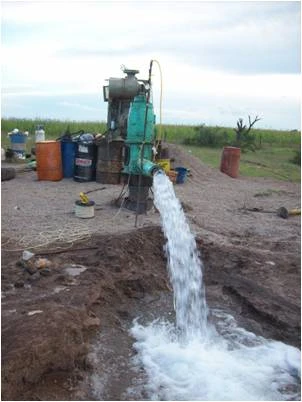

Water is essential for life and for many human activities, which is why today it is the most important resource.
One of the methods to obtain water is by drilling water wells. The drilling of a water well consists of a hole in the earth that will go through different strata until it reaches an aquifer. Therefore, knowing the existence of these aquifers is essential to locate the point where the deep well will be drilled. The study of hydrogeological reports and the prior knowledge of drilling technicians is essential for this. It is important to always take into account the procedures and permits in Conagua
In the drilling of a deep well, it is possible to go through several aquifers and different types of strata, so the experience of the technicians will be essential to address different situations. Different techniques can be used in drilling a water well. The well drilling system used will depend on the characteristics of the soils (particle size: gravel, sand, clay, silt, soils with a lot of organic matter), its plasticity and location of water tables.
A fundamental aspect of a water well is depth. In a well drilling we can reach several aquifers (from more superficial to deeper). The deeper aquifers will have more stability in the water supply and less possibility of contamination.
water wells consisting of pipes ranging in size from 6 to 45 cm in diameter and sunk into an aquifer . Tubewells are constructed by installing a pipe below the ground surface passing through different geological formations comprising water-bearing and non-water-bearing strata. Blind pipes (casing pipes) are placed in the non-water-bearing layers and well screens are placed in the water-bearing layers . Several tubewells have been and are being installed worldwide for meeting water demands in domestic,agricultural and industrial sectors. The type of tubewell to be constructed depends on the type of geological formation, intended use of the well and the availability of fund. their construction,development and maintenance Tubewells are also classified based on the depth, method of construction, entry of water into
the wells and the type/nature of the aquifer . As mentioned above, based on the depth of the well, tubewells are classified as shallow tubewells or deep tubewells. Shallow tubewells are of low capacity and their average depth is normally less than 35 m. They mostly tap one aquifer. Deep tubewells are of high capacity and their depth usually ranges from 60 to 300 m . They often tap two or more aquifers. Based on the method of construction, tubewells are classified as bored tubewells, drilled tubewells, driven tubewells and jetted tubewells; they are described in Tubewells in unconsolidated formations generally consist of blind pipes, strainers and gravel pack (if necessary). However, tubewells in hard-rock formations are known as borewells, because the borehole remains stable for most of its depth and the tube is placed only in the upper weathered soil zone No strainer/screen or gravel pack is required for borewells.
Moreover, tubewells are also classified as fully penetrating tubewells or partially penetrating tubewells depending on whether the well screen penetrates the saturated thickness of the aquifer fully or partially. In some special hydrogeologic situations, the drilled hole is terminated at the top of the confined aquifer without penetrating it, and hence no strainer is required; such wells are called cavity wells or non-penetrating wells which are described below. In coastal areas, partially penetrating wells with controlled rate of pumping are used expediently to „skim‟ the upper layer of fresh water overlying the saline water. Such tubewells are popularly known as skimming Wells
Generally, cased-hole design requires more design detail than open-hole design. Also, cased wells in unconsolidated geological formations involve consideration of more design details compared to wells in consolidated geological formations (ie, fractured/fissured rocks). Well-designed water wells (tubewells or open wells) aim to ensure well performance, reduced pumping and maintenance costs, and long well life. This lesson focuses solely on cased hole and gravel pack design. for open hole design in hard, unconsolidated rock formations
Well diameter. Perforacion de pozos de agua profundos
The size of a well must be carefully selected because it greatly affects the cost of well construction. It must be large enough to accommodate the pump used for groundwater extraction with adequate clearance (at least 5 cm) for installation and efficient operation. In deep wells that have large static and pumping water levels, the wellbore diameter can be reduced below the lowest setting level of the pump during dry periods, especially in confined aquifers that have a relatively high piezometric level.
From Thiem's equation, it is clear that for the same drawdown in the pumping well, the yield of the well is inversely proportional to , where R0 is the radius of influence and rw is the radius of the pumping well. Considering R0 = 300 m, a pumping well with a diameter of 60 cm yields 12% more than a well with a diameter of 30 cm. This shows that drilling a large diameter well will not necessarily mean proportionally large yields. Table 16.1 summarizes the recommended pumping well diameters for various expected well yields.
well Depth





























Sign in to leave a comment.