
Mastering the Density of Titanium is the cornerstone of the "Buy-to-Fly" ratio in aerospace engineering, where every gram saved translates to massive fuel efficiency gains. Proven data from the defense sector shows that replacing stainless steel with titanium alloys can reduce structural weight by up to 40% while maintaining equivalent tensile strength .
This guide previews the density shifts between Grade 2 and Grade 5 Ti-6Al-4V and provides a 2026 technical framework for managing the weight-to-strength paradox in high-precision CNC machining .
1. Pure Titanium vs. Ti-6Al-4V: The Alloying Mass Shift
While pure titanium (Grade 1-4) has a density of approximately 4.51 g/cm³, the introduction of alloying elements for high-stress applications alters this baseline.
The most common aerospace alloy, Ti-6Al-4V (Grade 5), incorporates Aluminum (a lighter element) and Vanadium (a denser element). Because the percentage of Aluminum is higher (6%), the density of Grade 5 is actually lower than pure titanium, sitting at roughly 4.43 g/cm³. When calculating the center of gravity for rotating parts or flight surfaces, this subtle difference is critical. You can cross-reference these alloy-specific densities with the material standards at Baosheng Industry to ensure your CAD mass-property calculations are synchronized with the actual alloy chemistry.
2. Strength-to-Weight Ratio: The Titanium Advantage
The true value of titanium’s density is only realized when viewed through the lens of specific strength.
At 4.5 g/cm³, titanium is roughly 60% denser than aluminum but only 56% as dense as steel. However, its tensile strength often exceeds that of high-strength steels. This allows engineers to design thinner, lighter walls that can withstand the same pressure loads as much heavier steel counterparts. If you are still exploring the nuances of Density of Titanium and how it facilitates extreme weight reduction in subsea or aerospace environments, this resource provides the comparative stress-strain curves needed for structural validation.
3. Thermal Expansion and Density Fluctuations in Jet Engines
Titanium's density is highly sensitive to the extreme temperature gradients found in turbine environments.
As titanium reaches its high-temperature operating limit (approx. 500°C to 600°C for most grades), its volume expands, causing a decrease in functional density. In 2026, the rise of hypersonic travel requires engineers to account for this "thermal thinning" in real-time. If the density drops too much due to thermal expansion, the vibrational frequency of a turbine blade can shift, potentially leading to catastrophic resonance. Designing for the "hot density" rather than the room-temperature specification is the standard for 2026 aerospace compliance.
4. Machining Sluggishness and the "Apparent Density" of Chips
A significant industrial pitfall in titanium manufacturing is the material's low thermal conductivity combined with its density.
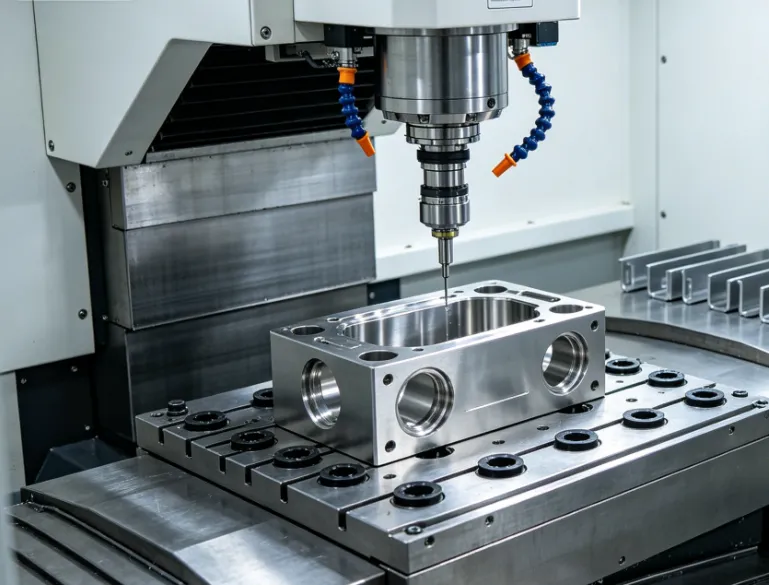
During CNC milling, titanium does not dissipate heat through the chips as effectively as steel or aluminum. This results in the cutting zone absorbing the majority of the thermal energy. Because titanium is relatively "light" but incredibly tough, the chips can become "gummy," welding themselves to the tool flute if the feed rate is not perfectly calibrated to the material's density. High-pressure through-tool coolant is mandatory to evacuate these chips and prevent the "re-cutting" of titanium particles, which would otherwise destroy the surface integrity of the finished part.
5. Detecting Alpha-Case Contamination through Density Audits
During high-temperature processing or welding, titanium can absorb oxygen and nitrogen, creating a brittle, hyper-dense surface layer known as "Alpha-Case."
While Alpha-Case is only a few microns thick, it is significantly denser and more brittle than the core material. This creates a prime location for fatigue cracks to initiate. In 2026, high-end quality control involves ultrasonic density mapping to detect these localized "hard spots." If a part shows a non-uniform density profile on its surface, it must undergo chemical milling to strip away the Alpha-Case, restoring the material's intended ductility and fatigue resistance.
Conclusion
Mastering the Density of Titanium allows engineers to push the boundaries of what is possible in weight-sensitive industries. By understanding the shift in mass between grades, accounting for thermal expansion, and monitoring for surface contamination, you can harness the full power of this "space-age" metal to produce components that are both incredibly light and nearly indestructible.



























Sign in to leave a comment.