
Choosing between Drilling vs Broaching is the fundamental decision that determines the structural integrity and production speed of any bore-related project. Proven laboratory testing shows that for non-cylindrical holes, using a broach instead of a drilling-plus-milling sequence can improve dimensional repeatability by up to 300% .
This guide previews the mechanical differences between rotating versus linear cutting forces and provides a 2026 technical perspective on how to optimize hole-making for both rapid prototyping and mass production.
1. Rotational Torque vs. Linear Shear Forces
The primary mechanical distinction between these two methods lies in the direction and nature of the cutting force applied to the workpiece.
Drilling uses a rotating tool with two or more cutting edges that shear material along a helical path. This generates significant torque, which requires robust fixturing to prevent part rotation. Broaching, however, utilizes a linear "push" or "pull" motion where each successive tooth on the tool removes a predetermined layer of material. While drilling is limited to circular holes, the linear nature of broaching allows for the creation of intricate internal profiles. You can explore how these high-force operations are managed in professional-grade production at Baosheng Industry, where specialized rigidity controls ensure zero-drift results.
2. Geometric Versatility: Round Holes vs. Complex Profiles
When evaluating Drilling vs Broaching, the shape of the final bore is the most immediate deciding factor.
Drilling is the undisputed king of the "starter hole." It is the most efficient way to remove bulk material and create a cylindrical opening. However, if that hole needs to be square, hexagonal, or feature an internal spline, a drill cannot complete the task. Broaching is almost always a secondary operation that follows a pre-drilled hole. A 2026 industrial tip for engineers: always design your pre-drilled "pilot hole" to be slightly larger than the smallest tooth of the broach to ensure the tool enters the material without catastrophic "chatter" or tool breakage.
3. Surface Finish and the "Burr" Factor
The quality of the internal surface finish varies significantly between these two processes due to the chip evacuation dynamics.
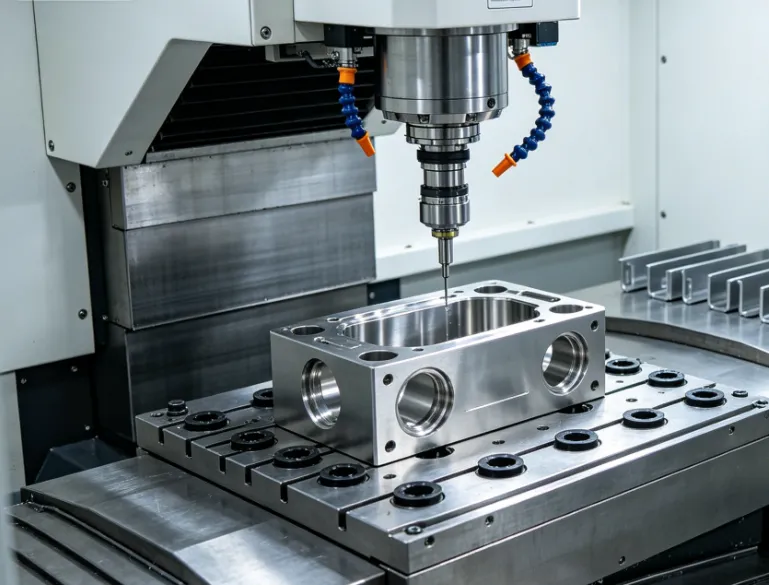
Drilling often leaves helical "corkscrew" marks on the bore wall and can create significant exit burrs as the drill breaks through the bottom of the part. Broaching provides a superior surface finish because the final teeth on the tool are dedicated "sizing" teeth that act more like a burnishing tool than a cutter. This results in a mirror-like finish that often eliminates the need for secondary reaming or honing. In high-precision hydraulic manifold production, broaching is preferred for its ability to produce clean, burr-free intersections that prevent system contamination.
4. Throughput and Cycle Time Efficiency
In high-volume manufacturing, the "single-pass" capability of broaching offers a throughput advantage that drilling centers struggle to match.
A standard CNC drill must move in and out of a hole (pecking) to clear chips, adding seconds to every cycle. A broaching machine finishes the entire internal profile in one continuous stroke, often in under 10 seconds. However, the initial setup time and tool cost for broaching are much higher. For prototype runs of 1-50 parts, drilling a hole and then using a CNC mill to interpolate the profile is more cost-effective. For runs exceeding 1,000 units, the speed of broaching becomes the dominant factor in reducing the total cost-per-part.
5. Heat Management and Material Integrity
The thermal energy generated during the cutting process can alter the microstructure of the metal, leading to localized hardening or "work hardening."
Drilling generates concentrated heat at the tip, which can be difficult to dissipate without high-pressure through-tool coolant. This heat can sometimes make the material too hard for subsequent tapping or finishing. Broaching distributes the heat across dozens of teeth, each in contact with the material for only a fraction of a second. This "cool" cutting action preserves the metallurgical properties of the bore wall, making it ideal for aerospace components where material fatigue and thermal stress must be strictly controlled.
Conclusion
Deciding between Drilling vs Broaching is a matter of matching your production volume to your geometric requirements. Drilling remains the essential first step for any bore, while broaching is the high-speed solution for transforming those bores into complex, high-precision features. By strategically layering these two processes, you can achieve a level of manufacturing efficiency that keeps your production line both fast and accurate.





















Sign in to leave a comment.