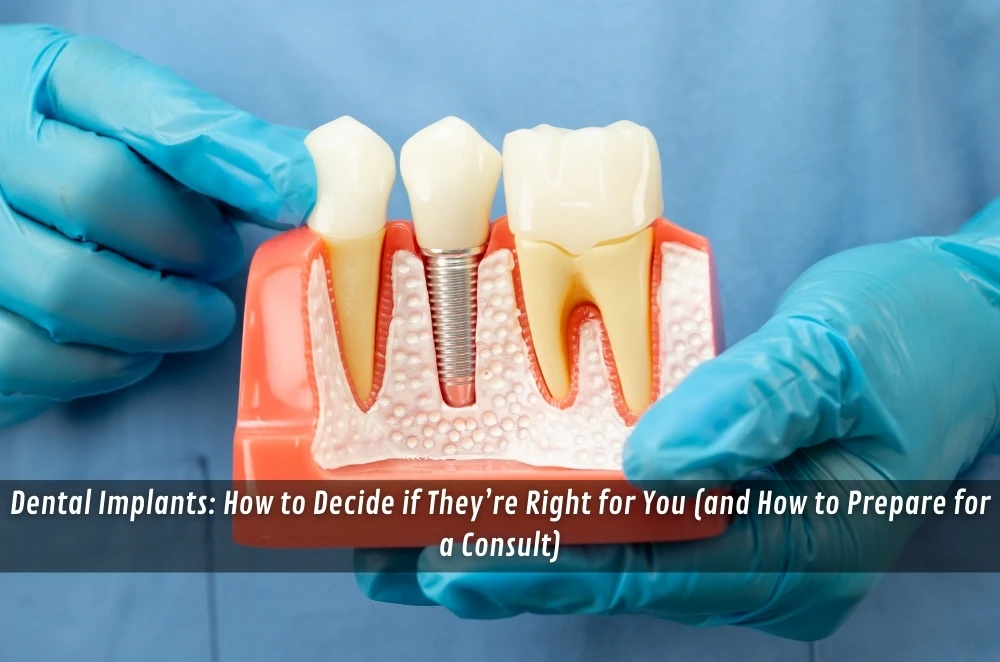

Missing teeth (or teeth that can’t be saved) can affect how you eat, speak, and feel about your smile, but the bigger impact is often quieter: avoiding certain foods, chewing on one side, or feeling unsure in photos.
Dental implants are one option for replacing missing teeth, and for many people they can feel closer to “real teeth” than removable options, but they’re not automatically the best answer for every mouth or every budget.
This guide walks through the decision factors that matter, the common missteps that derail outcomes, and a simple plan to get consult-ready without getting overwhelmed.
Why people consider implants (and when they’re not the first choice)
Implants are often considered when a tooth is missing, needs extraction, or when a bridge or denture hasn’t worked well for comfort or stability—often prompting people to book an implant consult in Melbourne area to understand their options.
They can also be considered when someone wants to avoid relying on neighbouring teeth for support (as with a traditional bridge), though that depends on the specific plan and oral health situation.
At the same time, implants aren’t always the first recommendation if there’s uncontrolled gum disease, active decay, smoking-related healing risks, or medical factors that affect surgery and bone healing.
Sometimes, a simpler solution is genuinely appropriate: a bridge, a partial denture, or even choosing to do nothing immediately while stabilising other dental issues.
The best decision usually starts with a clear goal (function, appearance, stability, longevity, easier cleaning) rather than starting with a product (“I want implants”) and trying to reverse-engineer the justification.
The decision factors that actually matter
The internet tends to focus on “how much do implants cost?” or “how long do implants last?” but the most important decision factors are often practical and personal.
1) Bone and gum health
Implants need healthy supporting bone and stable gums, and a clinician may assess whether there’s enough bone volume and density in the right place.
If bone is limited, it doesn’t always mean “no”, but it may mean a staged approach (for example, grafting) or a different treatment plan.
2) Overall health and healing capacity
Conditions that affect healing, certain medications, and smoking/vaping can influence risk, healing time, and suitability.
This isn’t about “passing” or “failing” a test; it’s about understanding trade-offs and controlling what can be controlled before committing.
3) Timeline tolerance
Some plans are faster, others involve staged steps across months.
If a person has a wedding, a work deadline, or travel coming up, the plan may prioritise predictable function and comfort during healing rather than the fastest possible finish.
4) Maintenance comfort
Implants still require daily cleaning and ongoing check-ups.
A good plan includes a realistic conversation about how to keep the implant area clean (especially if dexterity is an issue) and what support is available.
5) Budget reality and value, not just price
Costs can vary depending on complexity, number of teeth, grafting needs, type of restoration, and the diagnostic work required.
It’s more helpful to ask “what drives the cost in my case?” than to chase an average number that may not apply.
Practical Opinions (exactly 3 lines):
When in doubt, prioritise diagnosis over deals.
Choose predictability and maintainability over the fastest timeline.
If the plan feels rushed, get more clarity before committing.
Common mistakes people make before (and during) the decision
Most implant “regrets” start well before surgery, with unclear expectations or skipped steps.
Mistake 1: Treating a consult like a sales appointment.
A good consult should feel like planning, not pressure.
Mistake 2: Not disclosing health factors early.
Bring a list of medications and relevant medical history so the plan is designed for your reality, not an ideal scenario.
Mistake 3: Comparing treatments using only price or brand names.
Two plans can look similar on paper but differ massively in diagnostics, surgical approach, restoration design, and follow-up.
Mistake 4: Skipping the maintenance conversation.
If daily cleaning and recall visits aren’t discussed, you’re missing a core part of long-term success.
Mistake 5: Underestimating the “temporary teeth” phase.
Ask what you’ll have to wear or use while healing, and what eating limitations are likely.
Mistake 6: Assuming implants are the only “fixed” option.
Depending on the situation, other fixed restorations or staged solutions may meet the goal with less complexity.
What a good implant consult usually includes (and what to ask)
A high-quality consult typically involves three things: assessment, explanation, and an actionable plan you can understand.
What’s usually assessed
- The condition of gums and neighbouring teeth
- Bite and functional habits (including grinding)
- Bone level and anatomy (often with imaging, sometimes 3D)
- Risk factors that affect healing and maintenance
- Your goals and constraints (budget, timing, comfort, aesthetics)
What to ask (use this as a prompt list)
- What are my options besides implants, and why might they suit me?
- What steps are involved in my case, and what’s the likely timeline range?
- What could make the plan more complex (or more expensive) later?
- Will I need grafting or other prep work, and what does that change?
- What will I have during healing (temporary tooth/teeth), and how will it look and function?
- What aftercare and follow-up are included, and what does maintenance look like long-term?
- What are the main risks in my situation, and how are they reduced?
- If I do nothing for 6–12 months, what might change?
If it helps to have a structured set of prompts before speaking with a clinician, the High Dental Implants Melbourne consultation guide can be used to organise questions and priorities ahead of an appointment.
Operator Experience Moment (2–4 sentences)
In practice, the people who feel most confident about their decision are rarely the ones who researched the most products; they’re the ones who walked into the consult with clear goals and a short list of questions. When the “why” is clear (eat comfortably, stop a denture from moving, avoid damaging adjacent teeth), the treatment choices become easier to compare. The turning point is usually when the clinician explains the plan in steps and you can repeat it back in your own words.
A simple first-actions plan for the next 7–14 days
You don’t need to do everything at once; you just need to get organised enough to have a good conversation.
Day 1–2: Clarify the goal.
Write one sentence: “I want to replace ___ tooth/teeth because ___, and the result I want is ___.”
Day 2–4: Collect key information.
List medications, key medical conditions, allergies, and any previous dental surgery details you remember.
Day 4–6: Note your constraints.
Budget range (even if broad), timeline pressures, anxiety triggers, and any transport/support needs for appointments.
Day 6–9: Prepare your questions.
Use the prompt list above and circle the three questions you need answered to make a decision.
Day 9–12: Audit your habits.
If you smoke/vape or grind your teeth, note it honestly; these are planning inputs, not moral judgements.
Day 12–14: Decide what “good” looks like.
For you, is “good” mainly comfort, appearance, lower maintenance, fewer appointments, or a staged cost over time?
Local SMB mini-walkthrough (Melbourne)
A typical Melbourne small business owner approach is to plan around work peaks, not just dental steps.
Start by choosing a consult week that avoids major delivery deadlines, quarter-end, or seasonal rush.
Ask about appointment frequency so you can map it to roster planning and client meetings.
Factor in travel time if you’re coming from the suburbs and prefer off-peak parking or public transport.
If you’re customer-facing, ask what the “temporary teeth” phase usually looks like day-to-day.
Keep a buffer for follow-ups, because real life (and calendars) rarely stay perfectly aligned.
Choosing a provider and plan: what to compare without getting lost
Selecting an implant plan is less about hunting for a single “best clinic” and more about choosing the approach that fits your risks, goals, and tolerance for complexity.
Here’s what’s worth comparing:
- Clarity of the plan: Can the steps be explained simply, including what happens if a step changes?
- Diagnostics: What imaging and assessments are used to design the plan (and why)?
- Risk discussion: Are risks explained in your context, including the options to reduce them?
- Temporary solution: What will you have during healing, and is it predictable for work and social life?
- Maintenance plan: How will cleaning work, and what recall schedule is recommended?
- Communication style: Are you given time to think, or pushed to decide immediately?
A strong sign of quality is when the clinician explains trade-offs openly: faster vs staged, lower cost vs predictability, minimal intervention vs long-term stability.
Key Takeaways
- Implants can be a strong option, but suitability depends on bone, gums, health factors, and maintenance—not just preference.
- A good consult should produce a clear step-by-step plan, including what you’ll have during healing.
- Compare options using predictability, maintenance, and risk reduction, not just price.
- Use a 7–14 day prep plan to clarify goals, gather health info, and bring better questions.
Common questions we get from Aussie business owners
How do I know if I’m even a candidate for implants?
Usually the first step is a proper assessment of gums, bone, bite, and health factors, rather than trying to self-diagnose from symptoms.
A practical next step is to write down your medical conditions and medications so you can disclose them early and accurately.
In Melbourne, appointment planning often matters as much as suitability, so consider your work calendar when booking.
How long does the whole process take?
It depends on whether extra steps are needed (like extractions, grafting, or staged healing) and what kind of temporary tooth solution is used.
A practical next step is to ask for a timeline range with “best case” and “if we need Plan B” scenarios, so you can plan leave and workloads.
In most cases, people in busy metro areas like Melbourne want predictable milestones more than fast dates.
Are implants “set and forget” once they’re done?
In most cases, implants still need consistent cleaning and professional reviews to keep gums healthy and catch issues early.
A practical next step is to ask what daily tools are recommended (brushes, interdental aids) and how often follow-ups are usually scheduled.
Usually this is easiest to maintain when it’s built into a routine—think of it like servicing something you rely on daily.
Should I get a second opinion before committing?
Usually a second opinion is worthwhile if the plan feels rushed, the steps aren’t clear, or the risks haven’t been explained in your context.
A practical next step is to request a written outline of the proposed steps so you can compare like-for-like between consults.
In most cases, Melbourne patients find it easier to compare plans when the focus is on sequencing and maintenance, not brand names or buzzwords.



























Sign in to leave a comment.