

Hospitals and health systems are under growing pressure to deliver better outcomes with fewer resources, tighter margins, and increasingly complex care environments.
Traditional AI systems—rule-based automation, static predictive models, and isolated decision-support tools—are no longer sufficient to handle this complexity.
This is where agentic AI in healthcare is emerging as a foundational architectural shift. Unlike passive AI models that only respond to inputs, agentic AI systems are designed to set goals, reason across context, take autonomous actions, and continuously adapt—all while remaining governed by clinical and operational oversight.
For healthcare organizations planning large-scale digital transformation, designing the right agentic AI architecture is critical to achieving scalability, safety, and measurable ROI.
Core Components of Agentic AI in Healthcare Platforms
Agentic AI is not a single algorithm or tool. It is an architectural paradigm composed of multiple coordinated components that work together across clinical, operational, and administrative workflows.
Goal Definition and Decision-Making Engines
At the heart of agentic AI architecture lies a goal-driven decision engine. Unlike traditional AI that simply predicts outcomes, agentic systems are designed to act toward defined objectives.
In healthcare platforms, these goals may include:
- Reducing avoidable hospital readmissions
- Closing care gaps for chronic conditions
- Optimizing clinician workload distribution
- Improving quality scores in value-based care contracts
The decision-making engine continuously evaluates real-time data against these goals and determines the next best action—whether that’s escalating a case to a care manager, adjusting monitoring frequency, or triggering patient outreach.
For hospitals, this means AI systems that don’t just inform decisions but actively orchestrate care processes.
Memory, Context, and State Management
One of the defining characteristics of agentic AI in healthcare is its ability to retain memory and contextual awareness over time.
Healthcare workflows are longitudinal by nature. A patient’s condition, adherence patterns, social determinants, and previous interventions all matter. Agentic AI systems rely on advanced state management to:
- Maintain longitudinal patient context
- Track prior decisions and outcomes
- Adapt behavior based on historical effectiveness
This memory layer allows AI agents to evolve from reactive tools into continuously learning care coordinators, capable of adjusting strategies based on what has or hasn’t worked for a specific population or facility.
From a system architecture perspective, this requires robust data models, scalable storage, and event histories that can be queried in real time.
Human-in-the-Loop Control Models
Despite increased autonomy, agentic AI in healthcare must never operate in isolation. Safety, trust, and regulatory compliance demand strong human-in-the-loop controls.
Effective agentic architectures include:
- Configurable approval thresholds for clinical actions
- Escalation paths to clinicians or administrators
- Transparency into AI reasoning and decision logic
- Override and audit mechanisms
For example, an AI agent may autonomously identify rising risk in a patient's cohort, but clinician approval may be required before modifying care plans or initiating clinical interventions.
This balance between autonomy and oversight ensures that agentic AI enhances—not replaces—clinical judgment.
Integrating Agentic AI with Existing Healthcare Systems
Even the most advanced AI architecture fails without seamless integration into the hospital’s existing IT ecosystem. Successful agentic AI deployments are built to augment—not disrupt—core healthcare systems.
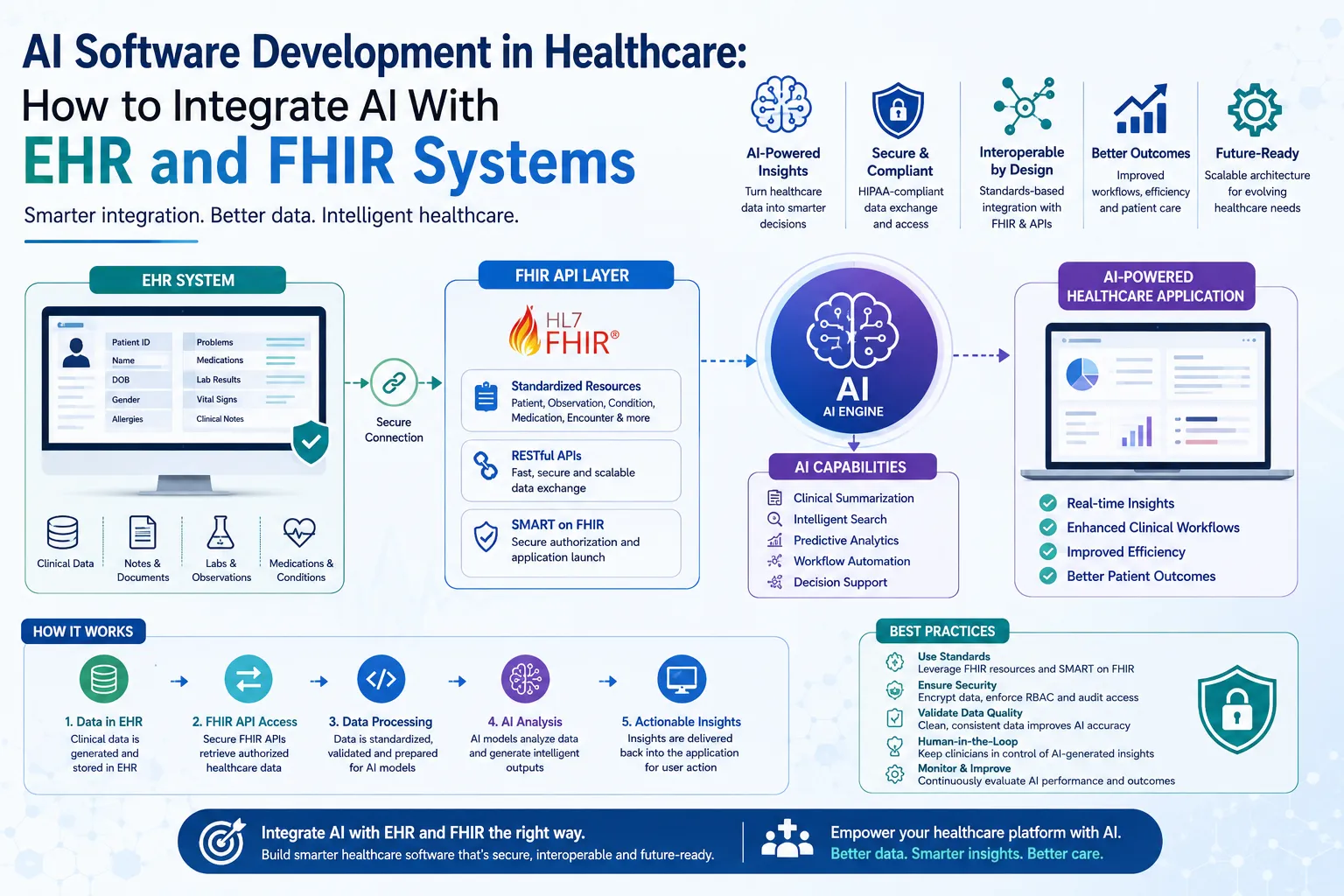
EHR, FHIR, and API-Based Integration
Hospitals operate within highly interconnected digital environments dominated by EHRs, clinical systems, and payer platforms. Agentic AI must integrate deeply with these systems to access real-time, actionable data.
Modern architectures rely on:
- FHIR-based clinical data exchange
- HL7 messaging for legacy interoperability
- Secure REST APIs for modular connectivity
Through these integrations, AI agents can:
- Monitor patient data streams
- Track care plan adherence
- Coordinate across departments and facilities
This standards-based approach allows hospitals to deploy agentic AI without extensive system rework, accelerating time-to-value.
Secure Data Access and Role-Based Controls
Agentic AI systems often require access to sensitive clinical, operational, and financial data. Without strong security architecture, this creates unacceptable risk.
Enterprise-grade agentic AI platforms implement:
- Role-based access control (RBAC)
- Attribute-based access policies
- Identity federation with hospital IAM systems
- Continuous monitoring and logging
Each AI agent operates within clearly defined permissions, ensuring that access aligns with regulatory requirements such as HIPAA and internal governance policies.
Security is not an afterthought—it is foundational to scalable agentic AI in healthcare.
Event-Driven AI Agent Workflows
Healthcare environments are dynamic. Lab results arrive, vitals change, appointments are missed, devices generate alerts—all in real time.
Agentic AI architectures are increasingly event-driven, enabling AI agents to respond immediately to meaningful changes across systems.
Examples include:
- Triggering care outreach when RPM thresholds are breached
- Escalating cases when documentation gaps appear
- Adjusting workflows based on staffing availability
By leveraging event streams rather than batch processing, hospitals can move from delayed response models to continuous, proactive care orchestration.
Why Architecture Matters for Enterprise-Scale Adoption
Hospitals and health systems operate at scale—across multiple facilities, specialties, and patient populations. Poorly designed AI architectures may work in pilots but fail in production.
A scalable agentic AI architecture ensures:
- Consistent performance under high data volumes
- Modular expansion across departments
- Maintainability as AI capabilities evolve
- Clear governance across autonomous agents
For healthcare leaders, architecture is not a technical detail—it directly impacts clinical outcomes, operational efficiency, and financial performance.
Commercial Impact of Agentic AI in Healthcare Systems
From a business perspective, agentic AI architectures unlock measurable value across hospital operations:
- Reduced operational overhead through autonomous coordination
- Improved care quality via continuous monitoring and intervention
- Better performance in value-based contracts
- Lower clinician burnout by automating routine decision pathways
- Faster innovation cycles through modular AI components
Health systems that invest early in robust agentic AI architecture position themselves to adapt quickly as care models, regulations, and patient expectations evolve.
Final Thoughts: Building for the Next Decade of Healthcare AI
Agentic AI in healthcare represents a shift from tools that assist decisions to systems that actively manage complexity at scale. However, success depends on architecture—how goals are defined, how context is preserved, how humans remain in control, and how AI integrates securely into existing ecosystems.
For hospitals and health systems, the question is no longer whether agentic AI will play a role, but how well their architecture is prepared to support it.
Healthcare organizations that design agentic AI thoughtfully today will lead the next generation of intelligent, resilient, and patient-centered care delivery.





























Sign in to leave a comment.