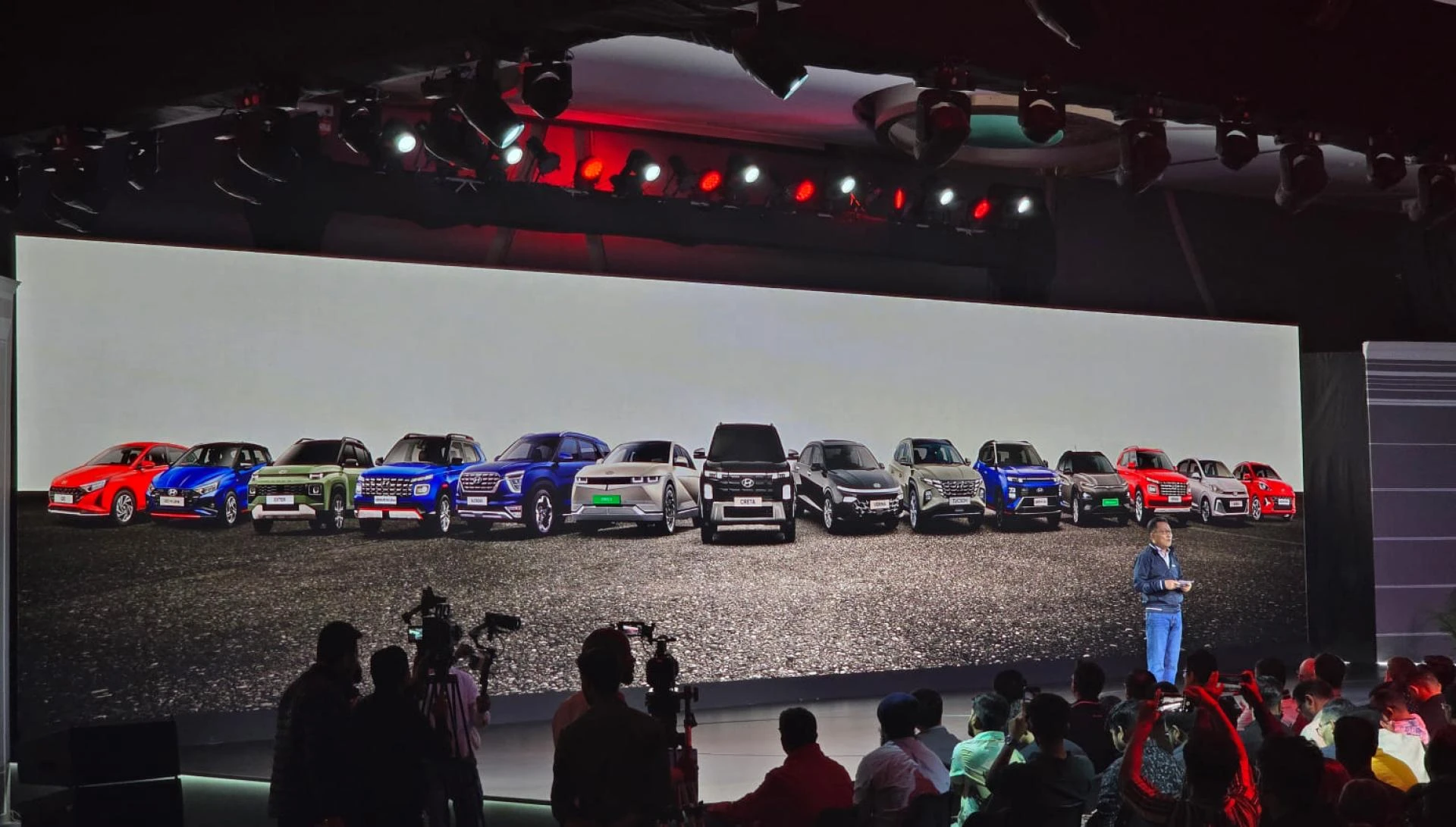

There's a difference between launching a product and making people believe in it. Most brand events are very good at the first thing and surprisingly bad at the second.
A launch is an announcement. Belief is a feeling. And feelings don't come from slide decks.
When Hyundai needed to introduce the Creta N-Line — a sportier, sharper evolution of one of India's best-selling cars — to internal teams and media, they needed more than a reveal. They needed a room full of people who walked out genuinely excited. Not politely impressed. Actually moved.
That's the brief IIC Lab worked from.
The Problem With a Standard Car Reveal
A car reveal follows a familiar script. Dramatic music. Slow lighting build. Curtain drop. Applause.
It works. It's been working for decades. But it has a ceiling.
The drama of the reveal moment lasts about 45 seconds. Then the car is just... there. On a stage. And the audience shifts from experiencing something to evaluating something.
For the Creta N-Line, the goal was to extend that "experiencing" window — to make the character of the car communicate itself before anyone sat in it or read a spec sheet.
What IIC Lab and agency partner Communique identified:
- The N-Line's identity is built on performance, aggression, and precision — design language that's felt, not described
- The audience of internal teams and media was sophisticated — they'd seen hundreds of car launches and would clock a generic reveal instantly
- A 3D anaglyph approach would let them show the car's design details as spatial objects — surfaces, lines, aerodynamic geometry — rather than as a flat image
How 3D Anaglyph Content Works for a Car Launch
The anamorphic illusion content creation process for this project was anchored in one technical insight: the N-Line's design language is all about tension.
Sharp creases. Sculpted vents. A front fascia built to communicate aggression at a glance. This is content that wants to be experienced in three dimensions — because that's how a car actually exists in the world.
Using 3D anaglyph rendering:
- The vehicle's exterior surfaces were reconstructed in high-detail CGI, with every panel line and crease rendered as a geometric edge in three-dimensional space
- The launch sequence was designed so the car assembled itself from component elements — each design detail emerging as a distinct spatial object before the full form resolved
- Depth was used dramatically: certain elements appeared to push out of the screen plane toward the audience, creating a physical sense of the car's presence before anyone had approached the actual vehicle
- The colour grade was calibrated to enhance the N-Line's signature contrast between dark surfaces and sharp highlights — the 3D rendering made those highlights appear to float
Over 300 attendees witnessed this launch. Media coverage reflected the difference between "we saw the car" and "we experienced the car" — a distinction the content was specifically designed to create.
Why the Tech Choice Matched the Brand
It's worth pausing on why 3D anaglyph rather than a different form of immersive content.
Anamorphic and anaglyph techniques work differently — anaglyph uses colour channel separation viewed through glasses to create stereoscopic depth, while anamorphic uses perspective geometry viewed from a fixed point without glasses. For an auditorium setting with 300 people, anaglyph delivers consistent 3D to the entire room simultaneously.
The choice was deliberate:
- A 300-person room means 300 different viewing angles — anaglyph handles this, anamorphic is more suited to smaller, controlled environments
- The glasses-based format actually added to the event theatricality — putting on the glasses became a ritual moment that primed the audience for something different
- The depth effect works identically for every seat in the house, which matters when your audience includes senior executives and journalists across a wide seating spread
This is what working with a genuine anamorphic content development company looks like — not just executing a brief, but understanding which technique serves which context, and why.
The Conviction Gap in Product Marketing
There's a phrase worth sitting with: conviction gap.
It describes the distance between what your marketing communicates and what your audience genuinely believes. You can have perfect messaging, beautiful creative, and a flawless event execution — and still have a wide conviction gap, because none of it made people feel the product.
For the Creta N-Line, closing that gap meant making 300 people feel the car's DNA in their bones before they ever touched it. The 3D content did that by reconstructing the car's design language as spatial experience — turning what would have been a visual presentation into something closer to standing next to the actual vehicle.
That's conviction. And it doesn't come from a flat screen.
What This Means for Your Next Launch
If you're working on a product launch — automotive, consumer electronics, fashion, FMCG — ask yourself one question: will our audience leave feeling something, or just knowing something?
Knowing is easy. Feeling is the hard part. And it's the only part that drives action, share, and memory.
Working on a launch that needs to hit different? Inkincaps has been crafting immersive content that creates conviction across industries. Let's talk about yours.



























Sign in to leave a comment.