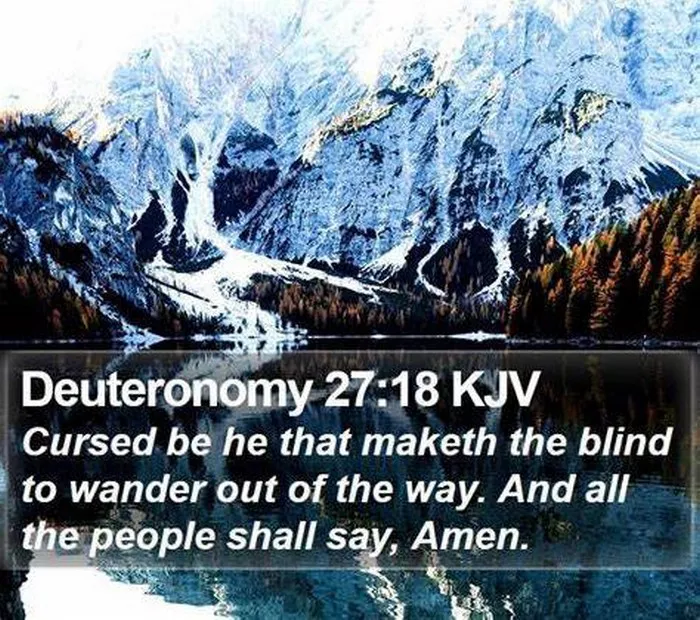

Read the Bible Quote of the Day – Deuteronomy 27:18 To Strengthen Your Spiritual Journey.
Deuteronomy 27:18 is part of a series of curses God commanded Moses to have the Israelites pronounce as a solemn reminder of the consequences of disobedience. This verse condemns dishonesty and deception in business, particularly cheating or defrauding others in trade.
The Context of Deuteronomy 27:18 KJV
The Setting of Deuteronomy 27
Deuteronomy is the final book of Moses’ writings before the Israelites entered the Promised Land. In chapters 27 and 28, Moses sets before the people the blessings for obedience and curses for disobedience to God’s laws.
Chapter 27 describes a public ceremony. God commands Israel to set up large stones engraved with the law on Mount Ebal and to pronounce blessings from Mount Gerizim and curses from Mount Ebal. This public declaration was meant to imprint God’s law on the people’s hearts and to remind them of the serious consequences of sin.
The Series of Curses
Verses 15 through 26 list a series of curses against specific sins. These curses cover various offenses against God and others, emphasizing the importance of holiness, justice, and faithfulness.
Deuteronomy 27:18 falls within this list and addresses dishonesty, especially in commercial transactions.
Deuteronomy 27:18 (KJV)
Here is the verse in the King James Version:
Cursed be he that maketh the blind to wander out of the way. And all the people shall say, Amen.
Deuteronomy 27:18 Meaning
Literal Meaning of the Verse
At first glance, the phrase “maketh the blind to wander out of the way” might seem unclear. In the historical context, it refers to deceiving or cheating someone who is vulnerable or unable to protect themselves.
The “blind” likely refers to a person who is either literally blind or figuratively vulnerable—someone who cannot see or recognize dishonesty or trickery. The “way” is the path of honesty and fairness.
This phrase is understood to mean cheating others by using dishonest scales or measures in trade, which was a common form of deceit in ancient times. Merchants could manipulate weights to give less product than promised, especially to those who were unable to notice.
Symbolic and Spiritual Meaning
The blind represent the vulnerable, including the poor, the weak, and the defenseless. God condemns exploiting these people by trickery or fraud.
This verse highlights God’s concern for justice and protection for those who cannot protect themselves.
The Seriousness of Dishonesty in God’s Eyes
Dishonesty breaks God’s covenant. It harms relationships, causes suffering, and disrupts community trust. God calls His people to be honest and upright in all dealings.
Using the metaphor of leading the blind astray stresses how sinful it is to take advantage of someone’s inability to defend themselves.
Comparison with Other Biblical Passages
The Bible consistently condemns dishonesty in business and exploitation:
Leviticus 19:35-36 says: “Ye shall do no unrighteousness in judgment, in meteyard, in weight, or in measure.”
Proverbs 11:1 states: “A false balance is abomination to the LORD: but a just weight is his delight.”
Psalm 82:3 commands: “Defend the poor and fatherless: do justice to the afflicted and needy.”
This verse fits into a broad biblical theme calling for justice and honesty.
Deuteronomy 27:18 Application in Life
Honesty in Business Today
Although we no longer use physical weights as commonly as in biblical times, the principle applies fully to modern business and financial dealings.
God calls Christians to act with integrity, avoiding fraud, deception, or exploitation of customers, clients, or partners.
Dishonest business practices might include:
Overcharging or hidden fees
False advertising
Selling defective or counterfeit goods
Misrepresenting facts to benefit oneself
Protecting the Vulnerable
Deuteronomy 27:18 reminds us to protect those who are vulnerable—those who might be “blind” to deceit, including:
The elderly
The poor
Children
Those unfamiliar with certain transactions or systems
Christians are called to be advocates for justice and fairness.
Practical Ways to Apply This Teaching
Be truthful in all dealings: No exaggeration or deceit.
Avoid taking advantage: Never exploit another’s weakness or ignorance.
Promote fairness: Use fair pricing and clear communication.
Educate others: Help those who may be vulnerable to avoid scams.
Advocate for ethical standards: Support laws and policies that protect consumers.
Living Out God’s Justice
The verse encourages believers to live out God’s justice in everyday life. Justice is not just a legal concept but a spiritual mandate.
Jesus teaches love for neighbor and warns against exploiting others for selfish gain (Mark 12:31).
Reflection on Personal Integrity
Deuteronomy 27:18 challenges each believer to examine their own integrity. Are we honest in small and big things? Do we respect others’ rights? Are we careful not to harm the vulnerable?
Conclusion
Deuteronomy 27:18 carries a strong message about honesty, justice, and protecting the vulnerable. The curse against those who “make the blind to wander out of the way” warns us against deceiving or cheating others, especially those who are defenseless.
This verse reminds Christians today of the importance of integrity in business, fairness in relationships, and advocacy for the weak. By living according to God’s principles, we build trustworthy communities that honor God.
As believers, let us embrace the call to honesty and justice. May we never lead others astray but instead lead with truth and love, reflecting God’s heart for all people.





















Sign in to leave a comment.