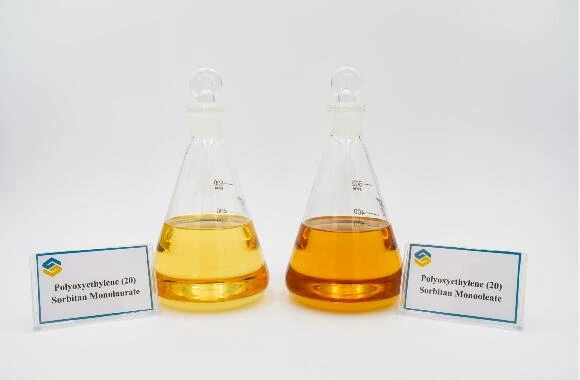

Synthetic Raw Materials Difference between polysorbate 20 or 80
Polysorbate 20 uses in cosmetics is a product of the polymerization reaction of sorbitan monolaurate and ethylene oxide, while polysorbate 80 is synthesized by the polymerization of sorbitan monooleate and ethylene oxide.
Application Difference between Polysorbate 20 and 80
Polysorbate 20 is known as a non-ionic stain remover because it has relatively more hydrophilic groups (polyoxyethylene), which gives it a strong hydrophilicity property. Polysorbate 20 is usually used as an oil-in-water(O/W) type emulsifier and solubilizer.
Polysorbate 80 vs 60 is one of the most common polysorbates. The polysorbate 80 emulsifier has significant resistance to electrolyte and strong hydrophilicity, which allow it to be widely used in liquid, semisolid and solid preparations. Polysorbate 80 is used as an oil-in-water(O/W) type emulsifier, solubilizer, wetting agent, dispersant, and stabilizer.
What is the difference between polysorbate 20 and 80
Polysorbate 20 is a yellow to orange oily liquid, which has a faint odor and a slightly bitter taste. It contains relatively more hydrophilic groups, which allows it to be soluble in water, methanol, ethyl acetate, and toluene(methylbenzene) and insoluble in mineral oil and vegetable oil.
Polysorbate 80 is a light yellow to orange-yellow viscous liquid, which tastes slightly bitter and astringent. It's soluble in warm water, methanol, ethyl acetate, and very slightly dissolvable in mineral oil.
For more information about what is polysorbate 20 made from and polysorbate 20 use, please feel free to contact us!
As a professional polysorbate manufacturer, huana provides quality sorbitan fatty acid esters at competitive wholesale prices. Feel free to contact at any time.





















Sign in to leave a comment.