
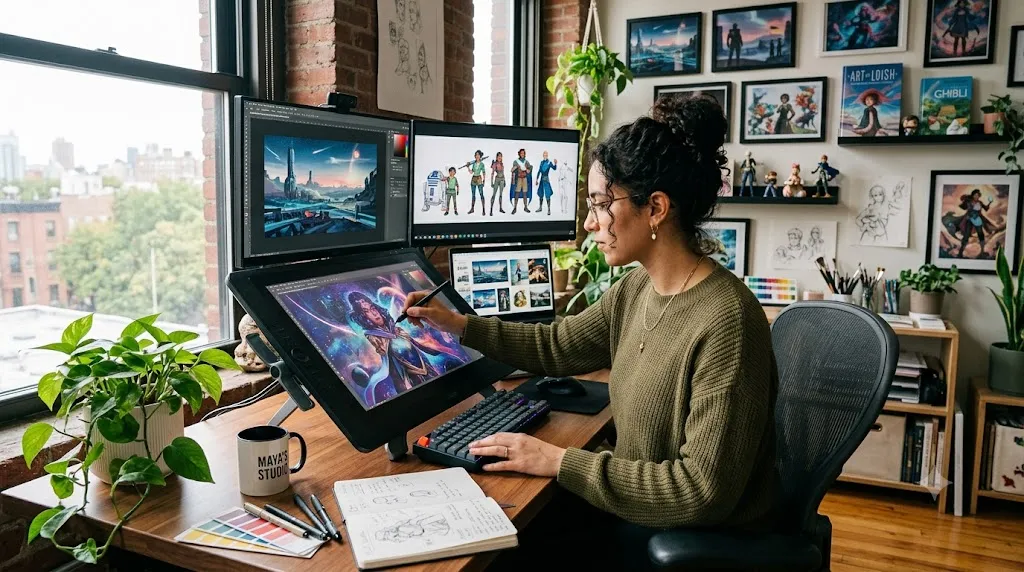
A collector scrolling through an online gallery today might land on a hand-painted watercolour, then a piece generated frame by frame in animation software, then a 3D environment built entirely on a screen. All three are original work. Only one of them existed as a category twenty years ago. That's the shift digital artists have brought to the art world, and it's worth understanding before you write off anything made with software as "not real art."
Art has always evolved alongside its tools. Painters once debated whether photography counted as art. The same conversation is happening again, this time about screens and code.
Traditional Art vs Digital Art: What Actually Changes
The core creative process, an idea shaped into something visual, doesn't really change. What changes is the material.
| Traditional Art | Digital Art | |
| Primary tools | Canvas, paint, physical materials | Software, tablets, digital rendering |
| Editability | Limited once applied | Can be revised extensively before finishing |
| Formats possible | Painting, sculpture, print | Illustration, 3D, animation, generative work |
| Physical original | Yes, one unique object | Often a file, sometimes a limited print |
Neither column is "more legitimate" than the other. They're different processes that happen to produce the same thing at the end: a piece someone made deliberately, with skill and intent.
What Digital Art Actually Includes
The category is broader than most people assume. It covers digital illustration and digital painting, but also concept art, 3D artwork, motion graphics, and generative pieces built partly through code. Each of these represents a different relationship between the artist's decisions and the tool's capabilities.
Where the Real Skill Sits
Software doesn't create the artwork. It's easy to assume otherwise, especially with generative tools in the conversation now, but the concept, the composition, and the visual storytelling still come from the artist's own thinking.
What separates a strong digital artist from someone who's simply competent with software usually comes down to three things: a clear creative concept behind each piece, technical control over composition and colour, and a visual identity that stays recognisable across their work. Tools change fast. That identity is what actually holds a body of work together.
How Collectors Are Actually Finding These Artists
Discovery used to mean a gallery show or a local recommendation. Now it happens through browsing, comparing portfolios, and reading about an artist's background before ever seeing a piece in person.
That shift has upsides and a real risk. It's easier than ever to find work from artists you'd never encounter locally, but it's also easier to judge a piece on a thumbnail alone. Taking a few extra minutes to look through an artist's full portfolio rather than a single standout image tends to reveal whether the work is genuinely consistent or just one lucky result.
A Few Things Worth Checking Before You Buy
Reviewing an artist's previous work shows their consistency and creative range, not just their best piece. Understanding how a specific work was made, whether it's fully hand-drawn, built in a 3D environment, or assisted by generative tools, adds context that changes how you read the piece. And the strongest digital artwork usually communicates something beyond visual polish: an idea, a mood, a story, not just a striking effect.
Skipping this research is the most common mistake collectors make. A piece that looks impressive on a phone screen doesn't always hold up once you understand nothing behind it but the effect itself.
Technology Is the Tool, Not the Point
It's tempting to talk about digital art mostly in terms of what's technically possible: new software, interactive pieces, virtual environments. Those are real developments, but they're not what makes any single piece worth collecting.
The artists working in this space are doing what artists have always done, translating ideas into something visual that someone else can connect with. The medium keeps expanding. What makes a piece meaningful hasn't changed nearly as much as the tools used to make it.



















Sign in to leave a comment.