
Here's a harsh reality about today's real estate market: good location and good design are no longer enough.
Buyers have options. Lots of them. In any micro-market, you're competing against multiple developers, all with similar amenities, comparable pricing, and equally attractive locations. The traditional differentiators — location, price, specifications — have become table stakes. The real battle is happening somewhere else entirely.
The battle for experience.
Rustomjee Verdant Vista in Thane faced this exact challenge. Founded in 1995, Rustomjee had built a reputation for innovative design and eco-friendly construction. But Thane's competitive landscape demanded more than just a good project — it demanded an experience that would stand out in a crowded market.
They needed digital twin for real estate that could communicate location advantages and 75+ amenities in a way that would make buyers stop, engage, and remember.
The Experience-Led Market Reality
Buyers Are More Sophisticated — They've seen it all. They've visited multiple Experience Centres. They know the difference between a sales pitch and genuine value. Generic presentations don't impress them anymore.
Differentiation Is Harder — When everyone has a swimming pool, a clubhouse, and landscaped gardens, amenities stop being differentiators. They become expectations. How do you stand out when everyone offers the same things?
Attention Is Scarce — Buyers visit multiple projects in a single day. By the time they reach your project, they're tired, overwhelmed, and struggling to remember details. Your project blurs into the rest.
Location Context Is Complex — Your project isn't just a building — it's part of a neighborhood, a connectivity network, a lifestyle ecosystem. But communicating that context through brochures and scale models is incredibly difficult.
The Rustomjee Challenge
Rustomjee Verdant Vista had genuine advantages — strategic location in Thane's evolving landscape, 75+ amenities spread across multiple towers, a 25KM catchment area with schools, hospitals, corporate hubs, and entertainment venues, and transit connectivity that needed proper explanation.
But traditional approaches were failing. Scale models showed the building but not the location context. Brochures listed amenities but didn't let buyers experience them. Sales presentations described connectivity but didn't make it tangible. Sample flats showed interiors but not the surrounding lifestyle.
What Digital Twin for Real Estate Companies Actually Delivers
V-Estate partnered with Rustomjee to create something different: an interactive and tech-forward experience anchored by a central hero interaction.
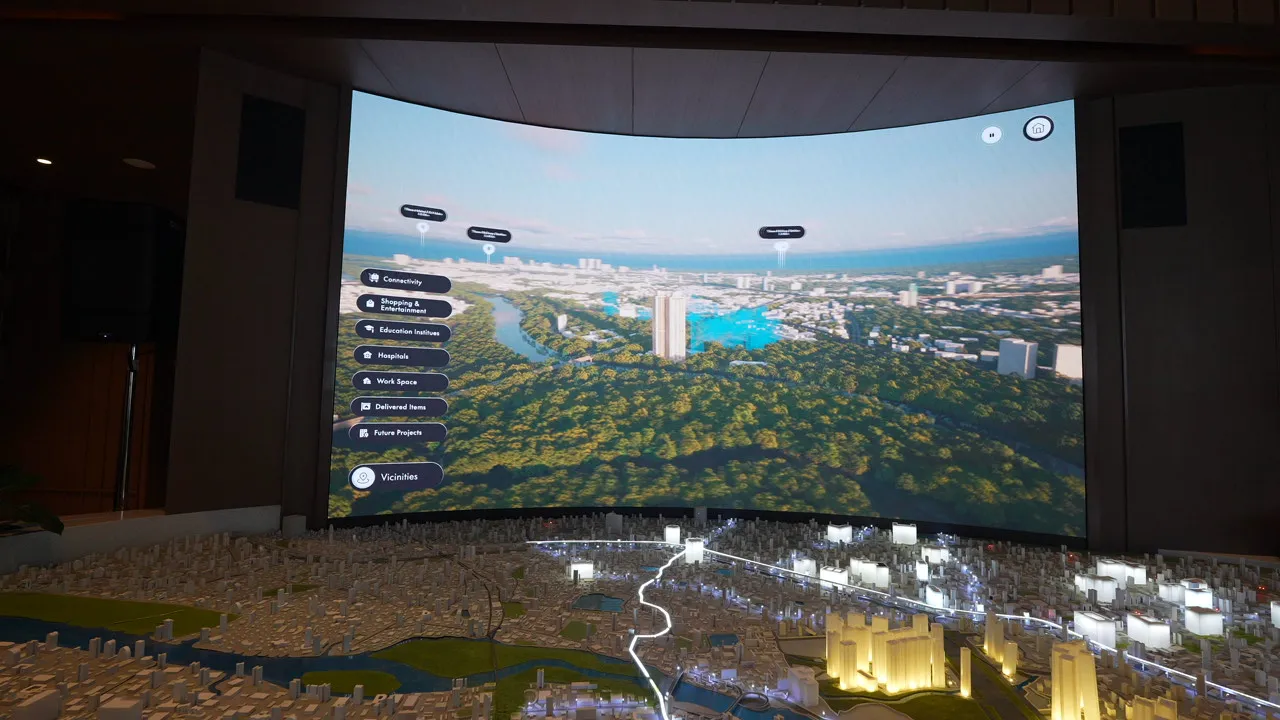
Vicinity Scale Model with IoT Integration — This zone highlighted the 25KM catchment area in a very precise and interactive manner. Key landmarks — educational institutions, corporate hubs, entertainment venues, highways, railway stations, transit routes — all mapped visually and intuitively.
But here's what made it remarkable: commute paths with distance and time calculations using real-time animations. Buyers didn't just see that a location was 5km away — they saw the route, understood the time, and experienced the connectivity.
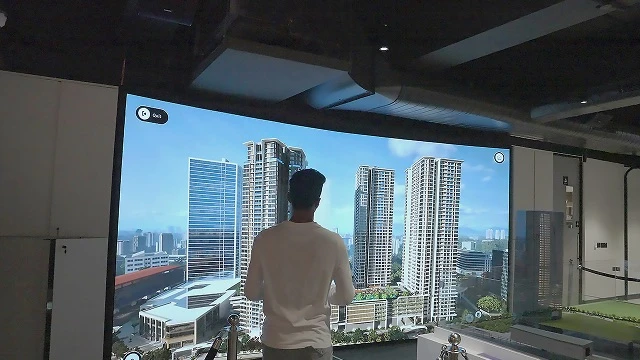
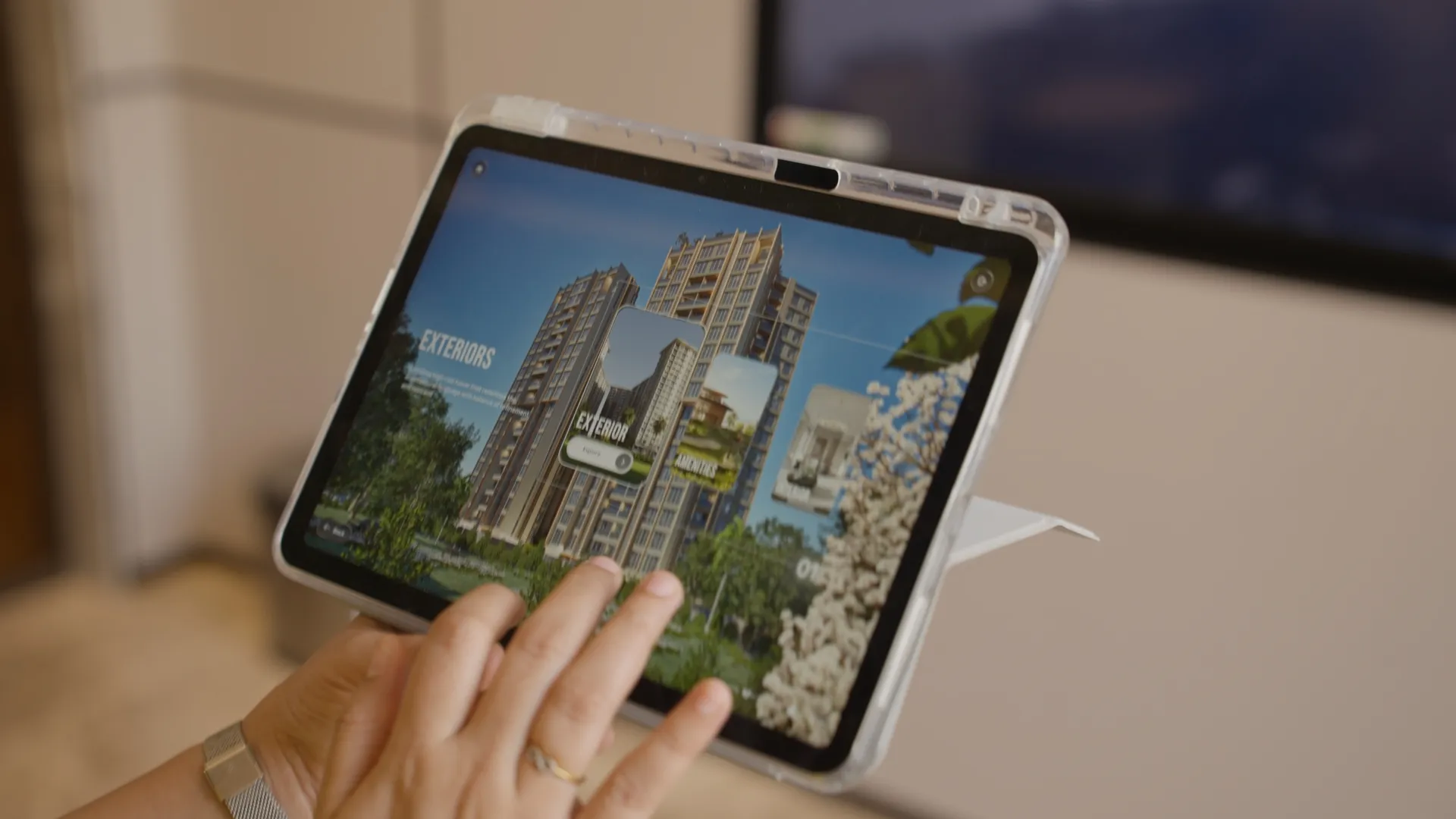
Physical-Digital Integration — A 16 ft x 8 ft curved LED panel (PP2.0) was integrated with the physical scale model, completely controlled via an 11-inch iPad Pro. Sales executives could guide buyers through the location interactively, highlighting specific touchpoints that mattered to each individual buyer.
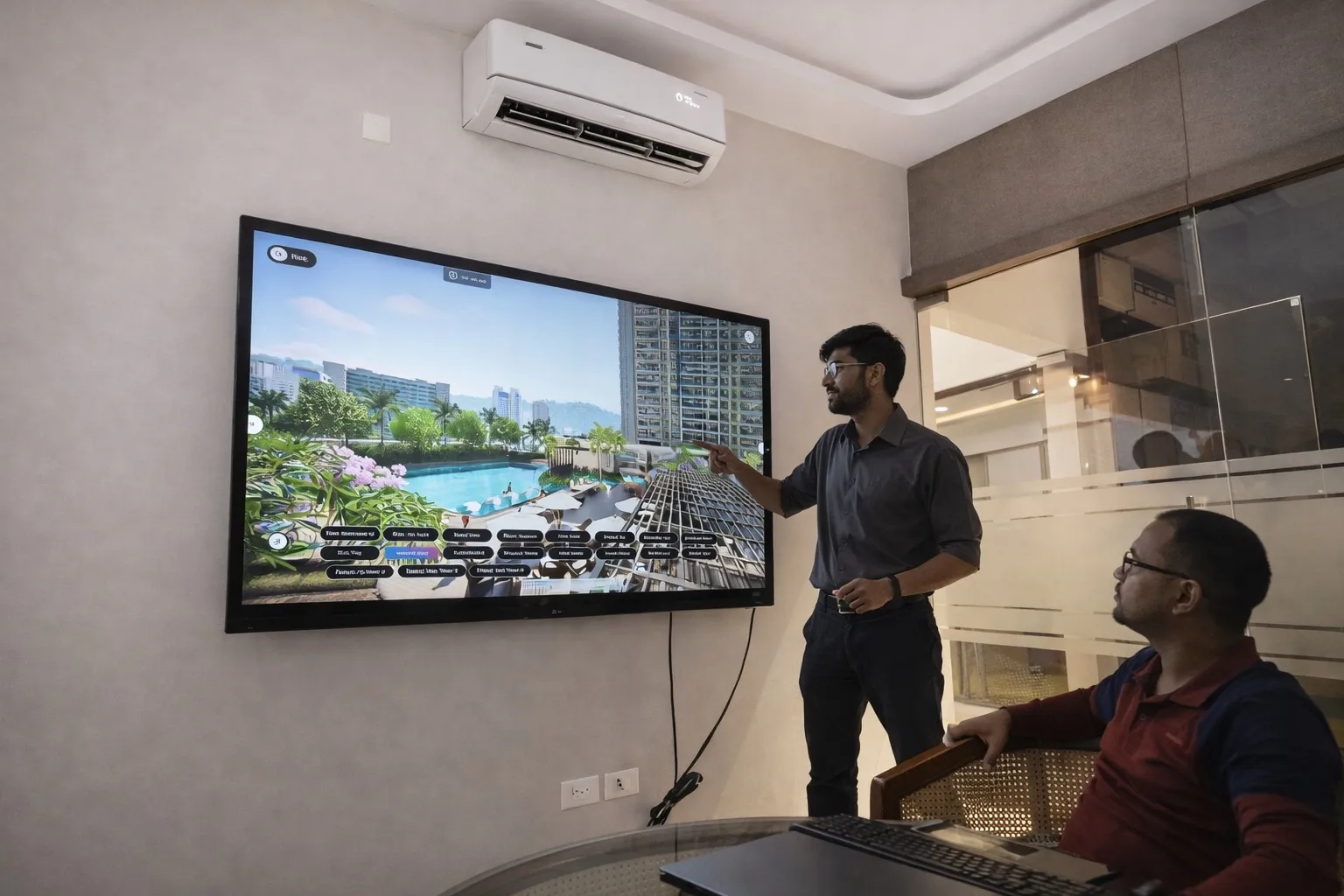
Interactive Real-Time Sales Tool — A 55" touchscreen display connected to a high-performance workstation rendered 4K real-time digital twins of the property. Buyers could freely navigate through key zones and features, understanding the project at their own pace, in their own way.
The Results That Matter
30% Increase in Conversion Ratio — This isn't just impressive — it's transformational. A 30% improvement in conversions changes the entire economics of sales operations. Faster closures. Better efficiency. Stronger ROI.
First-of-Its-Kind Launch in Thane — The deployment became a talking point in the market. The experience itself became a differentiator, driving footfall and creating buzz that traditional marketing couldn't achieve.
Enhanced Recall Value — Buyers remembered Rustomjee because the experience was memorable. In a crowded market where all projects start to blur together, being remembered is half the battle.
Sales Team Adoption — The software became central to Rustomjee's sales strategy for the project. When sales teams embrace technology enthusiastically, you know it's actually working — not just impressive in theory, but valuable in practice.
Why Digital Twin Matters for Experience-Led Competition
Clarity Beats Persuasion — In experience-led markets, buyers don't want to be persuaded — they want to understand. Digital twins provide clarity through direct exploration, making confidence the natural outcome.
Personalization at Scale — Every buyer is different. Digital twins serve all needs seamlessly, personalizing the experience without requiring custom sales pitches.
Location as Lifestyle — Your project isn't just a building — it's part of a neighborhood, a connectivity network, a daily routine. Digital twins show this context in ways that brochures and scale models never could.
Differentiation Through Innovation — When everyone has similar amenities, location advantages, and pricing, the sales experience itself becomes the differentiator. Digital twins signal innovation and sophistication that sets you apart.
The Competitive Advantage of Digital Twin
What Rustomjee discovered is that digital twin technology delivers competitive advantage on multiple levels. When buyers visit multiple projects, the one with interactive digital twins stands out — it's memorable, sophisticated, and signals that this developer takes the sales experience seriously. Interactive exploration increases dwell time and develops stronger connection, driving faster decisions. And when buyers can explore interactively, sales conversations improve from explaining features to discussing lifestyle.
What This Means for Your Competitive Strategy
If you're competing in an experience-led market, digital twin technology isn't optional — it's essential. Your competitors will adopt it. Once buyers experience interactive exploration, static presentations feel inadequate. And the ROI case for digital twins has become compelling, not aspirational.
The Experience-Led Market Reality
The fundamental shift in real estate marketing is this: the experience of buying has become as important as what you're buying.
Design, location, amenities — these are still critical. But they're no longer sufficient. Buyers expect a sales experience that matches the sophistication of the product they're considering.
Rustomjee proved that in competitive markets like Thane, the sales experience itself becomes a differentiator. A 30% increase in conversions isn't just a metric — it's proof that experience-led marketing delivers actual business results.
Ready to compete in experience-led markets?
Let's talk about what digital twin technology can do for your competitive strategy. Whether you're facing stiff competition, launching in a new micro-market, or simply need to give your buyers the experience they expect, V-Estate brings the technology, expertise, and proven track record to make your project impossible to forget.
Book a Demo with V-Estate → Let's build your competitive advantage together.
























Sign in to leave a comment.