
Introduction
Choosing the wrong trucking company can lead to catastrophic consequences, including severely delayed shipments, complex compliance issues, denied insurance claims, and devastating financial losses. In the logistics industry, due diligence is not optional—it is a critical requirement for survival.
Many people perform a basic DOT Lookup expecting it to instantly reveal everything they need to know about a motor carrier before handing over valuable freight. In reality, a standard DOT lookup is merely the first step in a much more comprehensive carrier verification strategy. To truly protect your supply chain, you must dig deeper into the data provided by federal databases.
This comprehensive guide covers everything you need to know to properly vet a commercial motor carrier, including:
- Understanding DOT numbers and how a DOT Number Lookup works
- Navigating safety records and interpreting CSA scores effectively
- Recognizing operating authority and using an MC Number Lookup
- Identifying the largest carriers and maintaining rigorous screening standards across the board
Whether you are an independent shipper, a freight broker, or a dedicated fleet manager, mastering these vital verification tools ensures safer highway partnerships, fully protected cargo, and complete peace of mind.
What Is a DOT Number?
A USDOT Number is a unique identifier assigned by the Federal Motor Carrier Safety Administration (FMCSA) to commercial motor vehicles.
- What it does: It acts as a tracking mechanism for the federal government to monitor a company’s safety compliance, roadside inspections, crash history, and audit results.
- Why FMCSA issues them: To maintain a centralized database of companies operating commercial vehicles within interstate commerce (and in many states, intrastate commerce).
- Company Name vs. DOT Number: While companies can change their commercial or "Doing Business As" (DBA) name, their USDOT number remains permanently tied to their legal entity and safety profile, making it the most reliable tracking metric.
- When businesses need one: Any business that operates commercial vehicles transporting passengers or hauling cargo in interstate commerce must obtain a USDOT number.
Who Needs a DOT Number?
Federal regulations require a USDOT number for commercial entities that meet specific criteria. You generally need a DOT number if your vehicles fall under these categories:
- Interstate Commerce: Weigh more than 10,000 pounds, transport hazardous materials in quantities requiring a placard, or transport more than 8 passengers (including the driver) for compensation, or more than 15 passengers not for compensation.
- Commercial Fleets: Operate heavy-duty trucks, semi-trucks, or delivery vans crossing state lines.
- Hazmat Carriers: Transport any quantity of hazardous materials that requires safety placarding, regardless of vehicle weight.
- Passenger Transportation: Operate buses, shuttle vans, or limousine services across state lines.
- Intrastate Requirements: Many states (such as Texas, California, and Florida) also require intrastate carriers—those operating entirely within a single state—to obtain a state-specific or federal USDOT number.
What Is a DOT Lookup?
A DOT Lookup is the process of searching official FMCSA databases to retrieve safety, registration, and compliance records for commercial motor vehicle operators.
Purpose and Importance
The primary purpose of a DOT lookup is transparency and highway safety. It allows businesses and the public to ensure that the commercial vehicles operating on public roads meet federal safety standards, hold appropriate insurance, and are legally registered.
Who Uses It?
- Freight Brokers: To vet carriers before booking loads to mitigate legal and financial liability.
- Shippers: To protect their supply chain integrity by working exclusively with safe, compliant transporters.
- Fleet Managers: To monitor partner fleets, subcontracted carriers, or their own compliance metrics.
- Owner-Operators: To audit their own safety scores and ensure their public-facing record is accurate.
A DOT Lookup helps you verify whether a carrier is registered and provides access to important compliance and safety information.
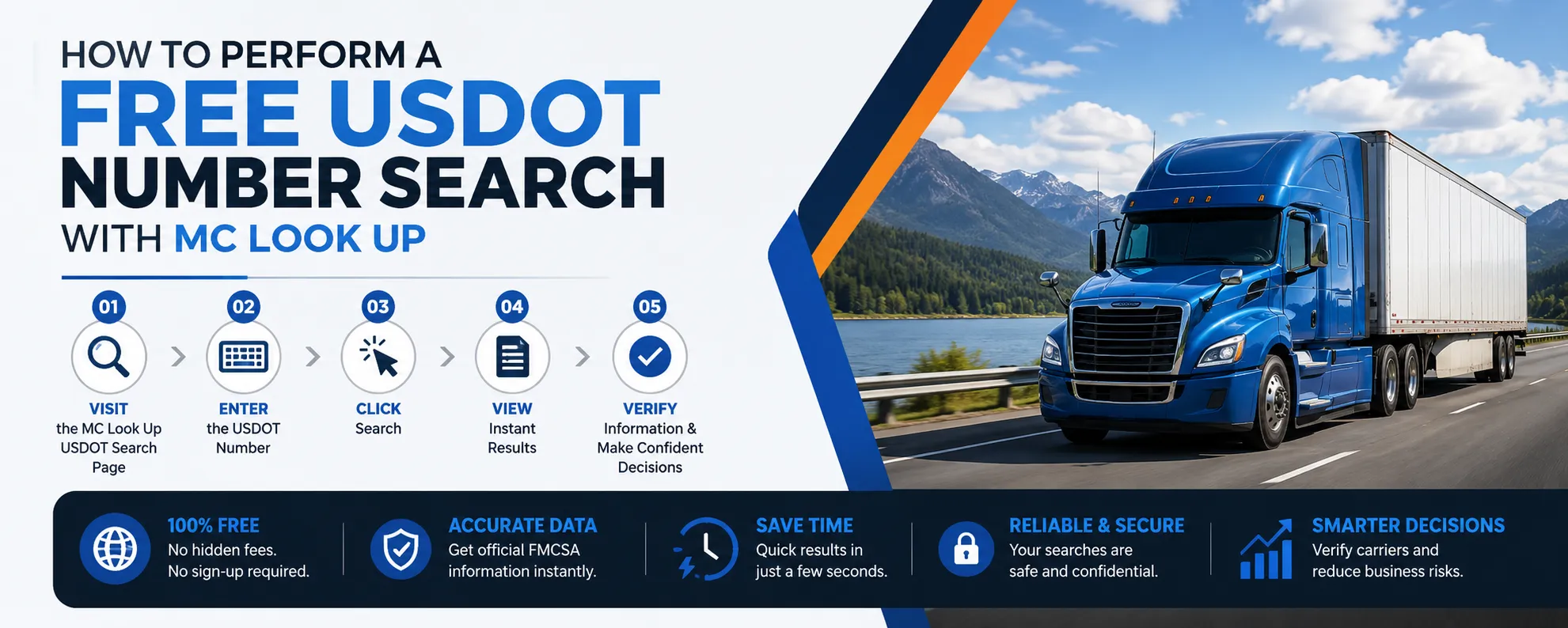
How to Perform a DOT Number Lookup
Conducting a manual lookup through federal databases takes only a few minutes when you follow a structured workflow:
- Find the DOT Number: Obtain the carrier's USDOT number from their website, bills of lading, equipment decals, or marketing materials.
- Enter it into a Lookup Tool: Input the number into an official federal database or an authorized search portal.
- Review Company Details: Check legal business names, physical addresses, and contact information to ensure they match your records.
- Check Safety History: Look at historical inspection rates, violation frequencies, and crash involvement.
- Verify Operating Status: Ensure the status is listed as "Active" and check whether their operating authority is authorized.
What Information Does a DOT Number Lookup Show?
When you query a USDOT number, the database yields a wealth of operational data. Key data points include:
- Company Name & DBA: Legal name and titles.
- Physical Address: The principal place of business.
- USDOT Status: Whether the company is active, inactive, or pending revocation.
- Operating Status: Specific authorizations for property, passenger, or household goods.
- Inspection History: Total roadside inspections for vehicles, drivers, and hazardous materials.
- Crash History: Federal records of reportable crashes (injuries, fatalities, or towed vehicles).
- Vehicle & Driver Count: The number of power units, trailers, and commercial drivers registered to the fleet.
- Cargo Types: General freight, refrigerated goods, chemicals, metals, etc.
- Safety Rating: Official FMCSA safety designations (Satisfactory, Conditional, Unsatisfactory, or Unrated).
How to Read DOT Lookup Results
Interpreting the raw data correctly prevents costly missteps. Here is how to break down the primary sections of a lookup report:
Company Status
Look for words like Active or Not Authorized. An active status means filings are up to date, while an inactive or revoked status indicates a failure to maintain compliance, file updates, or pay required fees.
Fleet Size
Compare the number of listed power units against the scale of the operation. A tiny fleet claiming to haul massive enterprise volumes warrants a closer look to check for potential double-brokering risks.
Inspection History
Examine out-of-service (OOS) percentages. Compare the carrier's vehicle and driver OOS rates against the national average. Rates significantly higher than the national average signal poor maintenance or lax safety protocols. Recent data highlights that roughly 1 in 5 roadside inspections results in an out-of-service order, making this a vital metric to monitor.
Crash Records
Review the severity and frequency of recorded crashes over the past 24 months. Pay close attention to preventable accidents and repeat patterns of behavior.
Safety Rating
An official Satisfactory rating is ideal. Treat an Unrated status as neutral—many smaller carriers remain unrated because they haven't undergone a comprehensive compliance review audit yet. However, an Unsatisfactory rating means you should avoid booking loads with them immediately.
Operating Classification
Check whether they are authorized as a carrier, broker, or freight forwarder, and verify that their intended cargo matches their authorized classification.
Understanding CSA Scores (CSA Score Guide)
The FMCSA’s Compliance, Safety, Accountability (CSA) program operationalizes safety data to identify high-risk carriers.
The Seven BASICs
The CSA program groups safety data into seven Behavior Analysis and Safety Improvement Categories (BASICs):
- Unsafe Driving: Speeding, reckless driving, improper lane changes.
- Hours-of-Service (HOS) Compliance: Logbook violations, driving past legal hour limits.
- Driver Fitness: Operating without a valid commercial driver's license (CDL) or medical card.
- Controlled Substances and Alcohol: Drug and alcohol violations.
- Vehicle Maintenance: Defective brakes, lighting, tires, and mechanical upkeep.
- Hazardous Materials Compliance: Improper placarding or shipping paper errors.
- Crash Indicator: Historical crash involvement patterns.
How Violations Affect Scores
Every roadside inspection violation adds points to a carrier's record. These points are weighted based on severity (e.g., a brake failure violation carries more weight than a burnt-out clearance bulb) and time-decayed—meaning points decrease in weight over a 24-month window.
What Is Considered a Good Score?
Keeping score percentiles well below FMCSA intervention thresholds is standard industry best practice.
| BASIC Category | What It Measures | Intervention Threshold |
|---|---|---|
| Unsafe Driving | Speeding, reckless operation | 65% |
| HOS Compliance | Electronic logging and driving hours | 65% |
| Vehicle Maintenance | Mechanical defects and upkeep | 80% |
| Crash Indicator | Frequency of preventable accidents | 65% |
DOT Number vs. MC Number: What's the Difference?
A common point of confusion for new shippers and logistics coordinators is the distinction between a USDOT number and an MC (Motor Carrier) number.
| Feature | DOT Number | MC Number |
|---|---|---|
| Primary Purpose | Identifies carrier and tracks safety | Grants interstate operating authority |
| Requirement | Required for most commercial carriers | Required for interstate for-hire carriers |
| Usage | Used in roadside inspections | Used for licensing and authority tracking |
A DOT Lookup confirms registration and safety information, while an MC Number Lookup verifies whether the carrier has the legal authority to transport freight across state lines for compensation.
Why a DOT Lookup Isn't Enough
Relying solely on a basic USDOT search leaves blind spots in your risk management strategy. Common vulnerabilities include:
- Active DOT but Inactive Authority: A company may have a valid, active USDOT number for safety tracking, but its for-hire operating authority might be revoked, suspended, or inactive.
- Revoked Operating Authority: Moving freight with a carrier whose MC authority has been revoked can invalidate cargo insurance coverage if a claim occurs.
- Insurance Lapses: A DOT lookup does not always instantly reflect active, primary liability or cargo insurance cancellations in real-time.
- Suspended Registrations: Administrative suspensions can occur due to unpaid fines or missing biennial updates while the core profile remains accessible.
How to Verify a Trucking Company Like a Freight Broker
Professional logistics providers rely on a standardized, repeatable vetting workflow before tendering any freight. Run through this checklist to replicate institutional-grade security:
- DOT Lookup: Check registration and basic safety profile.
- MC Number Lookup: Verify active interstate operating authority.
- CSA Scores: Review percentiles in the seven BASIC categories.
- Insurance: Confirm primary liability and cargo coverage minimums.
- Safety Rating: Ensure they do not have an "Unsatisfactory" rating.
- Inspection History: Check OOS rates against national averages.
- Crash Reports: Look for recent preventable accidents.
Largest Carriers and Why They Still Need Verification
It is easy to assume that enterprise-level fleets require zero vetting due to their household names and massive operational footprints. However, rigorous verification remains critical for several reasons:
- Dynamic Safety Ratings: Large carriers manage thousands of units; localized safety violations or compliance slips can shift rapidly across terminals and driver pools.
- Insurance Updates: Corporate policy renewals happen annually, and gaps can occur if filings are delayed.
- Authority Updates: Even major logistics providers undergo corporate restructuring, mergers, or subsidiary splits that alter operating authority structures.
- Sub-Contracting Practices: Large networks occasionally broker loads down to regional partners or owner-operators, requiring verification of the actual carrying entity.
Common Mistakes During a DOT Lookup
Avoid these frequent pitfalls when screening commercial carriers:
- Only checking the DOT Number: And ignoring the MC authority entirely.
- Skipping CSA scores: Failing to check underlying violation trends.
- Ignoring inspection history: Overlooking chronically high Out-of-Service rates.
- Not checking insurance: Assuming the FMCSA portal updates cancellations instantly.
- Assuming large carriers are always compliant: Skipping due diligence just because a brand is recognizable.
Conclusion
A DOT Lookup is an essential first step for checking a carrier's registration, safety history, and compliance. However, it doesn't tell the full story. To confirm interstate operating authority, it's important to perform an MC Lookup as well. With MC Lookup, you can quickly verify MC authority details and gain a more complete view of a carrier's operational status.
By combining DOT records, CSA score information, and MC authority verification, you can make more informed decisions before booking freight or partnering with a motor carrier.


























Sign in to leave a comment.