
And what the top 10% do differently — a field report from auditing dozens of fashion, apparel, and D2C brands
Press enter or click to view image in full size
Do You Know How Many Touchpoints a Customer Goes Through Before Buying Your Product?
Here’s a hint: it’s not one.
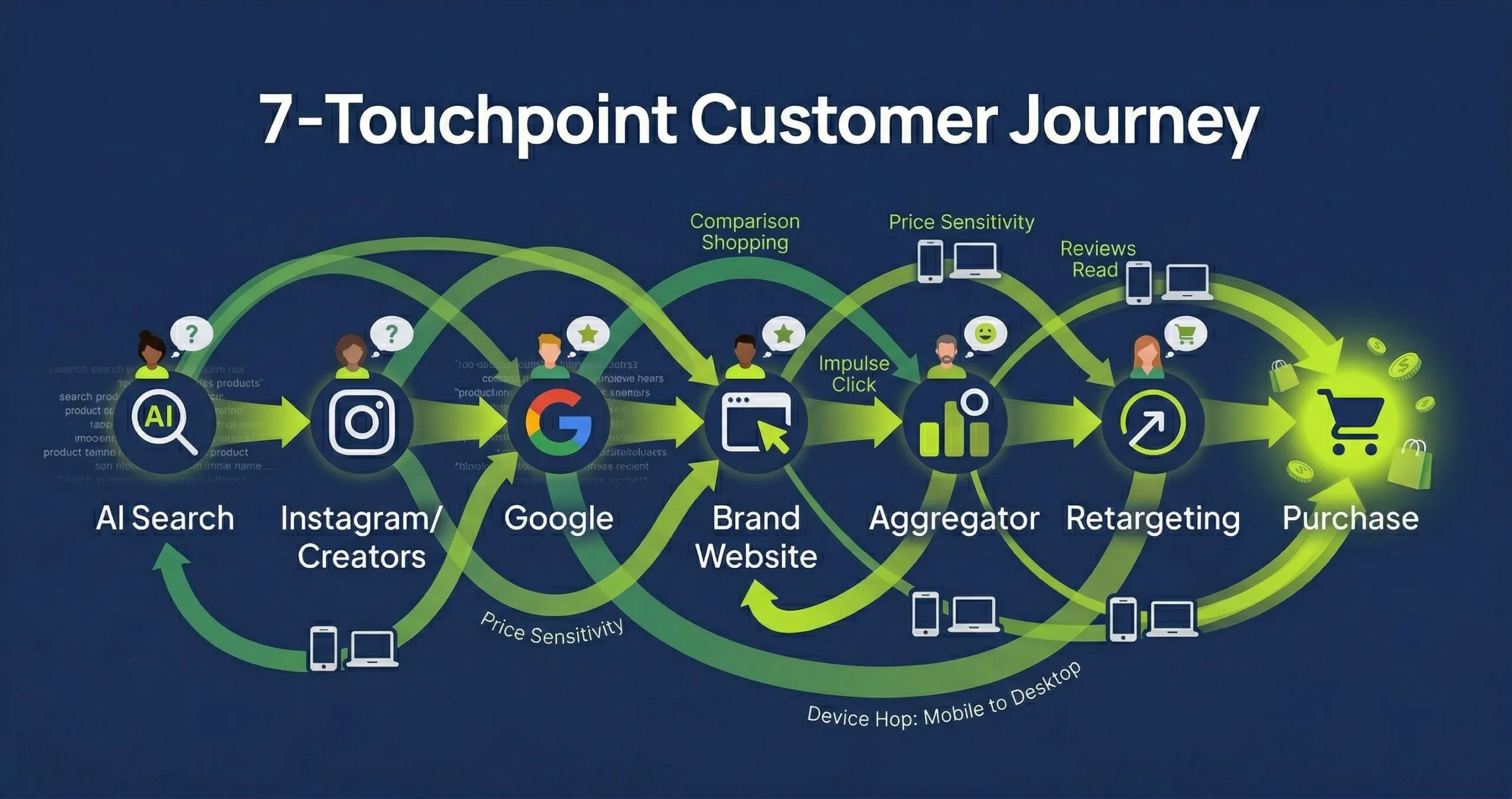
Let’s say someone wants to buy a sunscreen. What do they actually do in 2026?
First, they go to an AI tool — ChatGPT, Gemini, Perplexity — and ask something like “best sunscreen for oily skin” or “best sunscreen under ₹500.” They get a list of five brands. Now they have options.
Next, they go to Instagram. They search for those brand names, watch creator reviews, look for real-life testimonials. Out of those five brands, maybe two or three have actual creator content — real user videos, dermatologist mentions. The other two? No presence. No posts. No creator collaborations. They’re already off the shortlist.
Then they go to Google. They visit the remaining brands’ websites — checking ingredients, certifications, whether it’s dermatologist-tested. They compare. They narrow it down to two or three.
Then they go to Amazon, Nykaa, or another aggregator. They compare prices. Check for offers. Read customer reviews.
And finally — after all of this — they see a retargeting ad from one of those brands offering a better deal. They click. They buy.
Press enter or click to view image in full size

Ecommerce SEO 2026
Now here’s the question: which touchpoint do you attribute this conversion to? The AI tool that surfaced your brand? The creator who built trust? The Google search? The ad that closed?
The truth is — the decision was made across all of them. Remove any single touchpoint and your brand falls off the shortlist. This is how buying decisions work in 2026. And yet, when we audit ecommerce websites, we find that most brands are optimizing for exactly one touchpoint: their product page on Google.
Everything else — collections, content, images, social presence, AI discoverability, comparison positioning — is either missing or broken.
Press enter or click to view image in full size
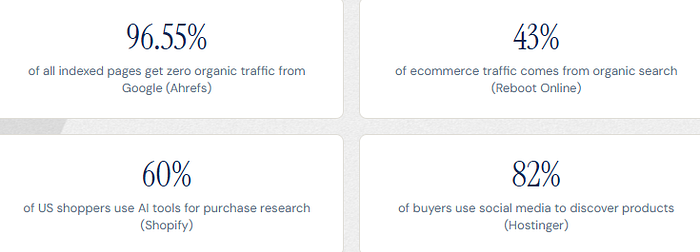
After auditing dozens of fashion, apparel, and D2C sustainability brands — primarily serving markets outside India — here are the patterns we see again and again. These are the mistakes keeping 90% of product pages invisible, and what the top 10% do differently.
The Audit Reality: 7 Out of 10 Sites Still Get the Basics Wrong
This is the uncomfortable starting point of almost every ecommerce SEO engagement we take on. Before we even get to strategy, content, or multi-touchpoint visibility — the foundation is broken.
Out of every 10 ecommerce websites we audit, 6 to 7 still have basic on-page SEO issues that should have been addressed before the site launched. Title tags auto-generated by the platform. Missing or duplicate meta descriptions across hundreds of product pages. Heading structures that skip from H1 to H4. Image alt text completely absent. Canonical tags missing or misconfigured.
Press enter or click to view image in full size
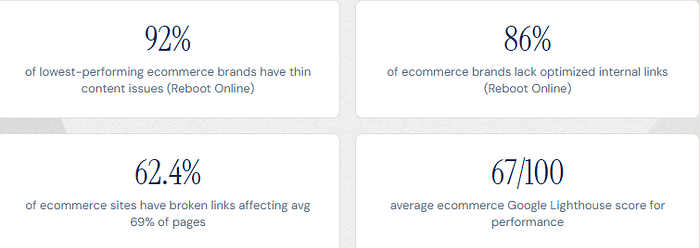
And here’s the one that catches even experienced marketers off guard: among ecommerce sites with missing canonical tags, an average of 40.38% of their pages are affected. That means a significant chunk of their product catalogue is competing against itself — duplicate versions of the same page diluting each other’s authority.
None of this is advanced SEO. It’s the foundation. And if the foundation is cracked, no amount of content marketing, social media, or AI optimization will fix it. The first move is always the same: audit, fix the basics, then build.
Press enter or click to view image in full size
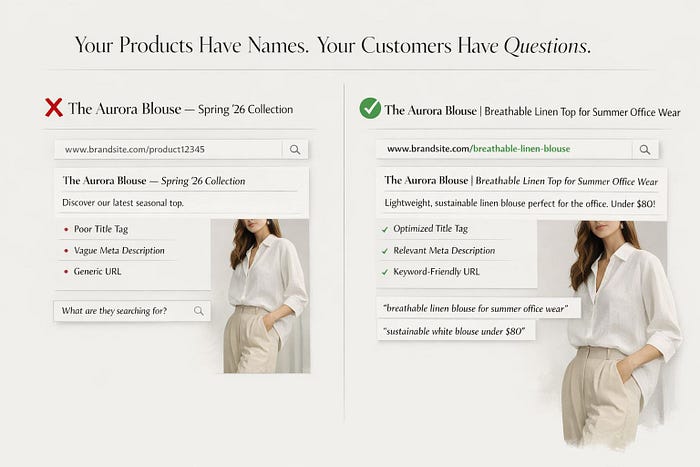
Your Products Have Names. Your Customers Have Questions.
This is one of the most persistent blind spots we encounter, particularly with fashion and D2C founders who are deeply invested in their brand identity — as they should be. But brand identity and search discoverability operate in different languages, and most ecommerce sites fail to bridge the gap.
Here’s what this looks like in practice. A sustainable fashion brand names a product “The Aurora Blouse — Spring ’26 Collection.” Beautiful name. Strong brand story. Zero search volume. Meanwhile, their ideal customer is typing “breathable linen blouse for summer office wear” or “sustainable white blouse under $80” into Google, ChatGPT, or Instagram search.
The product exists. The customer is searching. But the product name, page title, H1 tag, and meta description all speak brand language — not customer language.
Press enter or click to view image in full size

The fix isn’t about killing the brand name — it’s about layering. The product name stays. But the page title carries both: “The Aurora Blouse | Breathable Linen Top for Summer Office Wear — [Brand Name].” The H1, meta description, and product description weave in the language your customer actually uses. The URL includes descriptive terms, not internal SKU codes.
This is a balance — emotional brand positioning on one side, search intent on the other. Founders too attached to brand-centric naming without this bridge are leaving their most relevant customers unable to find them.
Press enter or click to view image in full size
The Collection Page Is Your Most Underused SEO Weapon
Ask any ecommerce founder how they organize their collections and you’ll hear the same answer: by product type. Tops. Bottoms. Dresses. Accessories. Maybe a seasonal collection. That’s it.
This is catalogue thinking. Not SEO thinking.
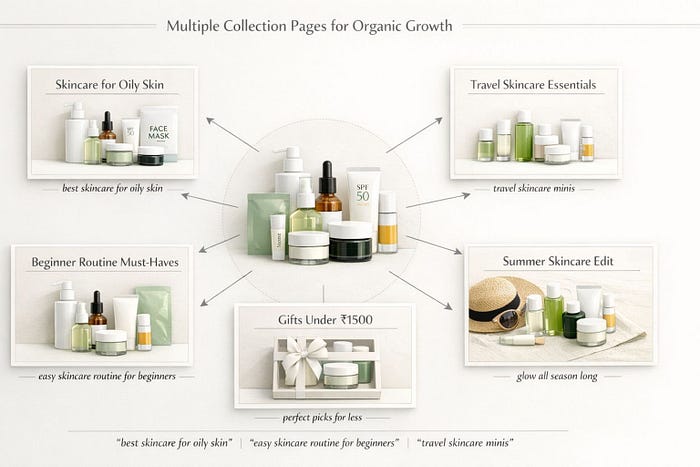
From the same set of products, dozens of high-intent, rankable collections can be created — and most brands are leaving this organic real estate completely untapped.
Think about it from the customer’s search intent. A customer doesn’t type “tops” into Google. They search “breathable workwear for summer,” “sustainable gifts under ₹2000,” “capsule wardrobe essentials for minimalists,” or “organic cotton basics for sensitive skin.” Each of these is a real search query with real volume. And each one can be answered with a collection page — using products you already have.
Every intent-based collection you create is a new organic entry point. A new URL that can rank for a long-tail keyword cluster. A new page that can appear in AI Overviews — where 80% of cited sources don’t rank organically for the original query (Stryde). A new asset for your social media team to promote.
Take your existing product catalogue and create collections by problem statement, by occasion, by customer segment, by price bracket, and by use case. You’re not creating new products. You’re creating new ways for the right customer to find the products you already have. The top brands generate 5–10× more organic entry points from the same inventory.
Press enter or click to view image in full size
Product Pages That Do Nothing But Describe the Product
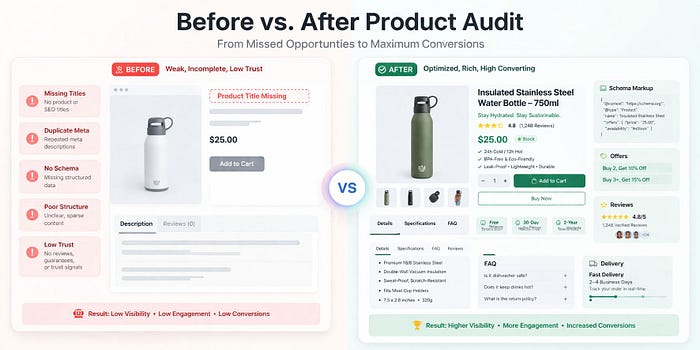
Open any average ecommerce product page and here’s what you’ll find: a product name, 2–3 lines of description, a price, an “Add to Cart” button, and maybe a few images. That’s not a page — it’s a catalogue entry. And Google treats it accordingly.
Press enter or click to view image in full size
So what does a product page that earns organic visibility actually look like? It looks like a page that answers every question a customer would ask a salesperson in a physical store.
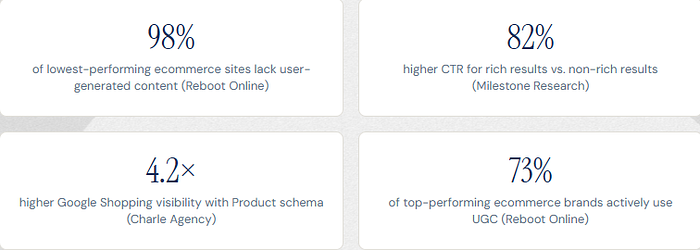
The top 10% include rich product descriptions that go beyond features and into use cases, styling suggestions, and objection handling. They include FAQ sections built from real customer questions. They implement Product schema, Review schema, and FAQ schema so search engines and AI tools can parse the page structure. They incorporate customer photos, reviews, and testimonials.
And they address something most brands forget entirely: the product description should educate, not just describe. If you’re selling a sunscreen, don’t just list “SPF 50, lightweight formula.” Explain what SPF 50 actually protects against, why lightweight matters for oily skin, how the formula compares to chemical vs. mineral alternatives. Give the customer a reason to stay on the page and read. Read more
























Sign in to leave a comment.