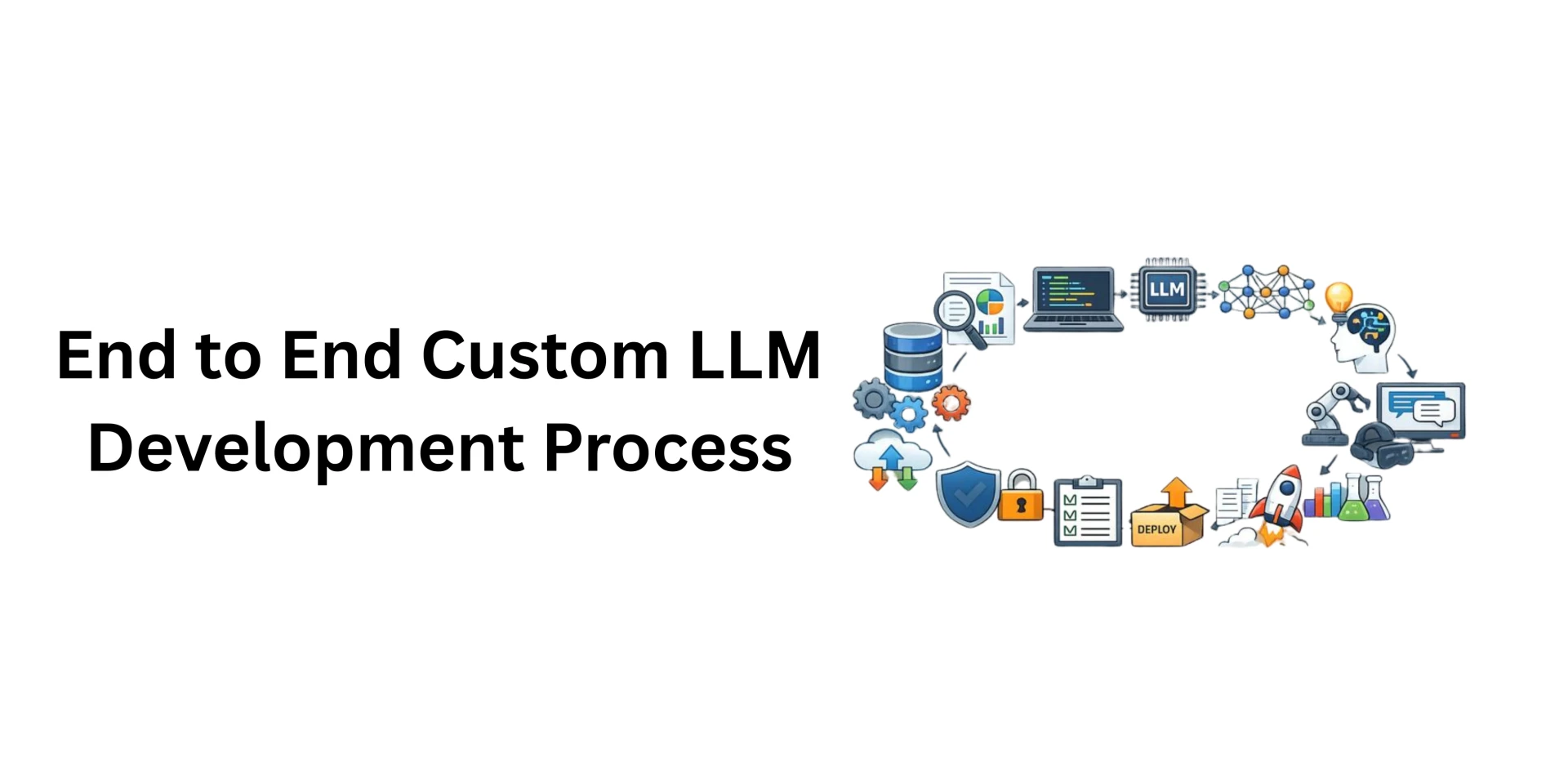

Many companies are going beyond off-the-shelf AI solutions as AI becomes increasingly integrated into corporate operations. Although generic models are quick to embrace, organisational data, procedures, and compliance requirements are rarely properly aligned with them. The need for custom LLM development, where big language models are created or modified especially for a business's goals, is being driven by this change. To make wise, high-impact AI investments, CEOs and other decision-makers must comprehend the entire development process.
Why Businesses Are Investing in Custom LLM Development
Public LLMs are intended for a wide range of applications. They work well for generic tasks, but they frequently have trouble with data security, governance, and domain-specific accuracy. Using confidential data, industry jargon, and internal policies, custom LLM development enables businesses to seamlessly integrate AI into their business context.
Better decision support, increased automation accuracy, and AI systems that support long-term strategy rather than short-term experimentation are all implications for businesses.
Step 1: Defining Business Objectives and Use Cases
Clarity is the first step in any successful custom LLM project. Organisations must specify the business issues the model will address before starting any technological effort. Automating customer service, speeding up internal research, streamlining compliance processes, or strengthening executive decision-making are a few examples of this.
Leadership alignment is crucial at this point. Risk considerations, success measures, and well-defined KPIs guarantee that the model produces quantifiable commercial value instead of turning into an expensive technological experiment.
Step 2: Data Assessment and Preparation
Custom LLM development is built on data. Businesses need to identify pertinent internal data sources, including databases, papers, support requests, and knowledge repositories related to their domain. After that, the data is cleaned, organised, and assessed for compliance and quality.
This step also involves data governance checks for regulated companies to make sure sensitive data is handled appropriately. The final model's correctness, dependability, and credibility are directly impacted by high-quality, well-prepared data.
Step 3: Model Choice and Customisation Plan
It is not necessary for every organisation to create a model from the ground up. Custom LLM creation frequently entails optimising a robust base model or integrating corporate information with pre-existing structures through retrieval-augmented generation (RAG).
The decision is based on performance needs, budget, and company objectives. A careful customisation approach ensures that the model complies with organisational requirements while striking a balance between cost, scalability, and control.
Step 4: Training, Fine-Tuning, and Validation
After the strategy is established, carefully chosen datasets are used to train or refine the model. Teaching language, context, and thinking patterns unique to the LLM domain is the main goal of this phase.
Thorough validation is crucial. The outputs are examined for consistency, explainability, bias, and correctness. This step is essential for CEOs to get confidence that the AI system can be relied upon in practical business situations.
Step 5: Deployment and System Integration
Following validation, a secure production environment, either on-site, in a private cloud, or within restricted enterprise infrastructure, is used to implement the bespoke LLM. The model is connected with current technologies, including internal apps, knowledge bases, and CRMs.
Custom LLM development transitions from theory to impact at this point. Employees may utilise AI organically in their everyday tasks thanks to seamless integration.
Step 6: Monitoring, Governance, and Continuous Improvement
"Set and forget" systems do not apply to custom LLMs. Continuous observation guarantees that the model maintains its accuracy as business requirements change. Governance frameworks aid in monitoring usage, controlling access, and upholding compliance.
The model can become a long-term strategic asset rather than a one-time deployment with regular updates, retraining, and performance evaluations.
Conclusion
Custom LLM development is more about control, differentiation, and long-term value creation for company executives than it is about technology. An end-to-end strategy guarantees that AI systems are safe, in line with corporate objectives, and confidently scalable.
Businesses that make strategic investments in bespoke LLM development now are setting themselves up for success in an AI-driven future with models that genuinely comprehend their operations and produce significant results.




























Sign in to leave a comment.