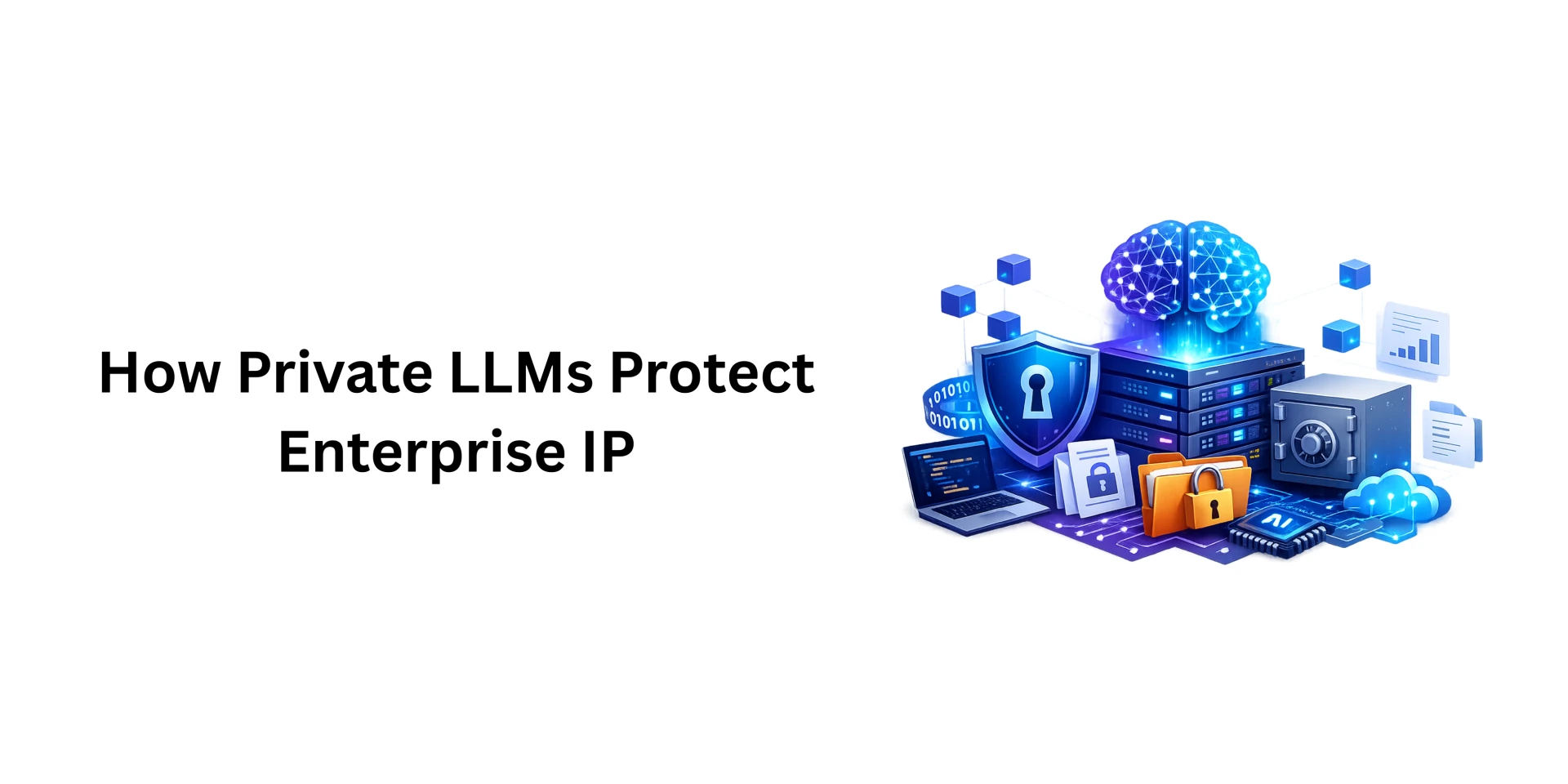

Organisations are increasingly sending sensitive data such as product roadmaps, source code, legal documents, consumer insights, and strategic plans into AI systems as it becomes more integrated into organisational operations. Large language models (LLMs) increase productivity significantly, but they also raise a crucial issue for leaders: intellectual property (IP) protection.
Private LLMs are crucial in this situation. Private LLM deployments provide a controlled, governance-first method for safeguarding proprietary knowledge while fostering innovation for businesses that are serious about secure corporate AI.
Why Adoption of AI Puts Enterprise IP at Risk
Trade secrets and patents are no longer the exclusive forms of enterprise intellectual property. It now consists of:
- Internal research and documentation
- Proprietary codebases and algorithms
- Partner and customer information
- Forecasts and strategic communications
This data may be processed outside of an organization's control when it depends on external or shared AI systems. Adoption of AI may unintentionally expose intellectual property to third-party threats, regulatory scrutiny, or unintentional data leakage in the absence of a clear security architecture.
These threats must be taken into consideration from the outset of a secure enterprise AI strategy.
What Distinguishes Private LLMs?
Private LLMs are installed solely for a particular company, usually in on-premises or private cloud settings. They are not shared by several clients, in contrast to public or API-based models.
For IP protection, this architectural distinction is crucial. Private LLMs guarantee:
- No exposure to cross-tenant data
- Total command over the processing and storing of data
- Clearly stated usage guidelines and access permissions
This is the cornerstone of secure corporate AI for businesses.
Design-Based Data Isolation and Ownership
Data isolation is one of the most effective IP protection strategies in private LLMs. All inputs, outputs, prompts, and fine-tuning datasets are kept inside enterprise-controlled infrastructure.
This ensures:
- External models are never trained using enterprise data.
- The organisation retains complete ownership of proprietary knowledge.
- The data of other renters has no bearing on AI outputs.
CEOs view data ownership as a strategic defence for long-term commercial value rather than merely a technical issue.
Robust Access Controls and Governance
Granular governance, which is challenging to accomplish with shared AI services, is made possible with private LLM installations. Businesses can use:
- RBAC, or role-based access control
- Permissions at the department level
- Audit trails for the use and results of AI
By limiting access to sensitive IP to authorised people, these safeguards lower the possibility of internal misuse or unintentional exposure. Internal governance is just as important to secure company AI as external threats.
Compliance-Ready Security Architecture
This includes:
Strict legal frameworks like GDPR, SOC 2, ISO 27001, or industry-specific compliance requirements govern the operations of many businesses. From the beginning, private LLMs can be designed to meet these specifications.
- Enforcement of data residency
- Encryption both in transport and at rest
- Comprehensive recording and auditing
Private LLMs lower legal and regulatory risk while protecting company intellectual property by integrating compliance within the AI infrastructure.
Stopping Large-Scale Knowledge Leakage
IP leakage is becoming more likely as teams employ AI. This risk is decreased by private LLMs by:
- Removing reliance on external inference endpoints
- Enabling personalised output filtering and quick handling
- Enabling large-scale internal AI usage policies
Because of this, private LLMs are an essential component of any secure enterprise AI strategy, particularly for companies that want to scale AI across departments.
Why Private LLMs Should Be Seen by CEOs as IP Insurance
Business executives view private LLMs as a type of IP protection insurance rather than just a technological advancement. They enable businesses to confidently use AI without giving up control over their most precious assets.
Organisations that prioritise secure enterprise AI will be better positioned to innovate, comply, and lead as AI becomes a key component of competitive advantage.



















Sign in to leave a comment.