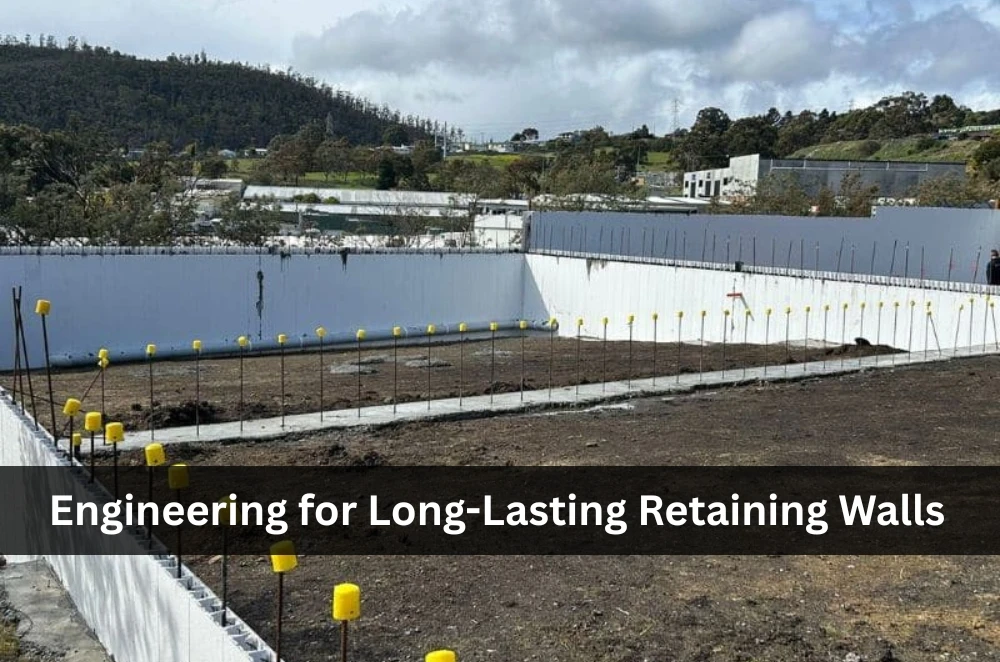

A retaining wall seems straightforward until you start planning one. I learned this the hard way years ago when I built a small garden terrace at my old place. I spent more time picking out landscaping blocks for retaining wall materials than thinking about what the soil might do after a few storms. Predictably, the wall shifted within a year. Not dramatically — just enough to annoy me every time I walked past it. That lesson stuck. The parts you don’t see, the engineering bits beneath the surface, almost always determine how long a retaining wall lasts.
Below is a grounded look at the engineering considerations that actually matter — the kinds of things you learn after building, repairing, and pulling apart more walls than you intended.
Understanding the forces behind every retaining wall
Most walls fail slowly, long after the builder has left the site. It’s rarely the product that’s to blame. It’s the forces acting on the wall that catch people out.
A few unavoidable ones:
- Lateral earth pressure: Soil leans and pushes. Gravity does the rest.
- Hydrostatic pressure: Water gathers behind the wall and ramps up pressure fast.
- Surcharge loads: Driveways, footpaths, garden structures — anything placed above the wall adds weight.
- Seasonal soil movement: Expansion, shrinkage, and settlement are all part of life, especially with clay-heavy soils.
Once a wall climbs to a metre or more, or sits near footpaths or structures, engineers generally step in. Council requirements vary, but the logic stays the same. Approved engineered retaining wall systems ensure the wall actually matches the conditions it’ll face.
Site preparation: the invisible work that decides everything
People often talk about materials first. Engineers talk about the ground beneath them. And for good reason.
1. Soil type
Clay swells. Sand drains. Silt holds water. None behaves the same.
Even a basic soil check helps predict what the wall might deal with over time.
2. Proper compaction
I’ve seen well-built walls collapse because the backfill was rushed. Compaction needs to happen in layers, not one big dump of soil. The aim is even support — no voids, no soft spots.
3. Footings and the base course
Segmental blocks may not need a concrete footing, but they still rely on a solid, level base. A misaligned first course, even by a few millimetres, echoes through the entire wall.
4. Drainage
A wall with poor drainage is a wall on borrowed time. Ag pipe, 20 mm drainage gravel, and filter fabric aren’t optional extras; they’re the lifeline that prevents water from building pressure behind the wall.
A neighbour once asked me why their “new” wall bulged after a storm. The answer sat right there: the builder skipped gravel backfill entirely. Soil alone can’t shift water fast enough.
Choosing materials that hold up over time
There’s no shortage of retaining wall products, but not all respond to engineering conditions the same way.
Segmental blocks
Durable, DIY-friendly, and designed with interlocking features. They suit curved walls or tiered layouts and pair well with geogrid reinforcement for taller builds.
Concrete sleepers
When strength matters most, sleepers offer predictable performance. Paired with steel posts, they’re solid, straight, and built for high-pressure situations.
Natural stone
Beautiful but inconsistent. Each piece behaves differently, which complicates engineering. Better suited to shorter garden features unless you have specialist support.
Timber
Good for rustic aesthetics and smaller installations. Less ideal for long-term structural walls because of rot, moisture and termite risk.
Budget comes into it, too. People often ask about things like stone wall block prices, but that’s usually the wrong starting point. Lifespan and load conditions should drive material choice long before cost comparisons.
Reinforcement: the thing that turns a wall into a system
A retaining wall system is never just the visible face. The strength usually sits behind it, often literally.
Geogrid
Geogrid is the unsung hero of many modern walls. Layered between block courses and extended back into the soil, it creates a massive reinforced mass. Without it, many taller walls simply can’t hold.
Steel posts
Used with sleeper walls, steel posts take on the bulk of the structural load. Their spacing, depth and thickness aren’t eyeballed — they’re engineered.
Rebar inside concrete
For masonry or poured walls, steel bars add the tensile strength that concrete lacks on its own.
Reinforcement also needs correct placement. A few centimetres off can create weak points. It’s careful work — slow, repetitive, but critical.
Why drainage is the quiet villain (or the quiet hero)
Water is relentless. It will sit, swell, and push until something gives. I’ve repaired more water-damaged walls than any other kind.
A functioning drainage setup usually includes:
- A gravel envelope behind the wall
- A slotted drain pipe positioned at the base
- Filter fabric to stop sediment clogging the system
- Correct grading so water doesn’t pool near the top
The most common oversight? Surface water. Even a slight slope can direct a surprising amount of rain toward the backfill.
During one project, we discovered a neighbour’s downpipe had been discharging uphill of a wall for years. The wall lasted longer than it should have, to be honest.
The common mistakes that quietly shorten a wall’s life
Some errors show up again and again:
- Rushed compaction
- Incorrect or missing geogrid
- Base course not perfectly level
- Using soil instead of drainage gravel
- Overloading the top of the wall unintentionally
- Ignoring council guidelines for taller walls
Most of these problems aren’t dramatic. They creep in slowly, then show themselves all at once.
When you should bring in an engineer
Not every wall needs professional design, but some do — and the signs are usually obvious:
- Anything over one metre
- Walls bearing driveways, paths, or structures
- Reactive clay sites
- Multi-tiered terrace walls
- Curved walls with changing loads
- Sites with poor access or clear drainage challenges
Engineers don’t just produce drawings. They assess real-world risks — soil, water, load, movement — and shape a design around them.
Final thoughts
Long-lasting retaining walls don’t come down to luck or even the “strongest” product. They come from understanding how soil behaves, how water moves, and how loads shift over time — which is why best practices for poured wall construction place so much emphasis on engineering fundamentals. The visible part of the wall — the blocks, sleepers or stone — is just the surface.
When the design respects the site and the forces involved, the wall tends to mind its own business for decades. When one step is skipped, even accidentally, the wall eventually lets you know.


























Sign in to leave a comment.