You need experience to get a job. But you need a job to get experience.
This impossible paradox has frustrated job seekers for decades. But in 2025, the game has finally changed.
According to The Interview Guys' comprehensive 2025 job market analysis, 65% of employers now use skills-based criteria when evaluating entry-level candidates, up from 56% in 2022. Meanwhile, Beamjobs' entry-level resume research shows that highlighting transferable skills, relevant projects, and demonstrating potential can successfully compensate for lack of traditional work experience.
But here is what most entry-level candidates miss: your resume does not need to show years of employment to prove you can excel in a role. It needs to show capabilities, enthusiasm, and readiness to contribute from day one.
This guide reveals exactly how to write an entry-level resume with no experience that gets interviews, what sections to emphasize instead of work history, and how to position yourself as a hire-ready candidate. Whether you use specialized platforms like an avua resume builder to structure your first professional document or craft it manually, understanding what entry-level hiring managers actually want makes all the difference.
Why Entry-Level Hiring Changed in 2025
The requirements for landing your first job have fundamentally shifted in your favor.
The New Entry-Level Reality
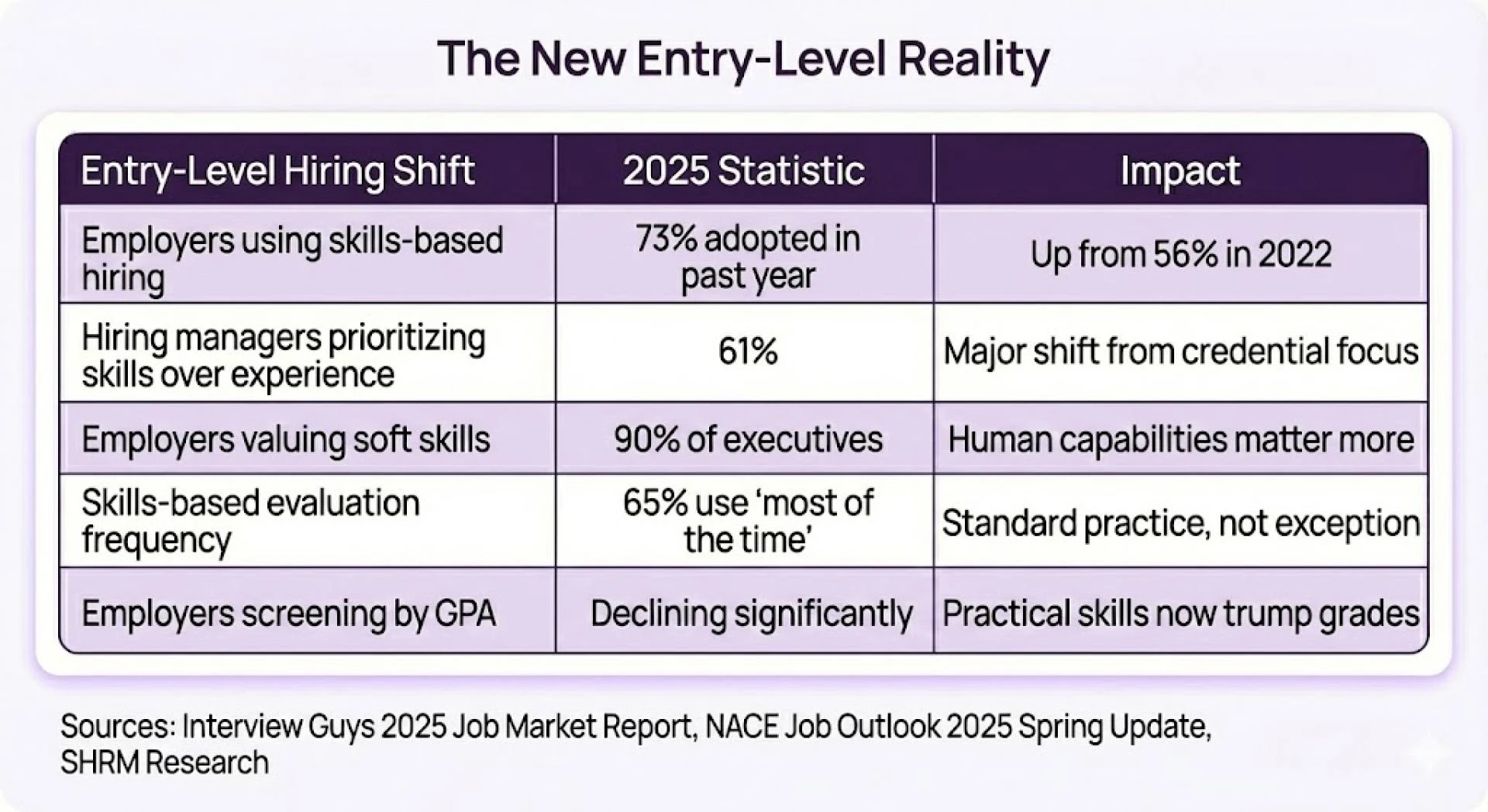
Sources: Interview Guys 2025 Job Market Report, NACE Job Outlook 2025 Spring Update, SHRM Research
With 73% of employers adopting skills-based hiring in the past year according to SHRM research, and 61% of hiring managers prioritizing capabilities over credentials, entry-level candidates without traditional experience finally have a fair chance.
What to Include When You Have No Work Experience
The key is reframing what counts as relevant experience.
Section 1: Professional Summary or Objective
Your opening 2-3 sentences set the tone. For entry-level candidates, career objectives work better than professional summaries because they state what you want while highlighting what you offer.
Weak objective: "Recent graduate seeking entry-level position to gain experience and develop skills."
Strong objective: "Recent Computer Science graduate with Python certification and 3 academic projects demonstrating full-stack development capabilities. Seeking entry-level software engineering role to apply problem-solving skills and contribute to innovative technology solutions."
The strong version emphasizes concrete skills, specific achievements, and clear value proposition. An avua resume analysis tool can help craft objectives that balance humility with confidence effectively.
Section 2: Education (Your Strongest Section)
When you lack work experience, education becomes your work experience. Expand this section beyond just listing your degree.
Include degree and major, graduation date or expected graduation, GPA if 3.5 or higher, relevant coursework related to target role, academic projects with outcomes, honors and awards, and study abroad or specialized programs.
Example education section:
Bachelor of Science in Marketing University of California, Los Angeles Graduated: May 2024 | GPA: 3.7/4.0
Relevant Coursework: Digital Marketing Strategy, Consumer Behavior Analysis, Marketing Analytics, Brand Management
Senior Capstone Project: Developed comprehensive marketing strategy for local nonprofit, increasing social media engagement by 250% and generating 45 new volunteer inquiries within semester.
Section 3: Skills (Prove Your Capabilities)
According to Teal HQ's entry-level resume analysis, employers want to see both technical skills and soft skills clearly listed.
Organize skills into categories. Technical Skills including software proficiency, programming languages, tools and platforms, certifications. Professional Skills including communication, teamwork, problem-solving, time management, adaptability.
Do not just list skills. Reference them again in other sections to prove you actually possess them.
Section 4: Projects and Coursework
This section replaces traditional work experience. Treat academic projects, personal projects, volunteer work, and freelance work like professional positions.
Use this format for each project: Project Title, Organization/Course, Date, 3-4 bullet points emphasizing what you did, how you did it, and results achieved.
Example:
E-Commerce Website Development Personal Project | January 2024 - March 2024
- Designed and developed fully functional e-commerce platform using React, Node.js, and MongoDB
- Implemented secure payment processing and user authentication systems
- Optimized site performance achieving 2-second load times and mobile responsiveness
- Showcased project to portfolio receiving positive feedback from 3 industry professionals
Section 5: Internships and Volunteer Experience
Unpaid experience counts. According to Resume.io's entry-level guidance, internships and volunteer work demonstrate work ethic and real-world application of skills.
Format these exactly like traditional work experience. Job title, organization, dates, bullet points with achievements and quantified results when possible.
Do not write "Volunteer" in title if you had a specific role. "Marketing Coordinator (Volunteer)" is better than just "Volunteer."
Section 6: Certifications and Training
According to Teal HQ's certification research, industry-specific certifications provide significantly more value than general ones for entry-level positions.
Valuable entry-level certifications include CompTIA certifications for IT, Google Analytics for marketing, Microsoft certifications for business, Project Management certifications like CAPM, AWS Cloud Practitioner for cloud roles, HubSpot certifications for sales and marketing.
List certification name, issuing organization, date obtained, and expiration date if applicable.
Resume Format for Entry-Level Candidates
Format determines whether hiring managers see your strengths or your lack of experience.
Use Combination or Functional Format
The traditional chronological format emphasizes work history—exactly what you lack. According to ResumeLab's format analysis, combination format works best for entry-level candidates because it leads with skills before limited experience.
Combination format structure: Contact information, Professional objective, Skills section, Education, Projects and relevant experience, Certifications, Additional sections.
This positions what you can do before addressing what you have not yet done professionally.
Keep It to One Page
According to Beamjobs research, entry-level resumes should never exceed one page. You simply do not have enough relevant content to justify two pages, and trying to stretch makes you look inexperienced.
One page forces you to be selective, highlighting only your most impressive and relevant qualifications.
How to Demonstrate Experience Without Jobs
The key is recognizing that experience comes from many sources beyond employment.
Academic Projects
Every significant class project demonstrates professional capabilities. Did you work in teams? That is collaboration experience. Did you present findings? That is communication experience. Did you analyze data? That is analytical experience.
Transform coursework into professional language. Instead of "Completed group project for Marketing 401," write "Collaborated with 4-person team to develop comprehensive marketing strategy for local business, presenting recommendations to stakeholders and receiving 95% grade for strategic execution."
Volunteer Work
According to Zety's entry-level guide, when you have minimal professional experience, volunteer work belongs in your main work history section, not separated.
Format volunteer positions exactly like paid jobs. Emphasize skills developed, responsibilities handled, and measurable outcomes achieved.
Freelance and Side Projects
Any work you did independently counts. Built websites for friends? That is web development experience. Managed social media for family business? That is digital marketing experience. Tutored students? That is training and mentorship experience.
Treat freelance work professionally. Create a business name if you do not have one. "Freelance Graphic Designer" sounds more professional than "Made logos for people sometimes."
Extracurricular Activities and Leadership
Leadership in student organizations, sports teams, or community groups demonstrates management capabilities, teamwork, problem-solving, and initiative.
Transform club involvement into business language. "President of Marketing Club" becomes "Led 30-member marketing organization, coordinating 8 professional development events and managing $5,000 annual budget."
avua cv analysis can help reframe academic and volunteer experiences using professional terminology that resonates with hiring managers.
Power Words for Entry-Level Resumes
Action verbs make your limited experience sound more impressive.
Achievement-Focused Action Verbs
Use these to start bullet points: Achieved, Analyzed, Collaborated, Created, Demonstrated, Designed, Developed, Enhanced, Implemented, Improved, Initiated, Led, Managed, Organized, Presented, Resolved, Streamlined.
Weak: "Helped with organizing club events" Strong: "Organized 6 professional networking events connecting 150+ students with industry professionals"
Skill-Demonstrating Action Verbs
These emphasize capabilities over experience: Adapted, Applied, Assessed, Communicated, Coordinated, Evaluated, Facilitated, Generated, Investigated, Mastered, Researched, Supported, Trained.
Weak: "Worked on team projects" Strong: "Coordinated 4-person team through semester-long consulting project, facilitating weekly meetings and delivering final recommendations to client"
Addressing Employment Gaps and Concerns
Entry-level candidates often have gaps that need strategic positioning.
Recent Graduation
If you graduated recently, you do not need to explain gaps between graduation and now if you are actively job searching. Focus resume on demonstrating readiness to start.
Time Off for Education
Taking time to complete degree is perfectly acceptable. Do not apologize for it. Your education section proves what you accomplished during that period.
Career Exploration Period
If you took time after graduation to determine career direction, frame it as intentional. Mention courses completed, certifications earned, or relevant projects pursued during this time.
Tailoring Your Entry-Level Resume
Generic resumes fail for experienced professionals and entry-level candidates alike.
Research the Role and Company
According to Resume Mentor's entry-level optimization guide, every application requires customization emphasizing relevant skills, projects, and coursework aligned with specific job requirements.
Read job descriptions carefully and identify required technical skills, desired soft skills, mentioned tools or platforms, and company values or culture indicators. Adjust your resume to emphasize the most relevant qualifications for that specific position.
Use Job Description Keywords
Applicant tracking systems scan for specific terms. Extract keywords from postings and integrate them naturally throughout your resume, especially in skills section and project descriptions.
An avua ATS resume tool can help identify which terms from job descriptions you are missing and suggest where to incorporate them naturally.
Adjust Your Objective Statement
Rewrite your professional objective for each application, mentioning the specific company name and role you are applying for. This shows genuine interest rather than mass applications.
Generic: "Seeking entry-level marketing position" Customized: "Seeking Marketing Coordinator role at TechStartup Inc. to apply social media management and content creation skills supporting innovative SaaS marketing campaigns"
Common Entry-Level Resume Mistakes
Avoiding these errors immediately improves your competitiveness.
Mistake 1: Listing Irrelevant Information
Every line on your resume should add value. According to Careerflow's entry-level analysis, irrelevant jobs, outdated skills, or personal hobbies unrelated to the role clutter your resume.
Fix: Only include information that demonstrates skills or qualities relevant to your target position.
Mistake 2: Using Generic Descriptions
Weak, vague language makes you forgettable. "Responsible for" and "helped with" communicate nothing about your actual contributions or capabilities.
Fix: Use specific action verbs, include measurable outcomes, and prove your claimed skills through concrete examples.
Mistake 3: Ignoring ATS Optimization
Entry-level positions often receive hundreds of applications. ATS filters most of them before human review.
Fix: Use standard section headings, include keywords from job descriptions, avoid complex formatting, and save as PDF with selectable text.
Mistake 4: Underselling Academic Achievements
Entry-level candidates often list education as just degree and graduation date, missing opportunity to showcase relevant accomplishments.
Fix: Expand education section with relevant coursework, projects, honors, and specific achievements that demonstrate capabilities.
Mistake 5: Focusing on Duties Instead of Outcomes
Even in volunteer or project work, listing what you did matters less than proving what you accomplished.
Weak: "Attended meetings and completed assigned tasks" Strong: "Contributed to 15% increase in member participation through improved communication strategy and event coordination"
Testing Your Entry-Level Resume
Before applying, verify your resume positions you effectively.
The Skills Test
Can someone reading your resume identify your top 5 capabilities within 10 seconds? If not, your skills section needs prominence or clarity.
The Value Proposition Test
Does your resume answer "Why should we hire someone with no experience?" Your objective, projects, and achievements must collectively prove you bring value despite lacking traditional work history.
The ATS Compatibility Test
Copy your resume into plain text editor. Does formatting remain readable? Are sections clearly separated? Does critical information appear in correct order?
The Authenticity Test
Can you discuss every project, achievement, and skill listed in detail during interviews? If you cannot confidently explain something, remove it.
Real Entry-Level Resume Example
Here is how these principles come together:
Sarah Chen Los Angeles, CA | (555) 123-4567 | [email protected] | linkedin.com/in/sarahchen
Marketing Graduate with Digital Strategy Focus
Recent UCLA graduate with hands-on experience managing social media campaigns for local businesses, increasing engagement by 45% through data-driven content strategies. Seeking Marketing Coordinator role at GrowthTech to apply SEO optimization, analytics, and creative problem-solving skills supporting B2B marketing initiatives.
SKILLS Technical: Google Analytics, HubSpot, Hootsuite, Adobe Creative Suite, SEO optimization, A/B testing Professional: Content creation, data analysis, project management, client communication, collaborative teamwork
EDUCATION: Bachelor of Science in Marketing University of California, Los Angeles | Graduated May 2024 | GPA: 3.8/4.0
Relevant Coursework: Digital Marketing Strategy, Marketing Analytics, Consumer Behavior, Brand Management Senior Capstone: Developed comprehensive marketing strategy for local nonprofit, increasing social media engagement 250% and generating 45 volunteer inquiries within one semester
PROJECTS & EXPERIENCE: Social Media Marketing Campaign | Freelance | January 2024 - Present
- Manage social media presence for 3 small businesses, creating content calendars and analyzing performance metrics
- Increased average engagement rates by 45% through targeted content strategy and optimal posting schedules
- Conducted competitor analysis informing content direction and positioning improvements
Marketing Research Assistant | UCLA Marketing Department | September 2023 - May 2024
- Assisted Professor Johnson with consumer behavior research analyzing 500+ survey responses
- Created data visualizations and summary reports presented to department faculty
- Contributed to research paper accepted for publication in undergraduate marketing journal
CERTIFICATIONS: Google Analytics Individual Qualification | Google | Issued: March 2024 HubSpot Content Marketing Certification | HubSpot Academy | Issued: January 2024
Also Read - Common Mistakes to Avoid in a Project Manager Resume
Frequently Asked Questions
1. How do I write a resume with absolutely no work experience?
Focus on education, relevant coursework, academic projects, volunteer work, certifications, and transferable skills from extracurricular activities. Treat projects like professional positions with bullet points emphasizing what you accomplished and skills you demonstrated, using metrics whenever possible.
2. Should I include my GPA on an entry-level resume?
Include GPA only if it is 3.5 or higher on a 4.0 scale. If below 3.5, omit it entirely and instead emphasize relevant coursework, projects, and skills that demonstrate your capabilities better than a number.
3. What sections should an entry-level resume include?
Essential sections include contact information, professional objective, education, skills, and projects or relevant experience. Optional but valuable sections include certifications, volunteer work, leadership activities, and awards or honors that demonstrate achievement and initiative.
4. How long should an entry-level resume be?
Always keep entry-level resumes to one page. You do not have enough relevant experience to justify two pages, and trying to stretch content makes you look inexperienced. One page forces you to highlight only your strongest qualifications.
5. Can I list skills I learned in school but have not used professionally?
Yes, but provide context showing how you applied them. Instead of just listing "Python," reference it in your education or projects section: "Developed Python-based data analysis tool for capstone project processing 10,000+ data points." Demonstrating application proves capability.
The Bottom Line on Entry-Level Resumes
You do not need years of experience to land your first professional role. You need to prove you possess relevant skills, demonstrate learning agility, and show genuine enthusiasm for the opportunity.
The 2025 job market has shifted in your favor. With 73% of employers now using skills-based hiring and 65% evaluating candidates based on capabilities rather than credentials, your lack of traditional work history matters less than ever before.
Your resume must compensate for missing employment history by emphasizing education, projects, certifications, volunteer work, and transferable skills gained through academic and extracurricular activities.
Start with a strong professional objective that clearly states what role you want while highlighting specific skills you offer. Expand your education section beyond just degree and graduation date to include relevant coursework, significant projects, and academic achievements.
Create a projects section that treats academic work, volunteer positions, and freelance activities like professional experience. Use action verbs, include quantifiable results, and demonstrate capabilities through concrete examples.
List both technical and soft skills prominently. According to research, 90% of executives value soft skills, so communication, teamwork, problem-solving, and adaptability matter as much as technical capabilities.
Customize your resume for each application. Study job descriptions, extract keywords, and adjust your resume to emphasize the most relevant qualifications for that specific position. Generic resumes fail regardless of experience level.
Most importantly, remember that every experienced professional started exactly where you are now. Your lack of traditional work history is temporary. Your skills, potential, and enthusiasm are what get you hired.
Tools like an avua resume maker can guide entry-level candidates through structuring resumes that emphasize strengths over gaps, ensuring ATS compatibility while maintaining authentic presentation of capabilities and potential.
Your first professional role is within reach. The hiring landscape has changed. Employers are ready to evaluate you based on what you can do, not just where you have worked.
Now your resume needs to prove it.




























Sign in to leave a comment.