
The boundary between humans and technology is dissolving — not metaphorically, but literally. As we step into an age where our minds can directly communicate with machines, brain-computer interface UI (BCI UI) design stands at the frontier of innovation and responsibility.
These interfaces use EEG integration for learning and other neurophysiological signals to interpret human intention, emotion, and focus. By bridging brain activity with digital systems, BCI design offers new opportunities for accessibility, adaptive education, and immersive interaction.
However, as powerful as this technology is, it raises equally powerful ethical and practical questions. Who owns the data from our brains? How do we prevent bias in neuroadaptive learning systems? And how can designers ensure that adaptive user experiences remain transparent and humane?
Let’s unpack the ethical maze of neuroadaptive UI/UX design — where innovation meets moral responsibility.
What Is Brain-Computer Interface UI Design?
Brain-computer interface UI design connects human neural activity directly to digital interfaces. Using sensors — often EEG (electroencephalography) — these systems interpret electrical brain signals and translate them into actionable commands or adaptive feedback.
How It Works
- EEG Integration: Captures brainwave activity through sensors.
- Signal Processing: Filters and decodes cognitive states like focus, relaxation, or stress.
- AI Interpretation: Uses machine learning services to map patterns to interface behaviors.
- Adaptive Response: Adjusts UI design — layout, timing, content — based on mental state.
This creates neuroadaptive learning systems that evolve alongside the learner’s cognitive rhythm. It’s the ultimate extension of cognitive UX design — where the interface doesn’t just react to clicks, but to consciousness itself.
Traditional vs. Neuroadaptive UX
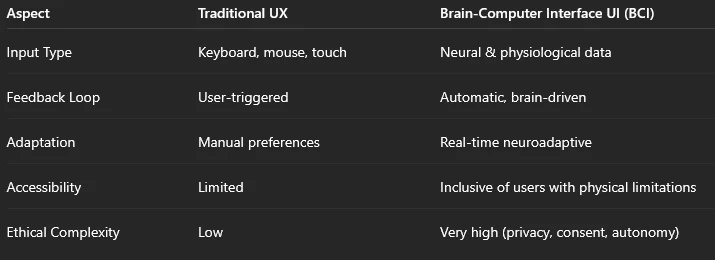
As seen, while BCI UI design opens vast possibilities, it introduces layers of ethical complexity rarely encountered in conventional digital design.
Why Are Ethical Questions Central to Brain-Aware Interfaces?
Designing interfaces that literally “read” the brain introduces unparalleled intimacy between humans and machines. Ethical frameworks are therefore not optional — they are fundamental.
1. Privacy of Thought
Brainwave data reveals not just reactions, but emotions, attention levels, and potentially subconscious responses.
- Risk: Unauthorized access or misuse of neural data could violate cognitive privacy.
- Solution: Apply end-to-end encryption and anonymization to EEG streams.
2. Informed Consent
Users must clearly understand what brain data is collected, how it’s used, and who can access it.
- Risk: Users may consent without realizing how revealing neural data can be.
- Solution: Transparent consent dashboards and ongoing opt-in mechanisms.
3. Algorithmic Bias and Autonomy
AI models used in neuroadaptive UI/UX design may misinterpret brain signals, especially across cultural or neurological differences.
- Risk: Misclassification of emotions or focus could disadvantage certain users.
- Solution: Train models on diverse datasets and audit regularly for bias.
4. Dependence and Cognitive Manipulation
If interfaces adapt too well, users might become passively dependent on them for focus and motivation.
- Solution: Build safeguards that empower learners rather than automate every decision.
These concerns redefine what “user-centered” means — when the “user” is not just the hand on a mouse, but the mind itself.
How Does EEG Integration Impact Design Ethics?
EEG integration for learning is both the backbone and the ethical flashpoint of brain-computer interface UI design. While it enables adaptive and personalized education, it also captures profoundly sensitive data.
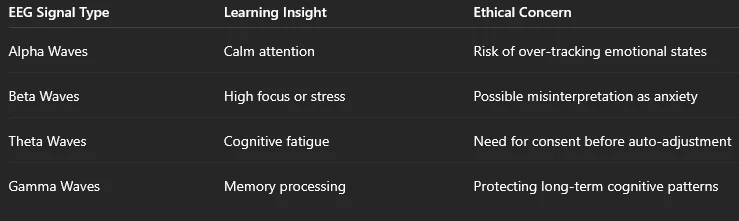
When combined with AI-ML solutions, these signals empower adaptive user experiences — but the ethics of “how much to adapt” must always guide the process. Over-automation risks crossing into cognitive intrusion.
Practical Challenges in BCI UI Development
Beyond ethics, designers face tangible engineering and usability hurdles when developing neuroadaptive learning systems.
1. Signal Accuracy and Noise
EEG signals are highly sensitive. Motion, sweat, or external interference can cause data inaccuracies, affecting user experience.
- Solution: Combine EEG with eye-tracking or heart rate sensors for reliability.
2. Hardware Comfort and Accessibility
Bulky EEG headsets can discourage long-term use. Designers must prioritize ergonomics and inclusivity.
- Solution: Focus on lightweight, wearable sensors integrated into daily accessories.
3. Cognitive Fatigue from Over-Feedback
Constant adaptation may overwhelm users.
- Solution: Balance automation with user control through cognitive UX design principles.
4. Cross-Platform Integration
Synchronizing neural data across apps, VR, and mobile interfaces demands high interoperability.
- Solution: Build flexible APIs powered by AI business solutions, to connect adaptive systems seamlessly.
5. Interpretation Complexity
Designers must understand neuroscience concepts — not just pixels and code.
- Solution: Encourage interdisciplinary collaboration between developers, neuroscientists, and ethicists.
Research Insights: What Studies Reveal
- Neuroadaptive UI/UX design using EEG and AI improved engagement by 30% but raised concerns about “algorithmic overreach.”
- Cognitive UX design frameworks that prioritize transparency gained higher user trust and acceptance.
- Research from ResearchGate emphasized the need for hybrid models combining predictive analytics technologies and human oversight to maintain balance between automation and ethics.
These findings confirm that the next frontier of brain-computer interface UI isn’t just technical — it’s moral.
Real-World Applications and Lessons
1. Accessible Education
BCI-powered tools help learners with mobility impairments interact through neural intent — a triumph for inclusivity.
2. Adaptive eLearning Systems
Platforms using EEG integration for learning adjust complexity based on mental effort. When frustration rises, the interface simplifies.
3. Immersive Corporate Training
Enterprises use UI/UX design, strategies to create adaptive dashboards that visualize focus, engagement, and stress levels.
4. Emotional Analytics in Games
Neurofeedback informs predictive analytics technologies, to optimize player engagement ethically.
5. Multimodal BCI in VR/AR
Combined EEG and gaze tracking enable realistic virtual classrooms — a leap in adaptive user experience, but one demanding rigorous consent frameworks.
Toward an Ethical Framework for Cognitive UX
The future of neuroadaptive learning systems will depend not only on AI performance but on ethical architecture. Designers must balance autonomy, privacy, and personalization.
Core Principles for Ethical Brain-Aware Design:
- Transparency: Explain how neurodata influences decisions.
- Empowerment: Keep users in control of adaptive features.
- Accountability: Regularly audit algorithms for fairness.
- Privacy by Design: Integrate data protection from the first line of code.
- Collaboration: Bridge AI ethics, neuroscience, and UX disciplines.
These values ensure that cognitive UX design remains grounded in human dignity as interfaces grow increasingly intelligent.
Conclusion
The future of brain-computer interface UI design lies at the intersection of empathy, ethics, and innovation.
By combining EEG integration for learning, AI-ML solutions, and robust ethical design principles, we can create technologies that empower — not exploit — the human mind.
As we continue refining neuroadaptive UI/UX design, one thing becomes clear: the most advanced systems won’t just read our thoughts; they’ll respect them.
Designing ethically conscious, adaptive user experiences is not just a technical challenge — it’s a moral responsibility shaping the next era of human-computer collaboration.
FAQs
1. What are Brain-Computer Interfaces in UX Design?
They are systems that connect brain signals to digital interfaces, enabling users to control or influence applications directly through neural activity.
2. Why is Ethics Important in BCI Design?
Because brain data is deeply personal, ethical cognitive UX design ensures privacy, consent, and fairness in how that data is used.
3. How does EEG Integration help in Learning Applications?
EEG integration for learning measures attention and fatigue levels, allowing systems to personalize content delivery and pacing.
4. Can Neuroadaptive Design Work in AR/VR?
Yes. AR/VR systems enhanced with brain-computer interface UI can adapt immersion levels and stimuli in real time for safe, engaging experiences.
5. What’s Next for Ethical Neuroadaptive Systems?
Future neuroadaptive learning systems will combine transparency, AI oversight, and human empathy — ensuring technology enhances cognition responsibly.




















Sign in to leave a comment.