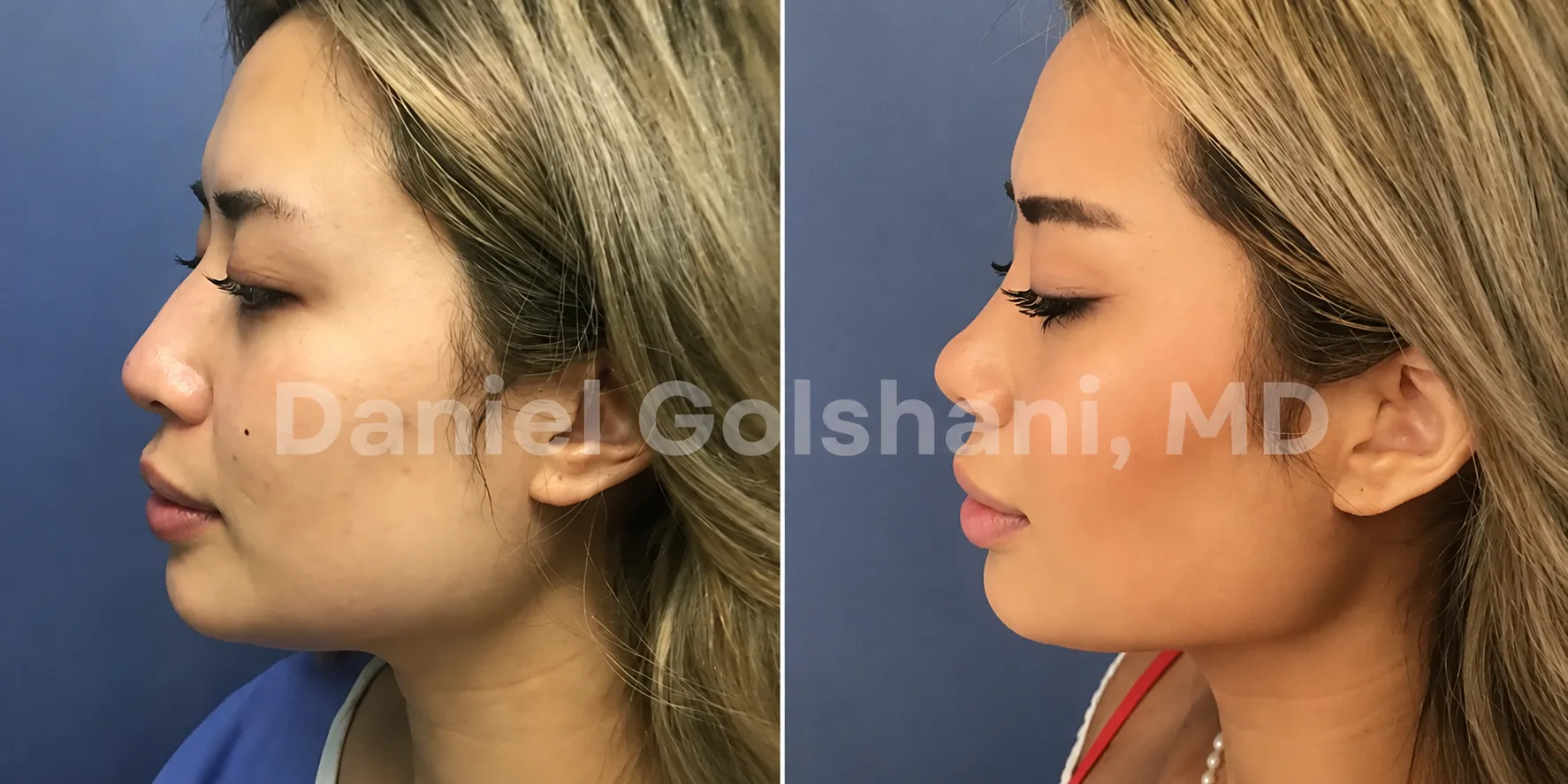

Nobody wants to look operated on.
But for patients considering ethnic rhinoplasty, that fear runs deeper than the usual anxiety about surgical results. It isn't just about avoiding the telltale signs of a nose job. It's about something more personal, more fundamental. It's the fear of walking into a surgeon's office as yourself and walking out looking like someone else entirely.
I've heard it said a hundred different ways across twenty-five years of practice. A Persian woman who wants refinement but doesn't want a nose that belongs on someone from a different continent.
A Middle Eastern man who wants to breathe better and look better, but still wants to be recognizable to his mother. A Korean patient who has spent years thinking about this decision, who chose her surgeon carefully, and whose first question in the consultation room was: " Will I still look like me?
The answer, when the surgery is done correctly, is yes. Unambiguously, yes.
But arriving at that answer requires a philosophy, not just a technique.
The Problem With the Old Definition of a "Good Nose Job"
For decades, the aesthetic standard in rhinoplasty was essentially singular. A refined nose meant a particular nose — narrow bridge, defined tip, upturned slightly, proportions that reflected one specific cultural ideal of beauty.
That standard didn't arrive from nowhere. It reflected the patient population that dominated cosmetic surgery for most of the twentieth century. And it produced, for those patients, results that worked well.
The problem emerged when the same standard was applied universally. When a nose designed for one face, one structure, thickness, and ethnic heritage was transplanted onto a face it was never meant to inhabit.
The results were obvious. Not because the surgery was technically poor. But the goal was wrong from the beginning.
A nose that looks natural on one face can look completely foreign on another. Proportion isn't absolute it's relational. It's about how your nose relates to your cheekbones, your forehead, your jawline, and your skin. Ethnic rhinoplasty exists precisely because those relationships differ beautifully, meaningfully across ethnicities. And honoring those differences isn't a compromise. It's the entire point.
What Ethnic Rhinoplasty Actually Means in Practice
The term ethnic rhinoplasty describes rhinoplasty performed with specific awareness of the patient's ethnic background and the structural characteristics associated with it, and with the explicit goal of preserving those characteristics while achieving the desired refinement.
That sounds straightforward. In execution, it is anything but.
Different ethnicities present different structural realities. Thicker skin behaves differently under the knife than thin skin; it conceals fine tip work, demands different techniques, and requires the surgeon to think in terms of projection and definition rather than delicacy.
A broader nasal base has its own geometry, and reducing it requires a different approach depending on whether the width comes from soft tissue, bone, or both. A low dorsum, common in many East and Southeast Asian patients, may call for augmentation rather than reduction, which introduces an entirely different set of decisions around grafting and materials.
None of these are problems to be solved. They are features to be worked with. The surgeon who approaches ethnic rhinoplasty with genuine respect for the patient's heritage sees them that way as the specific, individual architecture of the face in front of them, not as deviations from some imagined norm.
This is the distinction that separates ethnic rhinoplasty Beverly Hills patients seek out from standard rhinoplasty performed without ethnic awareness. The technique may overlap. The philosophy does not.
The Consultation That Changes Everything
In my practice, the ethnic rhinoplasty consultation is longer than most patients expect. It is also frequently the most important hour of the entire process.
We talk about what the patient wants to change. We talk, at equal length, about what they want to keep. Those two conversations are inseparable — and the second one is often the more revealing.
What does your nose mean to you? Not aesthetically — personally. Is it the nose you share with your grandmother? The feature that tells people, without words, where you come from? The thing about your face that you've grown into, that you've made peace with, that you'd miss if it disappeared entirely?
These aren't abstract questions. They shape every surgical decision.
I also look at the family. If a patient brings photographs, parents, siblings, or older relatives, I learn more from those images than from any amount of clinical measurement. I can see the features that run through the family. I can understand what looks native to that face, what looks inherited, what would look foreign if it weren't suddenly there.
The goal is never to produce the best nose in the abstract. It is to produce the best version of your nose, refined where you want refinement, preserved where your identity lives.
Structural Realities That Demand Specific Expertise

Ethnic rhinoplasty is, technically speaking, among the most demanding work in facial plastic surgery. And that demand comes precisely from the need for preservation alongside refinement.
Thick skin
Common in Middle Eastern, African, and Hispanic patients, this limits how much tip refinement will show. A surgeon who doesn't account for this will either underdeliver or overoperate, trying to achieve visibility. The correct approach involves structural work beneath the skin that creates definition without relying on surface-level subtlety that the skin will simply absorb.
Augmentation rhinoplasty
Frequently appropriate for East Asian patients who seek a higher, more defined bridge without Western proportions, it requires grafting decisions that balance natural appearance with long-term stability. Implants, rib cartilage, ear cartilage. Each carries different properties, different longevity, and different implications for how the nose moves and ages. These decisions require both technical knowledge and honest conversation.
Nasal base reduction
An overreduced base looks as wrong as an unreduced one. The measurement isn't millimeters, it's proportion. And proportion is something you develop an eye for over the years, not something you calculate from a chart.
Ethnic rhinoplasty Beverly Hills patients who choose a surgeon with genuine experience in this work understand that the complexity is the point. The nuance is what produces a result that looks like you but better, refined, exactly what you wanted, rather than a result that looks like someone else entirely.
After the Surgery: What Patients Actually Say
The recovery from rhinoplasty is gradual. The final result takes a full year to settle, the tip refines slowly, the swelling resolves in stages, and the nose that emerges at month twelve is meaningfully different from the one you see at month one.
What patients tell me, once that process is complete, consistently returns to the same place.
They say they look like themselves. They say family members recognized the improvement without being able to name it. They say the thing they were most afraid of losing something essential about their face, their heritage, their identity, didn't happen.
They look like a refined version of who they already were.
That's the benchmark. Not a number on a measurement scale. Not a standardized aesthetic ideal. The benchmark is whether the person looking back from the mirror is recognizably, unmistakably, still you.
The Right Surgeon Doesn't Erase Your Heritage. They Honor It.
Ethnic rhinoplasty done well is invisible in the way all great surgery is invisible — not because nothing changed, but because everything that changed was supposed to change, and everything that mattered was left exactly where it belonged.
Your nose tells a story. It belongs to your face, your family, your history. The right surgeon understands that. They operate with that understanding in every decision they make — from the consultation room to the final stitch.
If you've been considering rhinoplasty but have held back out of fear that the result won't look like you, that fear is worth taking seriously. It means you're asking the right question. And it means the most important part of choosing a surgeon isn't their before-and-after gallery.
It's whether they listened when you told them what you wanted to keep.
Dr. Daniel Golshani is a double board-certified plastic and reconstructive surgeon and founder of Avosant Beverly Hills and the Rexford Surgical Institute. He has performed deep plane facelift surgery for over 25 years and is internationally recognised for natural-looking results and innovations in surgical technique. Dr. Golshani is also highly regarded for his expertise in ethnic rhinoplasty, creating refined, natural-looking nasal enhancements while preserving each patient’s unique facial features and cultural identity. For consultation enquiries, visit drgolshani.com or contact the Beverly Hills office directly at 9301 Wilshire Blvd., Suite 410, Beverly Hills, CA 90210.
























Sign in to leave a comment.