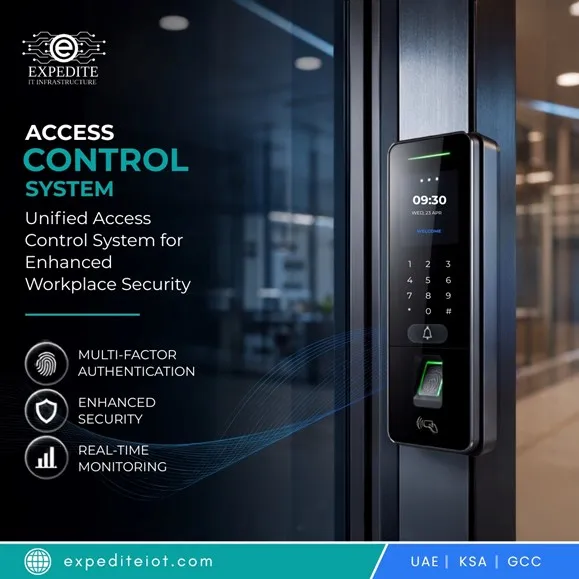

An intelligent Access Control System is the single most impactful investment a Kuwait organisation can make in its physical security infrastructure - replacing mechanical keys and unmonitored entry points with credential-based, fully auditable access governance that scales from a single office door to a multi-site campus spanning Kuwait City, Ahmadi, and Shuwaikh. With Kuwait Vision 2035 accelerating commercial development, financial sector expansion under the Central Bank of Kuwait (CBK), and growing regulatory focus on information security governance aligned with ISO/IEC 27001 across Kuwait's corporate, government, and energy sectors, the pressure on facilities and security managers to implement structured, evidence-generating access control has never been greater. Expedite IoT is a GCC-certified physical security integrator that delivers end-to-end access control solutions built for Kuwait's enterprise and industrial environments - combining precision hardware from the world's leading manufacturers with cloud-connected management software and deep regional compliance expertise.

Kuwait's Security Imperative: Moving Beyond Keys and Manual Logs
Kuwait's economic fabric is defined by high-value, high-risk sectors. The petroleum industry - anchored by Kuwait Petroleum Corporation (KPC), Kuwait Oil Company (KOC), and Kuwait National Petroleum Company (KNPC) - operates across hazardous industrial zones in Ahmadi and the Shuaiba complex where uncontrolled access is not a compliance issue but a life-safety one. CBK-regulated financial institutions concentrate in Kuwait City's Sharq and Dasman districts, where the physical protection of trading environments and data centres is subject to operational risk framework requirements. Government ministries along the Arabian Gulf Street corridor and public hospitals under the Ministry of Health network face visitor management and zone segregation obligations that manual registers simply cannot satisfy. Across all these environments, the transition from passive, key-based access to an actively managed, electronically governed entry system is no longer aspirational - it is operationally necessary.
The Expedite IoT Technology Suite for Kuwait
Advanced Access Control System
Expedite IoT's Advanced Access Control System platform replaces key management with role-based, policy-driven credential governance - centrally administered from a web-based management console that gives security teams instant visibility of every access event across their entire Kuwait estate. Multi-site operators managing facilities in Kuwait City, Ahmadi, and the Kuwait Free Trade Zone (KFTZ) apply access policies, run audit reports, and revoke credentials from a single interface. Time-zone scheduling, holiday calendar automation for Kuwait national holidays, and anti-passback enforcement eliminate the manual administration burden that legacy key programmes impose - while generating the time-stamped, tamper-evident audit logs that ISO 27001 access governance reviews, CBK compliance examinations, and Kuwait Ministry of Interior security inspections require.
Biometric Access Control System
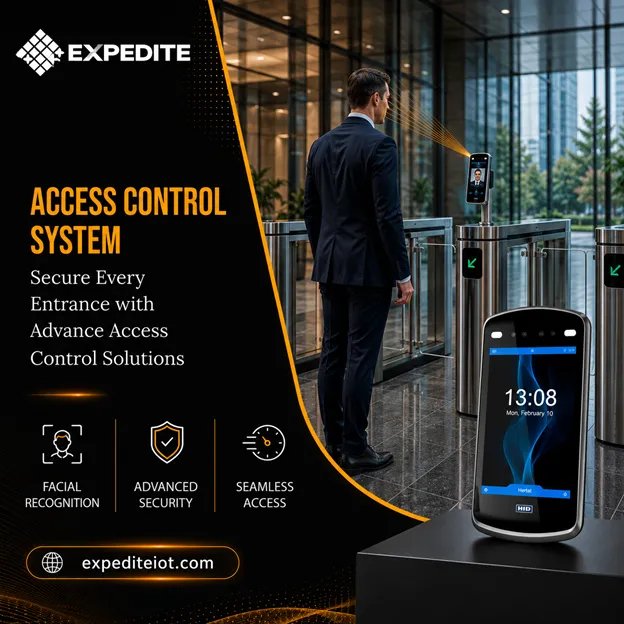
Where card credentials can be shared, lost, or transferred, a Biometric Access Control System makes access rights inseparable from the individual - eliminating the credential-sharing and tailgating vulnerabilities that undermine card-only deployments. Expedite IoT deploys fingerprint, iris, and three-dimensional facial recognition readers from HID Global, Suprema, and ZKTeco, each with certified liveness detection to prevent spoofing. For KPC and KOC-affiliated sites where contractor identity certainty is a safety requirement at hazardous zone boundaries, biometric authentication provides the identity assurance that card readers alone cannot. For CBK-supervised financial institutions, biometric multi-factor authentication at data processing environments satisfies both internal audit and third-party security assessment requirements.
Security Access Control System
A Security Access Control System goes beyond door management to create a defence-in-depth architecture - layering perimeter barriers, electronically controlled entry points, zone-based access policies, and real-time integration with CCTV and intruder detection into a unified security posture. Expedite IoT designs every Kuwait deployment on the principle of least privilege: each individual receives access only to the areas their role requires, with every exception documented and every deviation automatically flagged to the security management platform. This architecture maps directly to ISO/IEC 27001 Annex A.11 physical and environmental security controls - providing Kuwait organisations pursuing information security certification with the access governance evidence their auditors require.
Door Access Control System
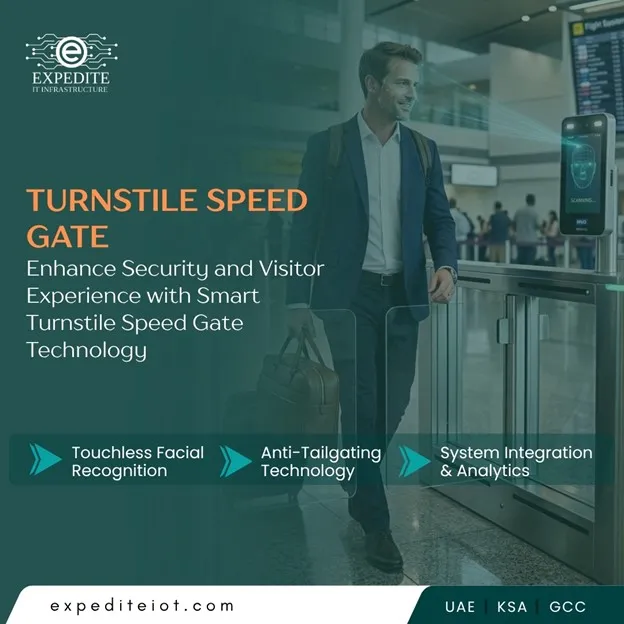
At the entry point level, Expedite IoT's Door Access Control System governs every threshold crossing with precision - from standard office doors with electric strikes to fire-rated emergency exit doors with fail-safe configurations compliant with NFPA 101 and Kuwait Civil Defence requirements, high-security vault and server room doors with multi-point locking, and lobby speed gates and turnstiles for high-traffic corporate buildings. Every door controller supports door position monitoring, forced-door and held-open alarming, and request-to-exit detection - providing a continuous operational event stream that security managers can monitor in real time and review retrospectively for compliance or incident investigation purposes.
Access Control Device
The physical Access Control Device - the reader through which users present their credentials - is selected and configured by Expedite IoT for Kuwait's specific environmental and security requirements. Outdoor and semi-exposed installations use IP65-rated, vandal-resistant enclosures rated for Kuwait's extreme summer temperatures and dust conditions. Reader communication uses OSDP v2 (Open Supervised Device Protocol) - the encrypted, bidirectional standard that prevents reader tampering and man-in-the-middle attacks, a critical security control referenced in IEC 62443 industrial cybersecurity frameworks applicable to Kuwait's energy sector deployments. Credential support spans HID iCLASS SE, MIFARE DESFire EV2, SEOS smart cards, and NFC/BLE mobile credentials - with mobile credential options eliminating physical card issuance entirely for Kuwait facilities seeking contactless, smartphone-based access management.
Access Control Solutions: Integration, Analytics, and Compliance
Expedite IoT's Access Control Solutions deliver value beyond the door through a platform layer that integrates physical access with the facility's broader security and operational ecosystem:
- CCTV and VMS integration (Genetec Security Centre, Milestone XProtect): access events triggering automatic camera recall for real-time visual verification and post-incident investigation
- HR and Active Directory integration: automatic credential provisioning on hire and instant revocation on termination - eliminating orphaned access rights that represent Kuwait's most common physical security vulnerability
- Visitor management connectivity: temporary, time-limited visitor credentials issued at reception kiosk check-in and automatically expired at departure
- BMS integration via BACnet: occupancy-driven HVAC, lighting, and elevator control reducing Kuwait facilities' energy costs while maintaining security posture
- Audit and compliance reporting: time-stamped, exportable access logs for CBK operational risk submissions, ISO 27001 access reviews, and Kuwait MOI security system inspections
- Muster and emergency management: real-time on-site personnel counts for Kuwait Civil Defence evacuation scenarios, accessible by fire wardens via mobile application
Access Control System Kuwait: Sectors and Deployment Geographies
Expedite IoT's Access Control System Kuwait-wide capability spans every major sector and geography the kingdom's economy encompasses. In the energy sector - covering KPC, KOC, and KNPC facilities across Ahmadi, Mina Al Ahmadi, and Shuaiba - contractor management, zone segregation, and ATEX-rated reader deployments for hazardous areas are standard elements of every project. In Kuwait City's financial district, CBK-regulated bank branches, investment company headquarters, and insurance group offices receive multi-factor authentication deployments with vault dual-authorisation and trading floor access time-lock policies. Government ministry buildings along Arabian Gulf Street and in the Ministries, Complex are designed to Kuwait MOI security system registration requirements. Healthcare facilities across Mishref, Rumaithiya, and Sabah Al Salem receive access architectures aligned with Joint Commission International (JCI) accreditation standards. Commercial towers in Al Hamra, Sharq, and Al Rai districts receive multi-tenant architectures that segregate tenant populations while enabling unified building management. Across all sectors, Expedite IoT's ISO 9001-compliant delivery methodology ensures full documentation traceability from design through commissioning.
Expedite IoT's Authority in Kuwait
- GCC-wide certified delivery track record across Kuwait, Bahrain, UAE, Saudi Arabia, Qatar, and Oman with documented project references in energy, financial, government, and healthcare sectors
- Authorised integration partnerships with HID Global, Suprema, ZKTeco, Genetec, and Honeywell — manufacturer-certified hardware supply and firmware support throughout system lifecycle
- OSDP v2-certified engineering team deploying encrypted reader-to-controller communication on every Kuwait installation
- ISO 9001-compliant project delivery with full design, acceptance testing, and as-built documentation packages for CBK, MOI, and industrial authority submissions
- In-house compliance advisory capability covering ISO/IEC 27001, IEC 62443, CBK operational risk, and Kuwait Civil Defence emergency egress requirements
- Regional spare parts inventory and GCC-based technical helpdesk - enabling fast on-site response for Kuwait clients without the lead times associated with internationally based vendors
Conclusion
Kuwait's organisations are at a turning point: the security, compliance, and operational efficiency advantages of intelligent access governance is too significant to defer, and the regulatory expectations of Kuwait's CBK, MOI, and industrial authorities are too clearly aligned with structured access control to ignore. Whether you need an Advanced Access Control System to modernise a legacy key programme, a Biometric Access Control System to secure a KPC contractor zone, a Security Access Control System for a CBK-regulated financial data environment, a Door Access Control System across a multi-floor commercial tower, or a certified Access Control Device suite for a healthcare facility pursuing JCI accreditation, Expedite IoT delivers every capability within a unified, compliant, and future-ready platform.
Our comprehensive Access Control Solutions are designed for Kuwait's real operational and regulatory environment - not a generic GCC template - and our Access Control System Kuwait-wide delivery capability is backed by manufacturer certifications, ISO 9001 project governance, and a regional support infrastructure that keeps your system performing at specification long after commissioning day.
FAQs
1. What is the difference between a standard access control system and an advanced one for Kuwait facilities?
A standard access control system manages door entry through basic card readers and a simple database of credentials - providing little more than an electronic lock. An advanced access control system adds a comprehensive management software layer delivering role-based access policies, multi-site centralised administration, real-time event monitoring, automated HR integration for credential provisioning and de-provisioning, anti-passback enforcement, and compliance-grade audit reporting. For Kuwait facilities operating under CBK supervision, ISO 27001 certification programmes, or KPC contractor management requirements, the advanced platform's audit trail depth, policy granularity, and integration capabilities are what make it a compliance asset rather than simply an electronic lock replacement. Expedite IoT recommends the advanced platform architecture as the baseline specification for any Kuwait facility processing more than twenty to thirty credential holders, given the operational and regulatory advantages it delivers at marginal additional cost compared to basic systems.
2. How does Expedite IoT handle ATEX-rated reader deployments at Kuwait oil and gas facilities?
ATEX and IECEx zone classifications at Kuwait petroleum facilities - covering areas where explosive gas or dust atmospheres may be present - impose strict equipment selection requirements that standard commercial access control hardware cannot satisfy. Expedite IoT's energy sector engineering team specifies ATEX Zone 1 or Zone 2-rated reader and controller enclosures that are certified for the specific hazardous area classification of each installation point, selected from the catalogues of manufacturers including STid and IDTECK who produce compliant biometric and card reader products for industrial environments. All ATEX-rated equipment is installed in accordance with IEC 60079 installation standards and documented with ATEX equipment schedules for submission to KPC, KOC, or KNPC HSE departments as part of the project handover package. Non-ATEX areas of the same facility use standard commercial hardware, with the system design clearly zoning the boundary between hazardous and non-hazardous area deployments.
3. How long does a typical access control installation take to complete in Kuwait?
Project timelines in Kuwait depend on facility size, integration complexity, civil works requirements, and authority approval lead times. A single-building commercial deployment of fifteen to thirty doors with standard access control integration typically completes from signed project scope to commissioned and tested system in three to six weeks. Multi-building campus deployments with CCTV integration, HR system connectivity, and visitor management linkage typically span eight to fourteen weeks. Energy sector projects involving ATEX-rated equipment, contractor management configuration, and KPC or KOC authority submissions typically run twelve to twenty weeks from scope sign-off. Expedite IoT provides a detailed project programme at the design approval stage, identifying critical path activities - particularly authority submission lead times and specialist hardware procurement - so that clients can plan their operational transition from legacy key systems to the new access control platform with confidence.
4. Can the access control system generate reports for Kuwait MOI security inspections?
Yes. Expedite IoT's access management platform includes a comprehensive reporting module that generates the documentation formats most commonly requested during Kuwait Ministry of Interior security system inspections and CBK operational risk examinations. Standard reports include a complete access event log - time-stamped, identity-linked, and exportable in PDF or CSV - covering any defined date range; credential holder summary reports listing all active, suspended, and expired credentials with access policy assignments; exception reports flagging forced-door events, held-open alarms, and denied access attempts; and zone occupancy reports showing personnel counts per access zone at any given time. All report data is stored in a tamper-evident database with an audit trail of any administrative changes, ensuring that the integrity of records cannot be questioned during a regulatory inspection. Custom report templates can be configured to match the specific data fields and formats requested by Kuwait authority inspection teams.
5. What credentials does Expedite IoT recommend for contactless access in Kuwait's post-pandemic workplace environment?
For Kuwait organisations prioritising contactless access management, Expedite IoT recommends a tiered credential strategy. For the majority of employees, HID SEOS mobile credentials delivered to iOS or Android smartphones via the HID Mobile Access platform provide the most seamless contactless experience - presenting via Bluetooth Low Energy without the employee needing to remove their phone from their pocket or bag, at distances of up to one metre from the reader. For employees who prefer a physical credential, MIFARE DESFire EV2 smart cards with contactless presentation provide equivalent cryptographic security to mobile credentials without requiring a smartphone. For the highest-security zones - data centres, pharmaceutical vaults, financial trading floors - mobile or card credentials can be combined with fingerprint or facial recognition as a second factor, ensuring that contactless convenience does not come at the cost of identity assurance. All credential options are managed from the same Expedite IoT management platform, allowing facilities to deploy a mixed credential environment without requiring separate administration systems.
Advanced Access Control System
Security Access Control System

























Sign in to leave a comment.