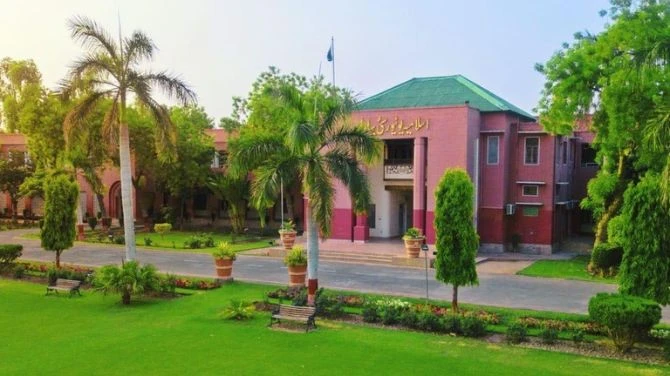

When we talk about the educational landscape of South Punjab, the conversation inevitably turns to the city of Bahawalpur. It’s a place where history whispers from the grand walls of the Noor Mahal and modernity thrives in its bustling bazaars. But for thousands of young minds and their families, Bahawalpur represents something far more critical: a beacon of accessible, high-quality education.
I remember my first visit to the city, not as a writer, but as a cousin accompanying a family on a university tour. The discussion about Colleges and Universities in Bahawalpur is not just a list of institutions; it's a story of transformation, opportunity, and a steadfast commitment to making world-class education available to all, regardless of their economic background. In a country where the cost of education can be a formidable barrier, the public sector universities here stand as powerful testaments to the ideal of affordable excellence.
The anxiety was palpable—would they find a place that was both reputable and within their means? What we discovered in Bahawalpur was a revelation. It wasn't just about the affordability; it was the palpable sense of ambition, the sprawling campuses, and the dedication of the faculty that truly impressed us.
This article is a culmination of that initial curiosity, an exploration into the institutions that form the bedrock of higher learning in this region. The landscape of Colleges in Bahawalpur, particularly its public universities, offers a compelling narrative that deserves to be told.
Why Bahawalpur? The Unlikely Educational Powerhouse
Nestled in the heart of the Cholistan desert, Bahawalpur might seem an unlikely candidate for an educational hub. For decades, students from this region had to migrate to Lahore, Karachi, or Faisalabad to pursue quality higher education, a move that placed a significant financial and emotional strain on families. This very challenge, however, became the catalyst for change. Recognizing the need for a local center of learning, visionary efforts were concentrated on establishing robust public institutions that could stem the brain drain and nurture local talent.
The result is a city that has proudly reclaimed its status. Today, Bahawalpur isn't just a stop on the map; it's a destination. Its universities are not mere degree-awarding bodies; they are microcosms of progress, deeply intertwined with the city's cultural and economic fabric. They have become magnets, attracting not just local students but also those from across Pakistan who seek a quality education without the exorbitant price tag of private metros. This transformation is a lesson in how focused investment in public education can revitalize an entire region.
The Islamia University of Bahawalpur: A Legacy Reimagined
It is impossible to talk about higher education in Bahawalpur without starting with its cornerstone, The Islamia University of Bahawalpur (IUB). Founded in 1925 as a religious college, it has evolved into a multidisciplinary giant. Walking through its Abbasia Campus is like traversing through time—the historic Islamic architecture stands shoulder-to-shoulder with state-of-the-art academic blocks, a physical manifestation of its philosophy: honouring tradition while embracing innovation.
IUB’s strength lies in its staggering diversity. From the Faculty of Chemical and Biological Sciences to the Faculty of Social Sciences, Engineering, and Medicine, it offers a vast academic canvas. Its affordability is its superpower. With semester fees that are a fraction of those at comparable private institutions, IUB democratizes education for the middle and lower-middle class. But low cost does not mean low quality. The university has consistently climbed in national rankings, boasting renowned faculty, modern laboratories, and a research output that commands respect. For many, an admission letter from IUB is the first step toward breaking a cycle of limited opportunity, a dream made tangible and accessible.
Khwaja Fareed University of Engineering and Information Technology: The Engine of Innovation
If IUB is the heart of academia in Bahawalpur, then Khwaja Fareed University of Engineering and Information Technology (KFUEIT) is its beating engine of innovation. Established more recently, KFUEIT was born from the pressing need to produce home-grown engineers and technologists who could drive Pakistan's future. Its focus is sharp, modern, and critically relevant.
The campus feels like a tech incubator. The emphasis here is on practical, hands-on learning. In its computer labs and engineering workshops, you don't just find students memorizing theorems; you find them building robots, coding software, and solving real-world problems.
The "affordable excellence" model shines brightly here. Pursuing an engineering degree is notoriously expensive, but KFUEIT provides a top-tier pathway into this high-demand field without burdening families with crippling debt. It’s a university that understands the assignment: to produce not just graduates, but innovators and problem-solvers who are ready to contribute to the national economy from day one.
The Sadiq Danawer College: A Foundation of Pre-University Excellence
The ecosystem of Colleges and Universities in Bahawalpur is not complete without acknowledging the foundational role played by its premier intermediate colleges. Among them, Sadiq Danawer College stands as a titan. With a history that stretches back to the era of the Bahawalpur state, this institution has been the preparatory ground for generations of professionals.
For many students, the journey to IUB or KFUEIT begins within the historic walls of Sadiq Danawer. It serves as a crucial bridge, equipping students with the academic rigor and discipline needed to thrive at the university level. The college offers a wide range of F.Sc. (Pre-Medical, Pre-Engineering) and F.A. programs, all at a cost that makes quality intermediate education accessible. The teachers here are often unsung heroes, providing the mentorship and grounding that shapes young minds before they step onto a larger stage. It is a testament to the fact that the pipeline of excellence starts much earlier than the undergraduate degree.
Beyond the Classroom: The Holistic Student Experience
What truly sets the public sector Colleges in Bahawalpur apart is the vibrant, holistic life they offer. Education here is not confined to syllabi and examinations. The campuses are alive with activity. From literary societies and debating clubs to sports competitions and cultural festivals, there is a constant buzz of engagement.
I recall the sight of students lounging on the lush green lawns of IUB, deeply engrossed in a book or passionately debating a topic. At KFUEIT, the energy is different—more focused and project-driven, with student teams preparing for national competitions. This environment fosters soft skills—teamwork, leadership, and communication—that are just as valuable as academic knowledge. For a student from a small town, this exposure is transformative. It builds confidence, forges lifelong friendships, and creates a well-rounded individual ready to make their mark on the world.
A Personal Reflection: The Real-World Impact
The narrative of affordable excellence is not an abstract concept; it has faces and stories. I think of my friend, the son of a schoolteacher, who graduated from IUB with a degree in Computer Science. Without the low tuition fees and the on-campus hostel facility, his family could never have afforded his education. Today, he is a successful software engineer, supporting his family and contributing to the economy. His story is not unique; it is replicated thousands of times over.
This is the real victory of Bahawalpur's public universities. They are engines of social mobility. They take raw, often untapped, potential and polish it into professional success. They prove that talent is distributed evenly across society, but opportunity is not. By removing the financial barrier, these institutions ensure that the future doctor, engineer, or scientist from a remote village in South Punjab has a fighting chance. This is their most profound and enduring legacy.



























Sign in to leave a comment.