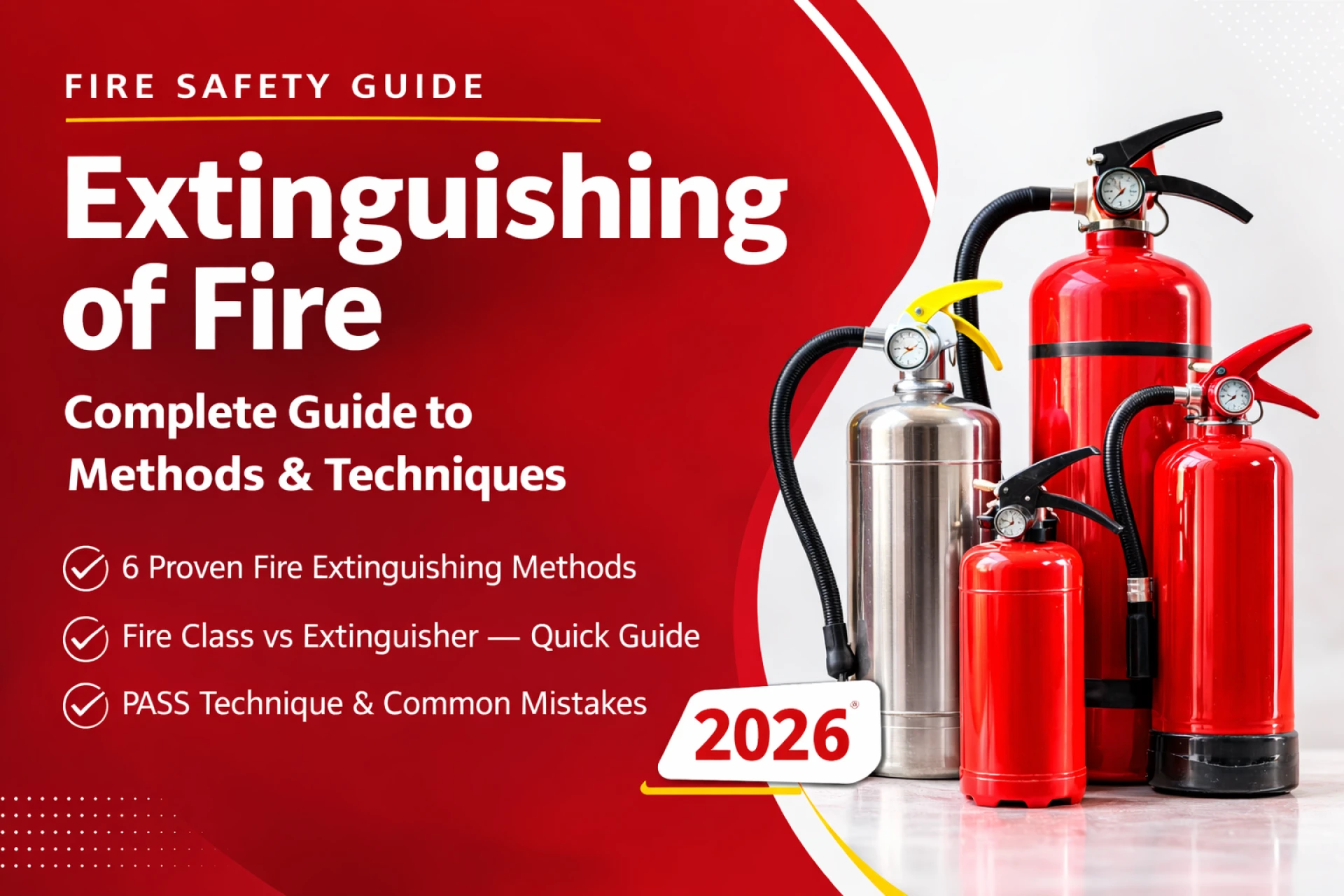

Every 2 minutes, a fire breaks out somewhere in India. Whether it is a kitchen accident, an electrical short circuit, or an industrial hazard, knowing the right method for extinguishing of fire can mean the difference between safety and disaster.
Fire extinguishers alone are not enough. You need to understand WHICH method works for WHICH type of fire. Using the wrong technique can make a fire worse — or even fatal.
In this complete guide, we cover every proven method for extinguishing fire effectively — from fire extinguishers and foam agents to CO2 systems and wet chemicals. Let us get started.
What is Extinguishing of Fire?
Extinguishing of fire refers to the process of stopping combustion by removing one or more elements of the fire triangle — heat, oxygen, or fuel. When any one of these three elements is eliminated, the fire cannot sustain itself and is extinguished.
Understanding this basic science is the first step to choosing the right extinguishing method for any fire emergency.
The Fire Triangle — Science Behind Extinguishing of Fire
Every fire requires three elements to burn:
- Heat — The energy that ignites and sustains combustion
- Fuel — The material that is burning (wood, oil, gas, metal)
- Oxygen — The air supply that feeds the flames
To extinguish fire, you must remove at least one of these elements:
- Remove Heat → Water cools the burning material below ignition point
- Remove Oxygen → CO2 and foam smother and cut off air supply
- Remove Fuel → Isolation and suppression systems cut fuel supply
- Break Chemical Chain Reaction → Dry powder interrupts combustion chemistry
6 Proven Methods for Extinguishing of Fire
1. Using Fire Extinguishers — Most Reliable Method
Fire extinguishers are the most reliable and widely used tool for extinguishing fire in both homes and industrial settings. However, not all extinguishers work for all fires. Different types are designed for specific fire classes:
- Class A — Wood, Paper, Cloth:
- → ABC Powder, Water, Foam, Clean Agent, Lithium-Ion
- Class B — Grease, Oil, Paint, Solvents:
- → ABC Powder, Foam, CO2, Clean Agent
- Class C — Flammable Gases (LPG):
- → ABC Powder, CO2, Clean Agent
- Class D — Metal Fires (Aluminium, Magnesium):
- → ⚠️ NONE of the standard extinguishers work!
- → Special Dry Powder extinguisher required
- Electrical Fires — Panel, Motor:
- → ABC Powder, CO2, Clean Agent, Lithium-Ion
- → ⚠️ NEVER use Water or Foam!
- Class K — Kitchen, Cooking Oils, Animal Fats:
- → ⚠️ NONE of the above work!
- → Wet Chemical extinguisher ONLY
Always remember the PASS technique when using a fire extinguisher:
- P — Pull the safety pin
- A — Aim the nozzle at the base of the fire
- S — Squeeze the handle to discharge
- S — Sweep side to side across the base of the fire
2. Water Application — Classic Method for Class A Fires
Water is the oldest and most widely available method for extinguishing fire. It works by cooling the burning material below its ignition point, removing the heat element from the fire triangle.
Water is effective for Class A fires involving wood, paper, fabric, and ordinary combustibles. However, water should NEVER be used on:
- Electrical fires (Class C) — Water conducts electricity and can cause electrocution
- Flammable liquid fires (Class B) — Water spreads burning oil and gasoline
- Metal fires (Class D) — Water can cause violent reactions with certain metals
3. CO2 and Foam Agents — Cutting Off Oxygen Supply
One of the most effective methods for extinguishing fire is cutting off its oxygen supply. This is achieved using:
- CO2 Fire Extinguishers — Carbon dioxide displaces oxygen around the fire, suffocating it without leaving any residue. Ideal for server rooms, data centers, and electrical panels.
- Foam Extinguishers — Create a thick blanket over burning liquids, sealing off oxygen and preventing reignition. Best for fuel stations and industrial areas.
- Fire Blankets — Physically smother small fires by cutting off oxygen supply. Effective for kitchen fires and clothing fires.
4. ABC Dry Powder — Most Versatile Extinguishing Method
ABC dry powder extinguishers are the most versatile tool for extinguishing fire across multiple fire classes. The powder — typically mono ammonium phosphate — works by interrupting the chemical chain reaction of combustion.
- Effective on Class A, B, and C fires
- BC powder (sodium bicarbonate) used for Class B and C fires in industrial settings
- Creates a powder cloud that may reduce visibility — use in open or well-ventilated spaces
5. Wet Chemical Agent — Specialized for Kitchen Fires (Class F/K)
Kitchen fires involving cooking oils and fats require a completely different approach. Wet chemical extinguishers contain a potassium-based solution that reacts with hot oils to form a soapy, foam-like layer — simultaneously cooling the oil and smothering the flames.
This is the only recommended method for extinguishing fire in commercial kitchens and restaurants. Water or powder extinguishers can cause dangerous splatter when used on cooking oil fires.
6. Fire Suppression Systems — Automatic Extinguishing of Fire
For large commercial and industrial spaces, automatic fire suppression systems provide the fastest response for extinguishing fire before it spreads:
- Sprinkler Systems — Activate automatically with heat, releasing water to extinguish fire
- Gas Suppression Systems (CO2/Clean Agent) — Flood enclosed spaces with suppression gas, ideal for server rooms and museums
- Foam Suppression Systems — Used in aircraft hangars and fuel storage facilities
- Kitchen Suppression Systems — Automatically detect and suppress cooking fires
Fire Class vs Best Extinguishing Method — Quick Reference Table
| Fire Class | Type of Fire | ABC | Water | Foam | CO2 | Clean Agent | Lithium-Ion |
|---|---|---|---|---|---|---|---|
| Class A | Wood, Paper, Cloth, Etc | ✔ | ✔ | ✔ | ✘ | ✔ | ✔ |
| Class B | Grease, Oil, Paint, Solvents, Etc | ✔ | ✘ | ✔ | ✔ | ✔ | ✘ |
| Class C | Flammable Gases like LPG | ✔ | ✘ | ✘ | ✔ | ✔ | ✘ |
| Class D | Metal Fires — Aluminium, Magnesium | ✘ | ✘ | ✘ | ✘ | ✘ | ✘ |
| Electrical | Panel, Motor, Electrical Fires | ✔ | ✘ | ✘ | ✔ | ✔ | ✔ |
| Class K | Kitchen, Cooking Oils, Animal Fats | ✘ | ✘ | ✘ | ✘ | ✘ | ✘ |
| ⚠ Class D — Metal fires require specially trained personnel with dedicated Dry Powder agents. No standard extinguisher works. | |||||||
| ⚠ Class K — Kitchen fires involving cooking oils MUST use Wet Chemical extinguisher ONLY. Never use water — it causes a dangerous fireball. | |||||||
Common Mistakes While Extinguishing Fire
Even with the right equipment, people make critical mistakes when trying to extinguish fire:
- Using water on electrical or oil fires — This makes the fire worse and creates serious safety hazards
- Aiming at the flames instead of the base — The base is the source; flames are just the symptom
- Standing too close — Maintain a safe distance of at least 2-3 meters when discharging an extinguisher
- Not calling emergency services — Always call the fire department even if you think you can handle it
- Using an expired extinguisher — Check your extinguisher pressure gauge and service date regularly
- Blocking the exit route — Always keep your back to an exit when fighting a fire
When to Call Professionals vs Extinguish Fire Yourself
Not every fire should be fought with a handheld extinguisher. Here is when to act and when to evacuate:
- DIY Extinguishing OK — Small, contained fire. You have the right extinguisher. Clear exit behind you. Fire is not spreading.
- Call Professionals Immediately — Fire is spreading rapidly. Smoke is thick and dark. You are unsure of fire class. Building evacuation has begun.
Your safety is always the priority. No property is worth risking your life. When in doubt — evacuate and call emergency services.
FAQ — Extinguishing of Fire
Q1: What is the meaning of extinguishing of fire?
Extinguishing of fire means stopping combustion by removing heat, oxygen, or fuel — the three elements of the fire triangle. Once any element is removed, the fire cannot sustain and goes out.
Q2: What are the 4 main methods of extinguishing fire?
The four main methods are: (1) Cooling with water to remove heat, (2) Smothering with foam or CO2 to remove oxygen, (3) Starving the fire by removing fuel, and (4) Chemical inhibition using dry powder to break the chain reaction.
Q3: Which gas is used for extinguishing of fire?
Carbon dioxide (CO2) is the most commonly used gas for extinguishing fire. It displaces oxygen around the fire without leaving any residue, making it ideal for electrical and sensitive equipment areas. Clean agents like FM-200 are also used in enclosed spaces.
Q4: How to extinguish fire without a fire extinguisher?
For small fires: use a fire blanket to smother flames, throw sand or dirt on campfires, close doors to cut off oxygen, or use baking soda on small kitchen fires. Never use water on oil or electrical fires.
Q5: What is the best method to extinguish fire at home?
For home use, an ABC dry powder extinguisher covers most fire types. For kitchens specifically, keep a wet chemical extinguisher. Fire blankets are also essential for kitchen and clothing fires.
Q6: Can water extinguish all types of fire?
No. Water is only effective on Class A fires (wood, paper, cloth). It is dangerous for electrical fires (conducts electricity), oil fires (spreads flames), and metal fires (causes violent reactions). Always identify the fire class before choosing your extinguishing method.
Q7: What is the PASS technique for extinguishing fire?
PASS stands for: Pull the pin, Aim at the base of the fire, Squeeze the handle, and Sweep side to side. This is the standard technique taught for operating any fire extinguisher safely and effectively.
Conclusion
Understanding the right method for extinguishing of fire is not just technical knowledge — it is a life-saving skill. Whether you are protecting your home, office, or industrial facility, choosing the correct extinguishing technique for each fire class can prevent property damage and save lives.
From CO2 for electrical fires to wet chemical agents for kitchen emergencies — every situation demands a specific approach. Make sure your fire extinguishers are ISI-certified, regularly serviced, and that your team knows exactly how to use them.
Need help choosing the right fire extinguisher for your space? Kanex Fire provides ISI-certified fire extinguishers trusted by 10,000+ customers across India. Explore our complete range today.

















Sign in to leave a comment.